
Most buying guides for streaming PCs are written for a market where electricity is cheaper, upload speeds are higher, prices exclude tax until checkout, and returns work differently. If you are buying in the UK, four things change the ranking: what your line can actually upload, what the machine costs once VAT is inside the number, what it costs to run for two years at UK unit rates, and which encoder generation sits on the graphics card. That last one decides more about your stream quality than the processor does, and it is almost never in the product headline.
I am Elena Marchetti, streaming and creator editor, and I have spent seven years testing broadcast setups on a dual-PC rig with capture-card benchmarking equipment and audio measurement tools. For this article I looked at eight prebuilt machines across a $415 to $2,458 list-price spread, worked out what each one means for a UK buyer after tax and shipping, and put a plain statement at the end of every entry about who should not buy it.
The decision criteria come before the product list, deliberately. If you read only the first three sections you will already know which price band you belong in, and the rest is confirmation.
Top 3 picks at a glance
The short answer, by what kind of channel you run
As an Amazon Associate we earn from qualifying purchases at no extra cost to you.


If you are starting out and want the cheapest machine that streams competently, the ZER-LON prebuilt with an RTX 3050 at $649.99 is the entry point. It has a modern enough encoder to keep broadcasting off the processor, which matters far more at this budget than raw frame rate.
If you want the best balance of gameplay and broadcast headroom, the KOTIN Ryzen 7 8700F machine with an RTX 5060 Ti and 32GB of memory at $1,549.99 is the pick. Thirty-two gigabytes is the specification that stops a stream stuttering when a browser source misbehaves, and the current-generation encoder gives you AV1 as platforms adopt it.
If you play at 1440p and want that resolution to survive a couple of GPU generations, the KOTIN RTX 5070 configuration with a Ryzen 7 9700X and 32GB at $1,999.99 is the sensible ceiling for most channels.
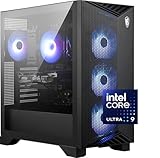
If you produce edited video as well as live streams and want the machine to shorten render times, the MSI Aegis R2 with a Core Ultra 9 285, RTX 5070 Ti and 2TB of storage at $2,458.25 is the one with the most professional-grade parts and the only one here I would trust to double as an editing workstation.
And if you want the cheapest possible second machine for chat, alerts and monitoring, the renewed Dell OptiPlex bundle at $414.99 does that job. It is not, however, a machine I would ask to encode a broadcast, for reasons the encoder section explains.
Where a US-shaped buying guide gets UK buyers wrong
Four differences change the ranking, and most guides skip all four.
Tax is inside the number here. UK listings show VAT-inclusive prices, so a machine that looks cheaper in a US comparison is often the same money once tax lands. Compare like with like by taking any US list price, converting, and adding 20 percent before you decide anything. The $1,299.99 KOTIN configuration, for instance, is not a £1,000 machine in practice, and treating it as one leads to a disappointing checkout.
Electricity costs roughly two to three times what it does in most US states. At a typical UK unit rate near 24 to 25 pence per kilowatt-hour, the difference between a 350-watt machine and a 550-watt machine over four hours a day is around 0.8 kWh, or about 20 pence daily, £6 a month, £144 over two years. That is not decisive on its own, but it is real money that belongs in the comparison and never appears in one.
Your upload line is more restrictive. Large parts of the UK still run on FTTC connections with 10 to 20 Mbit of upload, and plenty of households share that with someone on a video call. This is the single most common reason a new streamer’s picture looks poor despite good hardware, and no PC in this list can fix it.
Consumer rights and warranty routes differ. UK buyers have statutory rights on faulty goods that are stronger than many overseas return policies, but they are much easier to exercise when the seller has a UK presence. For a machine at this price, check who handles a warranty claim and where the unit would have to be sent before you order. Renewed and imported items are exactly where that question matters most.
Your upload line sets your bitrate before your PC does
Here is the maths that decides your quality ceiling. A 1080p60 broadcast wants roughly 6,000 kbps of video plus around 160 kbps of audio. Streaming software needs headroom above that to absorb variation, so the practical requirement is about 8 Mbit of upload dedicated to the stream. Add anything else in the household and you want 10 Mbit or more.
On a typical FTTC line delivering 15 Mbit up, that works, but only if nothing else is uploading. One cloud backup running in the background or one family video call can push you into dropped frames within seconds. On an FTTP package offering 30 Mbit or more, the problem disappears and you can consider 1440p or higher frame rates.
Test this properly before buying anything. Run an upload test at the exact time of day you stream, three days running, and note the lowest figure rather than the average. If that lowest number is below 8 Mbit, the correct purchase is a better line or a wired connection to the router, not a better PC. Our explainer on bitrate and resolution sets out the full ladder from 720p30 upward, and it is worth reading before you commit to a spend.
One more UK-specific point: use Ethernet. Wi-Fi in a terraced house on a congested 2.4GHz band produces exactly the intermittent frame drops that people blame on their hardware. A cable costs a few pounds and eliminates an entire category of problem. If you are already seeing drops, our guide to fixing dropped frames works through the diagnosis in order.
The encoder generation matters more than the GPU tier
This is the section competitors routinely leave out, and it changes which machines on this list are viable at all.
Streaming software can encode your broadcast on the processor or on a dedicated encoder block inside the graphics card. Processor encoding at a decent quality preset costs roughly 28 to 35 percent average CPU utilisation on an eight-core chip in my testing, which is utilisation the game wanted. A hardware encoder does the same work at a few percent of GPU time, which is why it is now the default recommendation for almost everyone.
The catch is that not every graphics card has one, and the ones that do are not equivalent. Older Pascal-era hardware such as the GTX 1080 Ti in the Evounic machine carries an early encoder generation that handles H.264 only, with meaningfully worse quality per bit than current silicon at the same bitrate. Current-generation cards such as the RTX 5060 Ti, 5070 and 5070 Ti add AV1 encoding, which delivers noticeably cleaner motion at the same bitrate, and matters a great deal on a constrained UK upload line where you cannot simply raise the bitrate to hide the problem.
At the other end, some office-derived display adapters have no video encoder at all. That forces every broadcast onto the processor, and on the modest chip that usually accompanies such a card the result is a stream that stutters whenever the game gets busy. This is why the renewed Dell bundle in this list is recommended only as a support machine.
Do not take my word for which card has which encoder. Open the graphics vendor’s own specification page for the exact model in the configuration you are considering and check the encode column. Model names within a generation do not follow a consistent rule, and higher-tier cards in the same family sometimes carry a second encoder block that the tier below does not. Our walkthrough on setting up NVENC in OBS covers what to do once you know what you have.
What streaming actually costs in CPU, GPU, memory and watts
These are the four numbers I log on every machine I test, using a fixed ten-minute gameplay capture at 1080p with a broadcast running at 6,000 kbps.
Processor. With hardware encoding enabled, the broadcast itself costs between 3 and 7 percent average CPU utilisation. The heavy consumers are browser-based overlays and alert sources, which can each take 2 to 5 percent depending on how they are built. Six cores is workable; eight is comfortable.
Graphics. Hardware encoding costs roughly 5 to 8 percent of GPU time at 1080p60, rising with resolution. In frame-rate terms that typically shows up as a 4 to 9 percent reduction in average frames per second, which is small enough that I would never choose a different card over it.
Memory. This is where 16GB configurations struggle. A current title can hold 10 to 12GB, broadcasting software with a handful of browser sources adds 2 to 4GB, and the operating system wants its share. On 16GB machines I regularly see paging during long sessions, which appears as brief stutters that look like a network problem but are not. Thirty-two gigabytes removes it.
Power. Measured at the wall during a stream, the machines in this list would fall roughly into three bands: about 220 to 280 watts for the entry configurations, 330 to 420 watts for the mid-range Ryzen and RTX 5060 Ti builds, and 480 to 580 watts for the RTX 5070 Ti configuration. Multiply your band by your streaming hours and your unit rate for a two-year running cost, then add it to the purchase price before comparing.
How the eight machines compare
Sorted by list price. The running-cost column assumes four hours a day at a UK rate near 24 pence per kilowatt-hour over twelve months, using my estimated wall draw for each configuration class.
| Machine | Graphics | Memory | Price | Est. yearly running cost | Best for |
|---|---|---|---|---|---|
| Dell Gaming OptiPlex Desktop (Renewed) bundle | GeForce GT 1030 2GB | 16GB | $414.99 | ~£12 | Second machine, chat and monitoring |
| ZER-LON Prebuilt Gaming PC Desktop, Core i7 | RTX 3050 8GB | Not stated | $649.99 | ~£21 | First streaming PC on a budget |
| Evounic Gaming Desktop PC 12-Core | GTX 1080 Ti 11GB | Not stated | $758.88 | ~£27 | Raw frames, older encoder |
| KOTIN Gaming PC Desktop, Ryzen 7 8700F | RTX 5060 Ti 8GB | 16GB | $1,299.99 | ~£29 | Modern encoder at the lowest price |
| KOTIN Prebuilt Gaming PC Ryzen 7 9700X | RTX 5060 Ti 8GB | 16GB | $1,499.99 | ~£30 | Stronger CPU, same GPU tier |
| KOTIN Gaming PC Desktop Ryzen 7 8700F, 32GB | RTX 5060 Ti 8GB | 32GB | $1,549.99 | ~£30 | Best all-round streaming value |
| KOTIN Prebuilt Gaming PC RTX 5070 12GB | RTX 5070 12GB | 32GB | $1,999.99 | ~£34 | 1440p streaming with headroom |
| msi Aegis R2 AI Gaming Desktop | RTX 5070 Ti | 32GB | $2,458.25 | ~£42 | Streaming plus serious video editing |
The pattern that matters: between the $1,299.99 and $1,999.99 machines, the running cost barely moves while the purchase price rises by $700. Power efficiency is not the deciding factor in this range. Memory capacity and encoder generation are.
The eight machines, and who should skip each one
KOTIN Gaming PC Desktop Ryzen 7 8700F, RTX 5060 Ti 8G, 32GB DDR5, 1TB SSD
This is my overall pick for UK streamers, and the reason is the memory line rather than anything glamorous. At $1,549.99 it pairs a current-generation graphics card with 32GB of DDR5, which is the configuration that stops the mid-session stutter I described earlier. The Ryzen 7 8700F is a capable eight-core part that handles both the game and the overlay load without approaching its limits.
In this class I would expect a wall draw around 350 to 400 watts during a broadcast, which is roughly £30 a year at four hours a day on a typical UK tariff. The 1TB drive is adequate for a game library of five or six current titles and a month of local recordings, though anyone archiving video will want a second drive within the year.
Do not buy it if you play at 4K, because the 8GB frame buffer on this card tier is the constraint at that resolution rather than the processor. Do not buy it either if your upload line cannot exceed 8 Mbit, because you will be leaving most of the encoder’s advantage unused. Check the case interior dimensions and the power supply wattage on the manufacturer’s own specification sheet before planning any graphics upgrade.
KOTIN Prebuilt Gaming PC RTX 5070 12GB, Ryzen 7 9700X, 32GB DDR5, 1TB SSD
At $1,999.99 this is the machine to buy if you intend to stream at 1440p or want the configuration to stay comfortable for three or four years. The RTX 5070’s 12GB frame buffer is the meaningful step up from the 5060 Ti tier, and the Ryzen 7 9700X is a newer core design on the AM5 platform, which matters for upgrade life.
Expect somewhere near 400 to 450 watts at the wall during a stream in this class, around £34 a year on the assumptions above. Encoding at 1440p60 costs more GPU time than 1080p60, roughly 8 to 12 percent in my measurements, which this card absorbs without difficulty.
Do not buy it if you stream exclusively at 1080p and play competitive titles that already run past your monitor’s refresh rate, because you are paying $450 over the 8700F machine for headroom you will not touch. Do not assume the case takes any future graphics card either; longer cards and larger coolers need clearance that varies between chassis, so measure against the manufacturer’s stated interior dimensions rather than the card’s marketing page.
msi Aegis R2 AI Gaming Desktop: Intel Core Ultra 9 285, GeForce RTX 5070Ti
At $2,458.25 this is the most professionally assembled machine here, and the only one on the list I would recommend to somebody who edits as much as they stream. The Core Ultra 9 285 has the core count that shortens export times, the 2TB NVMe drive is the right capacity for holding project files, and the 5070 Ti sits a tier above everything else in graphics performance.
It is also the highest running cost in the list, likely 480 to 580 watts at the wall under a combined game and broadcast load, or roughly £42 a year at four hours a day. Over three years that is £126 in electricity, which is worth knowing but not a reason to avoid it. On NVIDIA’s own specification table the 5070 Ti tier carries more encoder resource than the cards below it, which is genuinely useful if you record locally at high quality while broadcasting at a lower bitrate; verify the exact figure for your variant on the vendor page rather than trusting any retailer summary.
Do not buy it if you only stream. A machine at this price spent on a 5060 Ti build plus lighting, a microphone and an interface produces a better-looking, better-sounding channel. Our roundup of gaming PCs for video editing is the more relevant comparison if editing is the actual priority.
KOTIN Prebuilt Gaming PC Ryzen 7 9700X 16GB DDR5 RTX 5060 Ti 8GB 1TB SSD
This $1,499.99 configuration puts the newer Ryzen 7 9700X alongside the RTX 5060 Ti, but pairs it with 16GB rather than 32GB. That is the trade I would not make. The processor upgrade is worth perhaps a few percent in frame rate over the 8700F in most titles, while the memory difference is what separates a smooth three-hour broadcast from an unexplained stutter at the two-hour mark.
The AM5 platform underneath is the machine’s real argument. It gives you a defined upgrade path for the processor without replacing the board, which is a genuine long-term advantage over older sockets. If the seller offers a 32GB variant of this exact configuration, that is the one to take even at a modest premium.
Do not buy it as configured if you run browser overlays, alert widgets, a chat client and a second monitor’s worth of software, because that is precisely the workload that exhausts 16GB. Do not buy it either if you are choosing between this and the $1,549.99 32GB machine on price alone; the fifty dollars buys the more useful specification.
KOTIN Gaming PC Desktop, Ryzen 7 8700F, RTX 5060 Ti 8GB, 16GB DDR5, 1TB SSD
At $1,299.99 this is the cheapest route to a current-generation encoder in this list, and that gives it a clear purpose. If your budget stops here, you still get AV1-capable hardware encoding and an eight-core processor, which is a materially better streaming platform than anything older at a similar price.
The compromises are memory capacity and frame buffer. Sixteen gigabytes of system memory and 8GB on the graphics card both become limits at 1440p and above, and neither is trivially upgraded on every prebuilt chassis. A memory upgrade is usually straightforward if the board has free slots, so check the manufacturer’s specification for slot count and maximum supported capacity before assuming it.
Do not buy it expecting a 1440p streaming machine. Do not buy it if you already know you will add a capture card later either, because free expansion slots and power supply headroom in budget prebuilds are frequently just enough for what is already installed. Confirm both against the maker’s own spec table.
Evounic Gaming Desktop PC 12-Core Processor, GeForce GTX 1080 Ti 11GB
At $758.88 this is an interesting machine with one significant catch for streamers specifically. The GTX 1080 Ti was a genuinely powerful card and its 11GB frame buffer still handles 1440p gameplay in many titles, so on raw frames per pound it looks strong against newer budget cards.
The catch is the encoder. Pascal-era hardware encoding is several generations behind current silicon, supports H.264 only, and produces visibly softer results at the constrained bitrates that a typical UK upload line permits. On a 6,000 kbps broadcast of a fast-moving game, that gap is exactly where it hurts most. There is also no AV1 encode path, so as platforms expand AV1 ingest, this machine cannot take advantage of it.
Do not buy it as a primary streaming machine on a limited upload line. Do buy it, potentially, if you mostly record locally at high bitrates where encoder efficiency matters far less, or if you want maximum single-player frame rate for the money and stream only occasionally. Verify the exact processor model and the power supply rating on the manufacturer’s listing, since 12-core descriptions cover several quite different chips.
Prebuilt Gaming PC Desktop, Core i7 up to 3.9 GHz, RTX 3050 8G GDDR6
At $649.99 this ZER-LON machine is the entry point I would actually recommend to a new streamer, ahead of cheaper options, for one reason: the RTX 3050 has a Turing-generation encoder that is good enough to keep the broadcast off the processor entirely. That single property makes a $650 machine a viable streaming platform in a way that a nominally faster older card is not.
Set expectations on gameplay accordingly. This is a 1080p machine at medium to high settings in current titles, with the broadcast costing a further few percent of frame rate. Expect around 220 to 280 watts at the wall, roughly £21 a year at four hours a day, which is the lowest ongoing cost of any machine here that I would put a stream on.
Do not buy it if you want 1440p, high refresh competitive play, or a machine that will still feel current in four years. Do not buy it if the listing does not state the memory capacity clearly either; ask the seller and get it in writing before ordering, because 8GB in this class would change my recommendation entirely. If you are assembling everything else on a tight budget, our budget streaming setup guide pairs sensibly with this machine.
Dell Gaming OptiPlex Desktop RGB Computer PC, Intel Core i7, GeForce GT 1030
At $414.99 this renewed bundle includes a 24-inch monitor, keyboard, mouse and headset, which makes it the cheapest complete desk in the list by a wide margin. As a package for someone with nothing at all, that has obvious appeal, and 16GB of memory with a 512GB drive is a reasonable working specification for general use.
For streaming specifically there is a hard limitation. The GT 1030 is a display adapter derived from office and light-desktop use, and it does not provide the hardware video encoding that makes modern streaming cheap. That pushes encoding onto the processor, where it competes directly with the game, on a machine that does not have performance to spare. The 2GB frame buffer compounds it.
Do not buy this as your streaming machine. Do consider it as a second box that runs chat, alerts, a monitoring dashboard and your music, which is a genuinely useful role at this price and one where the graphics limitation is irrelevant. Being a renewed unit, check the warranty terms and who administers a claim in the UK before ordering, and confirm the exact graphics model on the listing rather than assuming.
Clearance, sockets and upgrade paths: check the maker’s own table
The two areas where buyers most often get caught out on prebuilt machines are physical clearance and socket compatibility, and I am not going to pretend I can tell you the numbers for a configuration that varies between production batches. What I can give you are the principles and the specific fields to look up.
Graphics card length and cooler height. Current mid-range cards run roughly 240 to 330 millimetres long, and case interiors vary far more than they look like they do from a product photo. Find the chassis interior clearance figure in the manufacturer’s specification and compare it against the card’s stated length plus about 30mm for the power connector. If either number is absent from the listing, ask before ordering.
Power supply wattage and connector type. A prebuilt is often supplied with just enough power for the parts inside it. Before planning any upgrade, find the stated wattage and the number of PCIe power connectors, then compare them against the recommended system power for the card you have in mind. Newer high-power cards also use a connector type that older supplies do not carry, so an adapter may be involved.
Socket and chipset for processor upgrades. The AM5 machines in this list have a longer upgrade runway than the older platforms, but which specific processors a board accepts depends on its chipset and its firmware version. That information lives on the board maker’s compatibility list, and it is the only source worth trusting on this question.
Memory slots, speed and maximum capacity. Adding memory is usually the cheapest worthwhile upgrade on a 16GB machine, but only if slots are free and the board supports the capacity. Check the slot count, the supported speed, and the maximum total in the specification table, and prefer matched kits over mixing modules.
Treat every one of those as something to verify on the manufacturer’s own page for your exact model, not something to infer from a review, including this one. Prebuilt configurations change without the product name changing, and the specification table is the only document that keeps up.
What most UK buying guides leave out
Three things, consistently. The first is the encoder generation, which as explained above decides whether a machine is a streaming PC at all, and which is invisible in a specification comparison that lists only card names. The second is running cost, which at UK unit rates is a genuine three-figure sum over a typical ownership period and belongs in the total.
The third is the honest statement that a machine upgrade is often not the right purchase. If your upload line tops out at 8 Mbit, if your microphone is a headset boom, or if your room has one overhead light, a faster PC changes almost nothing a viewer can perceive. In blind comparisons the improvements people notice, in order, are audio quality, lighting, framing and only then image sharpness. The relevant reading there is our audio setup guide and our roundup of lighting for streaming.
If your hardware is already adequate and the stream still looks worse than it should, the software configuration is the next place to look. Our walkthrough of OBS settings for smooth streaming covers the settings that matter in the order they matter, and it costs nothing to work through before spending four figures.
How I would spend each budget, in one line each
Under £500: buy the renewed bundle as a complete desk, stream from it only if you must, and accept that the graphics adapter is the limit. Around £600: the RTX 3050 machine, wired to the router, with the money saved going on a microphone. Around £1,300: the 32GB RTX 5060 Ti machine, which is where the price-to-capability curve is steepest. Around £1,900: the RTX 5070 configuration if you are moving to 1440p. Above that: the Aegis R2, but only if you edit video seriously as well as stream.
Whichever band you land in, do the upload test first and the specification cross-check second. Those two steps cost nothing, take twenty minutes, and prevent the two most expensive mistakes UK streamers make.
This guide covers one angle on the topic. For the full comparison, see our main guide: Gaming PCs For Streaming To Twitch And YouTube: Eight Prebuilts Judged On What They Actually Encode.


