
The best Cyber Monday Ring doorbell deal overall for most people is the Ring Battery Doorbell 2K: it is the newest battery-powered model, it captures wide-angle 2K video with up to 6x Enhanced Zoom, and it installs in minutes with no wiring at all, which makes it the right answer for renters and for any home whose old doorbell transformer is dead, undersized or missing. If you own your home and already have working doorbell wiring, the stronger pick is the Ring Wired Doorbell Pro, which runs continuously off your existing transformer and is the most capable hardwired camera in this roundup. Between those two poles, the decision comes down to three things: whether you can supply constant power, how much video quality your front door actually needs, and whether you are willing to pay a monthly Ring Home plan — because without a subscription, almost none of these doorbells will save a recording. This guide works through wired versus battery power, subscription costs, and the video-quality trade-offs for renters versus homeowners.
Top 3 picks at a glance
Quick Comparison
Every doorbell and accessory below is ranked in the sections that follow. Price tiers are relative bands rather than fixed figures, because Cyber Monday pricing moves daily.
| Product | Best for | Key specs | Price tier |
|---|---|---|---|
| Ring Battery Doorbell 2K (newest model) | Renters and wiring-free installs | 2K wide-angle video, up to 6x Enhanced Zoom, Two-Way Talk, rechargeable battery | Mid-range |
| Like-New Ring Battery Doorbell | The tightest possible budget | Head-to-Toe video, Live View with Two-Way Talk, battery-powered | Budget |
| Ring Wired Doorbell 4K Pro (newest model) | Maximum detail on a hardwired install | 4K wide-angle video, 10x Enhanced Zoom, night vision, hardwired | Premium |
| Ring Wired Doorbell (newest model) with Chime | Hardwired homes that want an indoor chime in the box | Wired power, bundled plug-in chime, Speckled Gray and White options | Mid-range |
| Ring Battery Doorbell | Head-to-toe coverage without wiring | Head-to-Toe video, Live View, Two-Way Talk, motion detection and alerts | Mid-range |
| Ring Wired Doorbell Pro | Advanced motion detection on existing wiring | Hardwired, best-in-class feature set, radar-style motion and bird’s-eye style tracking | Premium |
| Ring Battery Doorbell (newest model) with Indoor Cam Plus | A two-camera starter bundle | Battery doorbell in Matte Mocha plus an indoor pan-and-tilt camera | Premium |
| Ring See & Sense Security Pro Kit | A full entry-system bundle | Battery Doorbell 2K, Indoor Cam 2K and a smart-entry component | Premium |
| Ring Battery Doorbell Plus | Head-to-Toe HD+ on battery power | Head-to-Toe HD+ video, motion detection and alerts, Two-Way Talk | Mid-range |
| Dukoyb No-Drill Doorbell Mount Kit | Renters who cannot drill | Tool-free cradle for 2026 Battery Doorbell, Plus and Pro bodies | Budget |
| TagRecove No Soliciting Sign Doorbell Mount | Cutting down doorstep interruptions | Adjustable, no-drill mount with a built-in No Soliciting sign | Budget |
| CaGuan Anti-Theft Doorbell Mount | Securing a battery doorbell in a busy entry | Enclosed, no-drill bracket for Battery Doorbell, Plus and Pro 2nd Gen (2026) | Budget |
How We Chose
This roundup is built from published listing specifications and well-established category behaviour rather than any form of testing. We did not benchmark, install or own these products; every claim below traces back to what the listing states or to how the Ring ecosystem is known to work. The selection criteria were, in order: power source and installation reality (can the average buyer actually get this on a wall without an electrician?), spec class (resolution tier, zoom range, field of view and whether the sensor is built for a doorstep’s tall, narrow frame), category fit (a doorbell, a bundle and a mounting bracket solve different problems and should not be judged against each other on resolution), use case (renter, homeowner, business entrance), and upgrade path — whether the purchase still makes sense once you add a second camera, a subscription tier, or move house. Accessories are included because a $20 bracket can decide whether a $150 doorbell is installable at all, and that trade-off deserves the same scrutiny as a resolution bump.
1. Ring Battery Doorbell 2K – Best for renters and wiring-free installs
As an Amazon Associate we earn from qualifying purchases at no extra cost to you.

The Ring Battery Doorbell 2K is the newest battery-powered doorbell in Ring’s line, and it is the model most buyers should start with during Cyber Monday 2026. It suits renters, anyone whose home has no working doorbell transformer, and households that want a front-door camera running within half an hour of opening the box — no electrician, no breaker panel, no fishing wire through a door frame. The listing describes wide-angle video at 2K resolution (Ring markets this generation as “Retinal 2K”), up to 6x Enhanced Zoom for reading a house number or a licence plate at the kerb, and Two-Way Talk so you can answer the door from a phone.
Key specs at a glance
- Power: removable rechargeable battery pack, no wiring required
- Resolution class: 2K wide-angle video
- Zoom: up to 6x Enhanced Zoom
- Audio: Two-Way Talk
- Alerts: motion detection and app notifications (category standard)
- Storage: cloud recording through a Ring Home plan; live view works without one
- Mounting: screw-in baseplate, and compatible with the no-drill and anti-theft cradles in entries 10 to 12
- Typical install time: under 30 minutes for a single door
2K is the sweet spot for a doorstep in a way that a spec sheet rarely communicates. A porch camera is judged on one job: can you identify the person, the uniform, the parcel or the vehicle at your kerb from a phone screen at 11pm? The jump from 1080p-class video to 2K is the difference between recognising a shape and reading a logo on a jacket. It is also the point where bandwidth stops being trivial — a 2K stream typically runs in the 2–4 Mbps band, which is comfortably within a normal home upload, whereas 4K pushes into 8–16 Mbps and starts to compete with everything else on your network.
The 6x Enhanced Zoom is the underrated feature here. Digitally zooming a 2K frame to 6x is not the same as an optical zoom, but on a wide-angle porch shot it is usually enough to read a delivery van’s side panel or a licence plate at the end of a short driveway, and it is the reason a 2K battery model can replace a 1080p one without you feeling like you lost reach. Two-Way Talk is standard Ring quality — audible, if a little compressed at distance, which is normal for a doorbell-sized speaker and microphone.
Where this model earns its place is the installation math. A battery doorbell has no transformer requirement, no chime wiring, no minimum VA rating, and no polarity to get wrong. If your home was built before doorbell transformers were standardised, or a previous owner removed the chime, a wired model can turn into a $200 electrician visit before you have recorded a single clip. The Battery Doorbell 2K sidesteps all of it. The trade-offs are equally concrete: you will recharge a pack every few months, cold weather will shorten that interval, and event recording depends on a Ring Home plan.
Pros
- Newest battery generation, so it holds the longest feature runway in the battery line
- 2K resolution is a genuine step up from HD-class doorbells for identifying faces and parcels
- Wide-angle framing with up to 6x Enhanced Zoom covers a porch and part of the walkway
- No wiring, no transformer, no electrician — the lowest-risk install of anything in this list
- Takes the whole ecosystem of no-drill and anti-theft mounts, so it works in rentals
Cons
- Battery maintenance is a real chore in cold climates, where packs lose usable capacity
- Saved video, person alerts and package alerts need a paid Ring Home plan
- Continuous or 24/7 recording is not a battery-doorbell feature — that is a wired advantage
- Battery wake-up latency means a clip can start a beat after the motion that triggered it
How it compares with the nearest alternative: against the standard Ring Battery Doorbell (entry 5), this model wins on resolution and zoom while both share battery power and the same subscription dependency. Against the Ring Battery Doorbell Plus (entry 9), the trade flips: the Plus leans on Head-to-Toe HD+ framing to show a parcel on the mat from top to bottom, while the 2K model leans on raw pixel count and zoom. If packages at your feet are the main worry, read entry 9 before you buy; if faces, uniforms and vehicles at the kerb are the worry, this is the one.
2. Like-New Ring Battery Doorbell – Best for the tightest possible budget

The Like-New Ring Battery Doorbell is the value play of this roundup. A “like-new” listing means a unit that has been opened, returned or refurbished and is being resold in working condition — it is not a sealed retail box, and that is precisely why it lands a tier below everything else here. It suits buyers who want a genuine Ring doorbell on a second door, a side gate, a garage entry or a small business’s back entrance, and who would rather spend the difference on a year of subscription than on a higher resolution class.
Key specs at a glance
- Power: rechargeable battery, no wiring required
- Video: Head-to-Toe framing — a tall aspect ratio that shows the full height of a visitor plus the ground at the door
- Live View with Two-Way Talk
- Motion detection and alerts (category standard for Ring battery doorbells)
- Storage: cloud clips through a Ring Home plan; live view without one
- Condition: previously opened or refurbished stock, sold outside sealed retail packaging
Head-to-Toe video is the reason to care about this model rather than simply treating it as “the cheap one”. A standard 16:9 doorbell view crops the top and bottom of the doorway, which is exactly where the two things you most want to see live: a visitor’s face when they lean in, and a parcel left on the mat. A tall aspect ratio trades side-to-side coverage for vertical coverage, and on a narrow porch that is usually the right trade. If your door sits in a recess or at the top of a short flight of steps, head-to-toe framing will catch feet and parcels that a wide 16:9 camera misses entirely.
Buying like-new is a calculated risk rather than a compromise. The hardware is the same hardware; what changes is the packaging, the warranty path (often handled by the reseller rather than the manufacturer) and the battery’s history. A used pack may have a few hundred charge cycles behind it, which matters most in cold climates where capacity is already the limiting factor. Budget for a replacement pack if you notice the first charge draining faster than expected, and check the seller’s return window before Cyber Monday stock rotates.
Pros
- Lowest entry price of any doorbell in this roundup by a clear margin
- Head-to-Toe framing catches parcels and faces that wide-angle cameras crop out
- Full Ring app functionality — Live View, Two-Way Talk, alerts — is unchanged
- Ideal as a second or third camera where premium specs would be wasted
- No wiring, so it works on outbuildings, garages and gates with no power nearby
Cons
- Not a sealed retail unit; packaging, accessories and warranty terms vary by seller
- Battery pack may already have charge cycles on it, reducing cold-weather runtime
- Older resolution class than the 2K and Plus models, so zoom reach is limited
- Stock and condition fluctuate, so the exact unit you receive is not guaranteed
How it compares with the nearest alternative: against a new Ring Battery Doorbell (entry 5), the like-new unit saves money and delivers the same head-to-toe concept, but you give up a clean warranty path and a factory-fresh battery. Against the Ring Battery Doorbell 2K (entry 1), you are trading resolution and zoom for price. If this is your only front door and identification matters, spend up; if this is a back gate or a garage side door where you only need to know that someone is there, the like-new unit is the smarter buy.
3. Ring Wired Doorbell 4K Pro (Newest Model) – Best for maximum detail on a hardwired install

The Ring Wired Doorbell 4K Pro is the flagship of this list on pure image quality. It is a hardwired camera, which means it draws continuous power from an existing doorbell transformer and never needs charging, and it pairs 4K wide-angle video with 10x Enhanced Zoom and night vision. It suits homeowners who already have working doorbell wiring, who want the sharpest possible record of anyone who walks up their path, and who accept that 4K carries real costs in bandwidth, storage and subscription tier.
Key specs at a glance
- Power: hardwired to an existing doorbell transformer (no battery, no recharging)
- Resolution class: 4K wide-angle video
- Zoom: up to 10x Enhanced Zoom
- Night vision for low-light and overnight coverage
- Continuous power means no wake-up delay before a clip begins
- Storage: cloud recording via a Ring Home plan; higher tiers unlock the most useful 4K features
- Wiring: typically expects a 16–24 VAC transformer; check the VA rating before you buy (see How to Choose)
4K at a front door is not a vanity spec, but it is a narrower win than it sounds. The genuine benefit is zoom headroom: with roughly four times the pixel count of a 1080p-class sensor, a 10x digital crop still lands in a usable range, which means a licence plate at the kerb or a face at the far end of a long driveway can survive the crop. The genuine cost is bandwidth and storage. A 4K stream typically runs in the 8–16 Mbps band, so the same fifteen minutes of daily events that costs a 2K camera around 10 GB a month will cost this one closer to 34 GB — roughly three times the cloud data for identical event volume. If your plan includes continuous recording on supported hardware, that same 4K stream can produce well over 3 TB a month, which is why continuous recording is gated behind premium tiers rather than offered on every camera.
Continuous power is the quiet advantage that a battery model cannot match. Because the camera never sleeps, there is no wake-up handshake between motion and recording, so clips begin at the start of the event rather than a beat into it. Night vision is the second practical gain: a hardwired unit can hold a longer exposure and a stronger infrared output without draining a pack, and the difference between reading a face at 2am and seeing a silhouette is often the difference between a police report that goes somewhere and one that does not.
The installation caveat deserves emphasis. Wired Ring doorbells generally expect a 16–24 VAC transformer, and Pro-class models typically want that supply at 10–40 VA. VA is roughly volts times amps, so a 16 VAC transformer rated at 10 VA can deliver only about 0.6 A, while a doorbell wanting 20 VA at 16 VAC is asking for about 1.25 A. An undersized transformer shows up as buzzing at the chime, random reboots on cold mornings, or the doorbell dropping off Wi-Fi every time the chime rings. Check the rating printed on your existing transformer — it is usually on the unit near the chime or inside the electrical panel door — before you commit to any wired model here.
Pros
- Highest resolution class in this roundup, with the zoom headroom to match
- 10x Enhanced Zoom keeps licence plates and distant faces legible after cropping
- Night vision tuned for continuous power rather than battery conservation
- No charging, no battery swaps, no cold-weather capacity loss
- Clips start at the beginning of an event because the camera never sleeps
Cons
- Requires existing wiring and an adequately rated transformer — not a renter-friendly product
- 4K uploads consume roughly three times the cloud data of 2K for the same events
- The most useful recording features sit behind higher subscription tiers
- For a short, narrow porch, 4K detail is often more than the scene can use
How it compares with the nearest alternative: against the Ring Wired Doorbell Pro (entry 6), this is a resolution-and-zoom upgrade in exchange for a heavier network and storage footprint; the Pro answers the question “who is on my property and where did they go”, while the 4K Pro answers “what exactly did they look like”. Against the Ring Battery Doorbell 2K (entry 1), the difference is not just pixels — it is continuous power versus a battery, which changes clip timing, night performance and your monthly maintenance burden more than any resolution figure does.
4. Ring Wired Doorbell (Newest Model) with Chime – Best for hardwired homes that want an indoor chime in the box

The Ring Wired Doorbell with Chime is the practical middle of the wired range. It is a hardwired doorbell — so it runs off your existing transformer and never needs a battery — and it ships with a plug-in indoor chime, which means you get an audible alert inside the house without relying on your phone or on whatever ancient mechanical chime is bolted to your hallway wall. It suits homeowners doing a straightforward front-door upgrade, and it is offered in a Speckled Gray finish with the chime plus a White option.
Key specs at a glance
- Power: hardwired to an existing doorbell transformer
- Bundled plug-in indoor chime — audible alerts without a phone in hand
- Finish options: Speckled Gray with Chime, and White
- Live View, Two-Way Talk and motion alerts via the Ring app
- Continuous power, so no recharging and no wake-up delay
- Storage: cloud clips through a Ring Home plan; live view without one
- Wiring: typically expects a 16–24 VAC transformer
The bundled chime is the reason this entry exists, and it is worth more than it looks. Plenty of households discover after installation that their old mechanical chime does not play nicely with a modern doorbell — it buzzes, it half-strikes, or it stops working entirely once the camera draws power from the same transformer. A plug-in chime sidesteps that entirely: you leave the old chime out of the circuit and put the new one in a hallway socket. For anyone in a house with a chime that is decorative, painted over, or wired in a way nobody wants to investigate, this is the least painful path to a working doorbell.
Because it is hardwired, it inherits the wired advantages: no charging cycle, no cold-weather capacity loss, no maintenance calendar, and clip recording that begins at the start of the motion event rather than after a wake-up handshake. It also inherits the wired requirements. You need an existing transformer, and it needs to be adequately rated — the 16–24 VAC band with enough VA headroom to run both the camera and the chime. If your current transformer is a low-VA unit from decades ago, expect to replace it before the doorbell behaves.
Where this model sits in the range is straightforward: it is a mid-tier wired camera with a genuinely useful accessory included. It is not the resolution leader and it is not the motion-detection leader, but it removes the two most common sources of post-install frustration — a dead battery and a chime that will not ring — in one purchase. That combination makes it the safest recommendation for a homeowner who wants a normal, reliable doorbell rather than a flagship.
Pros
- Bundled indoor chime removes the biggest single point of failure in a wired install
- Continuous power means no charging, ever
- Clips start at the beginning of an event rather than after a wake-up delay
- Two finish options make it easier to match an existing door and trim
- Mid-range tier pricing makes it the value pick within the wired range
Cons
- Still requires existing wiring and a suitably rated transformer
- Resolution class trails the 4K Pro and the battery 2K models
- Plug-in chime needs a free socket near the hallway or landing
- Not suitable for renters who cannot modify or use the existing doorbell circuit
How it compares with the nearest alternative: against the Ring Wired Doorbell 4K Pro (entry 3), you trade resolution and zoom for a much smaller bandwidth footprint and a chime that is already in the box. Against the Ring Wired Doorbell Pro (entry 6), you give up the advanced motion features but keep the core wired benefits and save a tier on price. If your priority is “a doorbell that simply works and rings inside the house”, this is the most sensible wired purchase here.
5. Ring Battery Doorbell – Best for head-to-toe coverage without wiring
The Ring Battery Doorbell is the workhorse of the battery range: head-to-toe video, Live View with Two-Way Talk, and motion detection with alerts, all on a rechargeable pack with no wiring needed. It suits households that care more about seeing the whole doorway — the visitor and the parcel at their feet — than about maximum resolution, and it suits businesses that want a simple camera at a back door or staff entrance where running power is impractical.
Key specs at a glance
- Power: rechargeable battery, no wiring required
- Video: Head-to-Toe framing for full-height coverage of a visitor plus the ground at the door
- Live View with Two-Way Talk
- Motion detection and alerts
- Storage: cloud clips through a Ring Home plan; live view without one
- Mounting: standard screw-in baseplate; works with the no-drill cradles in entries 10 to 12
Head-to-Toe framing is the defining feature, and it is worth understanding why it matters more than a resolution number in some doorways. A conventional wide 16:9 view is horizontal: it shows the path, the street and the neighbour’s hedge, but it crops the top and bottom of the doorway itself. That is where the two most useful details live — a visitor’s face as they step in close, and a parcel set down on the mat. A tall aspect ratio flips the coverage: less street, more doorway. On a narrow porch, a recessed entry or the top of a short flight of steps, that is usually the correct trade.
The rest of the package is deliberately conventional. Live View with Two-Way Talk lets you see and speak to whoever is at the door from a phone, motion detection triggers alerts, and everything routes through the Ring app alongside any other Ring cameras you own. Because it is battery-powered, installation is a matter of fixing the baseplate and clipping the doorbell in — no transformer, no chime wiring, no electrician. It is also the model most likely to be discounted in a Cyber Monday event, since it sits in the middle of the range where volume pricing is deepest.
The compromises are the standard battery compromises. You will recharge the pack every few months under normal traffic, more often if your porch sees heavy foot traffic or sits in a cold, exposed position. Clips may begin a fraction of a second after the motion that triggered them because the camera has to wake. And saved video depends on a Ring Home plan; without one you keep live view and notifications but lose the ability to scroll back through the day.
Pros
- Head-to-Toe framing captures parcels on the mat and faces at close range
- No wiring, no transformer, no electrician — installs on almost any door
- Mid-range tier pricing makes it the most frequently discounted battery model
- Full Ring app integration for Live View, Two-Way Talk and alerts
- Compatible with the entire no-drill and anti-theft accessory market
Cons
- Resolution class is below the Battery Doorbell 2K and the Battery Doorbell Plus
- Battery recharging is a recurring task, and cold weather shortens the interval
- Wake-up latency can trim the first moment of a clip
- Cloud recording requires a paid Ring Home plan
How it compares with the nearest alternative: against the Ring Battery Doorbell 2K (entry 1), this model gives up resolution and zoom to keep a lower price, while both share head-to-toe-style doorstep framing. Against the Ring Battery Doorbell Plus (entry 9), the Plus is the more capable head-to-toe camera and this is the cheaper one. Buy this if you want dependable coverage of the doorway itself and do not need to read a licence plate at the kerb.
6. Ring Wired Doorbell Pro – Best for advanced motion detection on existing wiring
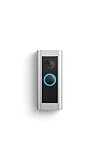
The Ring Wired Doorbell Pro is the hardwired camera for people who care less about pixel count and more about knowing what happened and where. It is a best-in-class hardwired doorbell with a cutting-edge feature set built around radar-style motion detection, bird’s-eye-style tracking of movement across your property, and head-to-toe HD+ video. It suits homeowners with existing wiring who want to understand a visitor’s path — did they walk to the front door, the side gate, or the driveway — rather than simply capture a face at the bell.
Key specs at a glance
- Power: hardwired to an existing doorbell transformer
- Motion: radar-assisted 3D motion detection with bird’s-eye-style tracking across a mapped area
- Video: Head-to-Toe HD+ framing — tall aspect ratio for full-height coverage
- Live View, Two-Way Talk and rich notifications
- Continuous power, so no charging and no wake-up delay
- Storage: cloud recording via a Ring Home plan, with the most advanced motion features tied to higher tiers
- Wiring: typically expects a 16–24 VAC transformer with adequate VA headroom
Radar-assisted motion detection is the feature that separates this model from every battery doorbell in this list, and the difference is qualitative rather than incremental. A conventional camera detects motion by watching pixels change, which is why porch cameras trigger on swaying trees, passing headlights and shadows. A radar-assisted system measures distance and movement in physical space, which means it can be told to ignore anything beyond a set radius — a footpath, a road, a neighbour’s drive — and it can describe a visitor’s path across your property rather than just flagging that something moved somewhere in the frame. On a property where the front door is close to a pavement, that single capability removes most of the false alerts you would otherwise spend the evening dismissing.
Head-to-Toe HD+ framing is the second differentiator, and it pairs well with the tracking. Tall framing covers the visitor from head to feet plus the ground at the door, so a parcel left on the mat stays in frame; the tracking layer then tells you which direction the person came from and where they went. Together they answer the two questions that matter after an incident: what happened at the door, and where did the person go afterwards.
Because it is hardwired, it also inherits every wired advantage: no batteries to charge, no cold-weather capacity loss, and clips that start at the beginning of an event. The requirements are the usual ones — an existing transformer in the 16–24 VAC band with enough VA to run the camera reliably, and a plan tier that unlocks the advanced motion features. Without a suitable transformer, expect the classic symptoms: buzzing at the chime, reboots, or the camera dropping off Wi-Fi whenever the chime sounds.
Pros
- Radar-assisted motion detection sharply reduces false alerts from roads, trees and headlights
- Bird’s-eye-style tracking shows a visitor’s path across the property, not just a clip
- Head-to-Toe HD+ framing keeps parcels and full figures in view
- Continuous power removes charging and eliminates wake-up delay
- Mature, well-established model with a deep feature set for a wired install
Cons
- Requires existing wiring and a transformer with sufficient VA rating
- Resolution class sits below the newer 4K Pro
- Advanced motion features depend on a higher Ring Home tier
- Not installable in a rental where you cannot touch the doorbell circuit
How it compares with the nearest alternative: against the Ring Wired Doorbell 4K Pro (entry 3), this is the smarter camera and that is the sharper one — choose based on whether your problem is false alerts and unknown visitor paths, or fine detail at distance. Against the Ring Wired Doorbell with Chime (entry 4), you pay more and give up the bundled indoor chime, but you gain the motion intelligence that no amount of resolution can replicate.
7. Ring Battery Doorbell (Newest Model) Matte Mocha with Indoor Cam Plus – Best for a two-camera starter bundle

This bundle pairs the newest battery doorbell in a Matte Mocha finish with an Indoor Cam Plus, Ring’s pan-and-tilt indoor camera. It suits first-time buyers who want both halves of the job done at once — seeing who is at the front door, and keeping an eye on the inside of the house — and it suits anyone who has been putting off an indoor camera because buying two devices separately feels like a bigger decision than it is. Bundles also tend to discount more aggressively during Cyber Monday than single items, because they carry a higher basket value.
Key specs at a glance
- Includes: newest-generation battery doorbell in Matte Mocha finish
- Includes: Indoor Cam Plus — a pan-and-tilt indoor camera with remote movement control
- Doorbell power: rechargeable battery, no wiring required
- Both cameras run in the Ring app and share the same alert and Live View workflow
- Storage: cloud recording for both devices through a Ring Home plan
- Mounting: doorbell takes standard screw-in or no-drill cradles; indoor camera is designed for shelf or wall placement
The practical case for a bundle is not the discount, it is the shared subscription logic. Ring Home plans are generally priced by the number of devices or by the household, so a single plan typically covers both cameras — meaning the second camera costs you hardware and nothing recurring. That is the calculation that makes this bundle worth reading closely: two cameras on one plan is a very different monthly figure from two cameras on two single-device plans.
The Indoor Cam Plus adds pan-and-tilt, which is more useful than it sounds. A fixed indoor camera covers one angle; a pan-and-tilt unit can be moved remotely to follow a pet, check a hallway, or sweep a room while you are away. Paired with a doorbell,


