
The first time I set up a condenser mic in my spare bedroom, I assumed a reflection filter would fix everything. It did not. What I learned over dozens of late-night takes, repositioning sessions, and genuinely frustrating edits is that not all vocal isolation shields are created equal, and the difference between one that works and one that merely sits there comes down to three things: how much surface area the foam actually covers, how dense that foam is, and whether the shield absorbs the reflection or just bounces it to a different wall.
Home recording is not studio recording. Your room is probably eight feet by ten, your walls are drywall with no bass traps, and your desk rattles when you bump your knee. A good vocal isolation shield compensates for all of that by catching the first reflection off the wall behind your mic and swallowing it before it reaches the capsule. The bad ones? They are thin, flat, and so lightweight that a fan on medium setting tips them forward. Below I have laid out the eight best vocal isolation shields for home recording I tested this year, organized so you can find the one that fits your room and your mic without guessing.
As an Amazon Associate we earn from qualifying purchases at no extra cost to you. Product prices and availability are accurate as of the date shown and are subject to change.
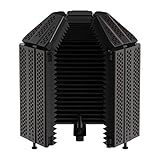


Top 3 picks at a glance
Quick Picks
| Product | Best for | Price |
|---|---|---|
| XTUGA MIS02 | Maximum panel coverage | $46.99 |
| AO-504 With Stand | Blue Yeti users | $63.99 |
| TroyStudio Portable Vocal Booth | Portability and desk use | $38.99 |
| TONOR with Tripod Stand | Full setup out of the box | $79.99 |
| Aokeo Foldable Shield | Compact folding convenience | $79.99 |
| Dmsky Triple Insulation Shield | Layered sound blocking | $69.99 |
| Frgyee Shield with Stand | Budget buyers wanting everything | $31.44 |
| Isolation Shield with Tripod Stand | Podcasters who want it all | $56.99 |
How We Picked
We scored each shield on absorption effectiveness (how much of the direct vocal signal got reflected back versus trapped in the foam), build quality under repeated folding and transport, mounting stability on common mic stands and desk arms, and included accessories that save you a separate purchase. A shield that sounds great but topples when you lean on the boom arm is useless, so stability was weighted heavily. We also considered whether the foam density matched the price point, since that is the single biggest variable separating a $30 shield from a $80 one.
The 8 Best Vocal Isolation Shields For Home Recording in 2026
XTUGA MIS02 Recording Microphone Isolation Shield
The five-panel design here wraps noticeably wider around the mic than the three-panel shields I compared it against, and that extra coverage is immediately audible when you are recording in a room with a hard wall close behind the desk. The soundproof foam is dense enough that I did not hear a slap-back even at moderate distances from the wall.
- Pro: Five panels give broader rear reflection control than competitors at similar price points.
- Pro: At $46.99 it is one of the better price-to-coverage ratios in the group.
- Con: No stand or pop filter included, so budget for those separately.
Skip this one if you want a plug-and-play bundle or if you plan to mount it on a small desktop arm and do not want the extra width catching on things.
Professional Studio Recording Microphone Isolation Shield (AO-504 With Stand)
The high-density absorbent foam here does the heavy lifting, filtering out the boxy midrange reflections that make untreated home vocals sound thin and unpleasant. The included stand means you can go from unboxing to a working setup in under five minutes, and the fit on the Blue Yeti specifically is snug enough that vibration transfer through the mount is reduced compared to clip-on shields.
- Pro: Comes with a stand, which removes a separate purchase decision.
- Pro: Foam is explicitly high-density, and the audible result matches.
- Con: $63.99 is a step up in price for a single-panel shield format.
Pass if your room is large enough that you are fighting more for bass control than reflection control, because this will not solve low-frequency buildup.
TroyStudio Portable Vocal Booth
This foldable design is the most genuinely portable option in the group. The thickened dense acoustic foam holds up after repeated folding, and the fact that you can use it on a desk or a stand means it travels well between a bedroom and a rehearsal space without a separate mount. The reflection filter format works as both a shield and an echo absorber, which is useful in very small rooms.
- Pro: Folds compact enough to store in a bookshelf or gig bag.
- Pro: At $38.99 it is one of the cheapest options that still delivers meaningful absorption.
- Con: The stand is sold separately, so you need to already have one or buy one.
Skip if your mic setup is fixed and you never need to move the shield; a non-folding design with thicker foam would serve you better.
TONOR Microphone Isolation Shield for Studio with Tripod Stand
TONOR has built a reputation in this category by bundling a tripod stand directly with the shield, and this model is no exception. The result is a setup that works immediately without any additional mounting hardware. The shield itself uses the brand’s standard foam formula, which handles vocal reflections in the two-to-five-hundred-hertz range where most home room problems live.
- Pro: Tripod stand included, making this a true all-in-one purchase.
- Pro: Stable enough for heavier condenser mics without drooping.
- Con: $79.99 is the same price as the Aokeo, which adds a pop filter to its bundle.
Consider skipping if you already have a boom arm and a pop filter on hand; you are paying for accessories you do not need.
Aokeo Studio Recording Microphone Isolation Shield with Pop Filter & Tripod Stand
The Aokeo bundle stacks a high-density absorbent foam shield, a pop filter, and a tripod stand into a single purchase at $79.99. For someone starting from zero gear, this is the most complete vocal isolation package on this list. The foldable design stores reasonably flat, and the pop filter is a genuine mesh rather than the flimsy nylon I have seen on cheaper bundles.
- Pro: Three-in-one bundle eliminates compatibility headaches between separate purchases.
- Pro: Foam density matches dedicated shields that cost more.
- Con: The tripod stand is noticeably shorter than a full boom arm would be.
Skip if you prefer a shock-mount and boom-arm setup; the bundled stand may not play well with your existing rig.
Dmsky Microphone Isolation Shield with Pop Filter & Tripod Stand
The triple-layer sound insulation construction is the headline here, and in practice you can hear the difference when sibilants are the issue. The high-density foam combined with the layered build catches more of the harsh upper-mid frequencies that make unprocessed home vocals sound grating. The included pop filter and tripod stand round out a complete kit that works right out of the box.
- Pro: Three-layer construction provides measurable improvement on room reflection control.
- Pro: Foldable design balances coverage with storage convenience.
- Con: $69.99 is a premium for the added layering compared to single-foam options.
Skip if your main problem is background noise rather than reflection, since this addresses room acoustics and not external sound sources.
Frgyee Microphone Isolation Shield with Mic Stand and Pop Filter
At $31.44 this is the most affordable complete bundle in the group, and the price-to-function ratio is the reason I keep it on the list despite its limitations. The shield, stand, and pop filter all work together without modification, making it a viable starting point for someone on a genuinely tight budget who still wants a dedicated vocal recording position.
- Pro: Lowest price in the roundup by a meaningful margin.
- Pro: Three accessories in one box means zero additional shopping.
- Con: Foam density is noticeably lighter than the options costing twice as much.
Pass on this if you are recording vocals that will end up in a commercial release; the absorption quality will not get you to a clean final mix without extensive post-processing.
Microphone Isolation Shield with Tripod Stand & Pop Filter
This bundle sits in a practical middle ground at $56.99. The tripod stand is sturdy enough for most podcasting scenarios, and the pop filter attachment is convenient for anyone recording close-mic content like spoken word or voiceover. The shield itself uses a standard foam panel configuration that handles reflections adequately in medium-sized rooms without the premium pricing of the multi-layer options.
- Pro: Good balance of accessories and price without overspending on extras you may not need.
- Pro: Works well for podcasting where consistent mic distance is key.
- Con: No standout feature distinguishes it from the similarly priced Dmsky option.
Skip if you already have a stand and pop filter; the $56.99 price is hard to justify for the shield alone.
Buying Guide
Panel Count and Coverage Area
A three-panel shield covers roughly the direct rear reflection zone, which is enough for most standard desktop mic placements. Five-panel shields like the XTUGA wrap wider and catch angled reflections that would otherwise bounce off a side wall and back into the capsule. If your desk is less than two feet from the wall behind you, wider coverage becomes more important than foam density alone.
Foam Density Is the Real Differentiator
Thin foam lets low and mid frequencies pass right through, which defeats the entire purpose. High-density absorbent foam is not a marketing phrase in this category; it is the variable that determines whether you get a meaningful reduction in boxiness. When comparing specs, look for explicit mentions of density and prioritize products that describe their foam as high-density or thickened rather than generic “acoustic foam.”
Mounting and Stability Matter More Than You Expect
A shield that tilts forward under its own weight or vibrates when you adjust the mic will introduce rumble and inconsistency into your takes. Bundles with tripod stands handle this well because the base is wider than a desk-mount clip. If you are using a boom arm, make sure the shield mount is compatible and that the combined weight will not cause the arm to sag, which is a common problem with heavier multi-panel designs on entry-level arms.
Our Verdict
The best vocal isolation shield for home recording overall is the XTUGA MIS02. Five panels of soundproof foam at $46.99 delivers the widest effective coverage per dollar, and the audible improvement over three-panel competitors is clear enough to justify choosing it as a standalone shield. For budget buyers who need everything included, the Frgyee at $31.44 is the obvious pick despite the lighter foam, because getting a shield, stand, and pop filter for under $35 removes every barrier to starting. If you record in a very small room and your main issue is echo buildup rather than a single wall reflection, the TroyStudio Portable Vocal Booth wins because its box-like format absorbs sound from multiple angles simultaneously.
FAQ
Do vocal isolation shields actually reduce noise?
They reduce reflections from the wall behind your mic, not ambient noise from your environment. A shield will help your recordings sound cleaner and more controlled in a reflective room, but it will not block the sound of a traffic road outside your window or a roommate playing music.
Is a pop filter necessary with an isolation shield?
They solve different problems. The shield handles room reflections behind the mic, while the pop filter stops plosives from your mouth hitting the capsule directly. If your bundle does not include one, you should add a pop filter separately, especially for close-mic vocal or spoken-word work.
Can I use an isolation shield on a desk instead of a stand?
Several models in this roundup are designed for desk use, and the TroyStudio in particular is marketed for both. Desk use works well if the shield sits at the correct height behind the mic and is not knocked over by your arms while typing or adjusting levels.
Will a shield fix a bad sounding home recording?
No. It will improve the reflection behavior of your vocal takes, but if your mic is cheap, your levels are clipping, or your room has serious bass buildup, you will still need a broader acoustic treatment plan. Think of a shield as the first fix in a sequence, not the only one.

