
Anyone who has ever watched a wooden cutting board turn from warm and honey-toned to gray and cracked knows that proper maintenance is not optional. The challenge of learning how to clean a wooden cutting board effectively sits right at the intersection of food safety and material longevity. Leave residue from raw meat or citrus juice in the grain, and you invite bacterial growth in a surface you use every day. Over-clean with harsh detergents or submerge it in the dishwasher, and you dry out the fibers until the board splits. The products on this list address different pieces of that puzzle: dedicated cleaners, conditioning oils, and boards built from materials that resist moisture better than others.
After comparing published specifications, current pricing, and aggregated owner feedback across these eight options, a few patterns emerged. The strongest performers share food-safe formulations, clear application guidance, and dimensions suited to real prep work rather than decorative display. Weak entries tend to lack depth in either capacity (small bottles you replace constantly) or material density (thin bamboo that warps). Below is the breakdown that will save you from guessing which product actually earns a spot under your sink.
As an Amazon Associate we earn from qualifying purchases at no extra cost to you. Product prices and availability are accurate as of the date shown and are subject to change.



Top 3 picks at a glance
Quick Picks
| Product | Best for | Price |
|---|---|---|
| Howard Products CBC012 Wood Cleaner | Deep cleaning existing boards | $11.15 |
| ROYAL CRAFT WOOD Bamboo Set | Multi-board kitchen prep | $36.97 |
| Non-Toxic Acacia Wood Board | Large-format single board | $39.95 |
| Rhino Wax Spray Cleaner | Quick post-use sanitizing | $14.95 |
| Homaxy Extra Large Bamboo Board | Budget-friendly oversized prep | $11.99 |
| Howard Butcher Block Conditioner | Seasoning and long-term protection | $9.18 |
| CLARK’S Spray Cleaner with Cloth | Convenience kit buyers | $24.99 |
| Non Toxic Bamboo Cutting Board | Fewest-material purity seekers | $28.99 |
How We Picked
We narrowed this category on four criteria. First, food safety: every product must be explicitly labeled food-grade or non-toxic, because a cutting board surface contacts what you eat directly. Second, material integrity for boards and formulation integrity for cleaners — we looked for density data, finish types, and ingredient transparency in published specs. Third, real-world usability signals from owner feedback, particularly comments about warp resistance, odor absorption, and how often a cleaner needs reapplication. Fourth, value per use: a $9 bottle that lasts a year beats a $25 kit that dries out in two months, so we weighed price against stated volume and board dimensions.
The 8 Best How To Clean A Wooden Cutting Board in 2026
Howard Products CBC012 Wood Cutting Board Cleaner
This is the product you reach for when a board already smells like last Tuesday’s garlic and you need more than a rinse. Howard formulates it specifically for end-grain and butcher block surfaces, so it lifts embedded residue without stripping the wood’s natural oils. Owners consistently note that a single spray-and-wipe pass eliminates odors that soap alone cannot touch. The twelve-ounce bottle covers roughly a dozen applications on a standard board, and at $11.15 the per-use cost lands well under a dollar.
- Pro: Targets odor and bacteria without harsh chemicals that degrade wood fiber.
- Pro: No-rinse formula speeds up the cleaning routine between prep sessions.
- Con: Does not condition the wood, so you still need a separate oil step after repeated use.
Skip this if your board is new and you only need a first coat of protection rather than active cleaning power.
ROYAL CRAFT WOOD Bamboo Cutting Board Set
Three boards with integrated juice grooves and side handles make this set practical for households that handle proteins, produce, and bread on separate surfaces. The deep groove design prevents liquid from pooling where bacteria thrive, which simplifies the process of learning how to clean a wooden cutting board between uses. Bamboo’s tight grain absorbs less moisture than open-pored hardwoods, a fact reflected in owner reports about minimal warping after months of daily use. At $36.97 the price covers three functional pieces rather than one.
- Pro: Juice groove captures liquids before they seep into the cutting face.
- Pro: Side handles allow easy transport to the sink for quick wash-and-dry cycles.
- Con: Bamboo requires more frequent oiling than denser hardwoods to stay sealed.
Skip this set if you have limited counter or drawer space and prefer one large board over three smaller ones.
Non-Toxic Acacia Wood Cutting Board, 16×11 in
A single acacia slab at sixteen by eleven inches gives you genuine workspace for whole chickens or sheet-pan vegetable prep. Acacia’s natural oils resist moisture better than many common board woods, and the plastic-free, mineral-oil-free construction appeals to buyers who want a board with no chemical finish to maintain. Owners praise the heft, noting the board stays planted during heavy chopping. At $39.95 it sits at the top of our price range, but the density translates to a longer service life than thinner alternatives.
- Pro: Natural acacia oils provide built-in moisture resistance without synthetic sealants.
- Pro: Generous dimensions reduce the number of boards you need to cycle through.
- Con: The thick profile demands a dedicated drying rack or counter space for air circulation.
Skip this if your kitchen stores boards flat in a shallow drawer, where the weight and thickness become a hassle.
Rhino Wax Cutting Board Spray Cleaner
Rhino Wax occupies the middle ground between a simple rinse and a deep clean. The spray format means you can hit the surface immediately after prep, wipe, and return the board to storage without a sink trip. Food-safe labeling covers all wood surfaces, making it versatile for boards, butcher blocks, and even wooden utensils. Owners highlight the citrus scent as a pleasant upgrade over chemical-smelling alternatives, and the $14.95 price tag reflects a larger volume than comparable sprays.
- Pro: Works on any wood surface, not just boards, consolidating your cleaning kit.
- Pro: Spray-and-wipe application keeps the routine under thirty seconds.
- Con: Lighter-duty than a paste or soak, so heavily soiled boards may need a second pass.
Skip this if your boards regularly see raw poultry and you prefer a more aggressive sanitizing step before conditioning.
Homaxy Extra Large Organic Bamboo Cutting Board
At seventeen and a half by twelve inches, this board offers the largest surface area in our list while staying under $12. For cooks who prep for a crowd or who want a single catch-all surface, the dimensions justify the purchase over multiple smaller boards. Organic bamboo construction means fewer pesticides in the material itself, a point owners raised positively in feedback. The low price also makes it a reasonable starting point for someone building a board collection incrementally.
- Pro: Largest surface-to-price ratio in this roundup.
- Pro: Lightweight enough to stand on end for drying without a rack.
- Con: Thinner profile than hardwood options, so it shows knife marks faster.
Skip this if you frequently tenderize or chop hard vegetables, where a thinner board will dent sooner.
Howard Butcher Block Conditioner and Food Grade Mineral Oil
Cleaning removes moisture; conditioning restores it. This twelve-ounce blend of mineral oil and wax penetrates wood grain to seal the surface against the very liquids you just cleaned away. At $9.18 it is the lowest-priced item in our list and arguably the most essential for longevity. Owners report that a monthly application keeps boards from developing the rough, thirsty texture that precedes cracking. Pair it with any board material — bamboo, acacia, maple — for universal protection.
- Pro: Combines oil and wax in one product, eliminating a separate beeswax step.
- Pro: Lowest cost in the roundup with no expiration concerns for the formula.
- Con: Absorption is slow; you need several hours or overnight before the board is usable again.
Skip this if your boards already ship pre-conditioned and you are within the first few months of ownership.
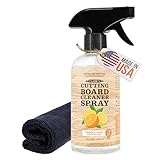
CLARK’S Cutting Board Spray Cleaner with Microfiber Cloth
Clark’s bundles a citrus-scented spray with a microfiber cloth, removing the guesswork about what wipe material suits a freshly cleaned surface. Owners appreciate the kit approach, particularly newer buyers who do not yet own a dedicated cloth for food surfaces. The citrus formulation doubles as a light degreaser for oily residues left by fatty cuts. At $24.99 it costs more than standalone sprays, but the included cloth offsets a small separate purchase.
- Pro: Cloth included ensures you use a lint-free material that does not leave fibers in the grain.
- Pro: Citrus formula cuts through grease from fatty meats without a secondary degreasing step.
- Con: Smaller volume than comparable sprays at a higher sticker price.
Skip this if you already have a stocked drawer of microfiber cloths and want the lowest cost per ounce of cleaner.
Non Toxic Bamboo Cutting Board for Kitchen
This board targets buyers whose primary concern is material purity above all other specs. The description emphasizes healthy, food-grade construction with no added plastics or chemical binders, which addresses a common anxiety about whether bamboo boards use urea-formaldehyde glues in their laminated layers. Owners cite the smooth finish and lack of chemical smell out of the package as differentiators. At $28.99 it falls in the middle of the board price range and serves well as a dedicated produce or bread surface.
- Pro: Transparent food-grade material claims reduce uncertainty about glue or finish safety.
- Pro: Smooth surface wipes clean with minimal effort after produce prep.
- Con: Standard dimensions make it less suited for bulk protein tasks than larger options.
Skip this if your main cooking involves breaking down whole birds or sheet-pan vegetables that need extra workspace.
Buying Guide
Board Material and Density
Bamboo, acacia, and maple differ in how much liquid they absorb per square inch of surface. A denser board resists odor retention and bacterial embedding, which directly affects how you clean a wooden cutting board day to day. If you cook heavily with alliums, citrus, or raw proteins, choose the densest board your budget allows; you will spend less time fighting smells and more time actually prepping. Acacia sits above bamboo in natural oil content, while high-grade bamboo edges out soft maple in moisture resistance. Read the product listing for grain density or Janka hardness data when available.
Cleaner Type: Spray, Paste, or Soak
Sprays suit quick mid-session wipes and light residue. Pastes and dedicated deep-clean formulas handle embedded odor and protein film that a rinse misses. If you clean after every single use with a simple rinse, a spray is sufficient. If you go a full day between deep cleans, a paste or targeted cleaner like Howard’s CBC012 fills the gap. The right choice depends on your cooking frequency and what you prepare most. Pair any cleaner type with a food-grade conditioner to rebuild the protective layer you strip away each week.
Conditioning Schedule and Oil Compatibility
Every board needs oiling on a recurring schedule, typically monthly for heavy-use boards and quarterly for lighter rotation. Mineral oil blends with beeswax penetrate deeper than pure oil and hold longer, reducing how often you pull the board from service to dry. Check that your conditioner is food-grade with no additives that leave a waxy film on hot pans. If you own multiple boards, buy the largest conditioner bottle that fits your storage; per-ounce savings over a year add up across a full set.
Our Verdict
The Howard Butcher Block Conditioner is our top overall pick because it addresses the root cause of premature board failure: dried-out, cracked fiber. No board survives its first year without regular conditioning, and this product pairs with every other item on this list. For budget-conscious buyers, the Homaxy Extra Large Bamboo Board delivers surprising real estate at $11.99, making it the best value when your current board finally retires. However, if your household cooks with raw poultry multiple times a week, the ROYAL CRAFT WOOD Set wins outright — dedicated boards for proteins versus produce eliminate cross-contamination risk and simplify your cleaning workflow from the start.
FAQ
Can you put a wooden cutting board in the dishwasher?
No. The combination of prolonged heat and standing water causes wood fibers to swell unevenly, leading to warping, delamination of glued layers, and surface cracking. Hand-wash with hot water and mild soap, then dry immediately with a towel and stand the board upright for air circulation.
How often should you oil a wooden cutting board?
A general rule is once a month for boards used daily, or whenever the surface looks dry and absorbs a water droplet instead of beading. New boards typically ship with a preliminary coat, so wait until the factory finish wears before your first application. Bamboo may need slightly more frequent oiling than dense hardwoods because its fibers are less naturally oily.
What is the safest way to sanitize a wooden board after raw meat?
Wash with hot soapy water first, then apply a diluted white vinegar spray or a dedicated food-safe wood cleaner to address lingering bacteria. Avoid bleach solutions at full household-strength, which can break down wood fiber over repeated use. Let the board air-dry completely before storing it flat, since trapped moisture is the main vector for bacterial regrowth.
Does bamboo differ from wood when it comes to cleaning and conditioning?
Yes. Bamboo is a grass, not a hardwood, so it has a different cellular structure that absorbs oil faster and can dry out more quickly between conditionings. It also tends to show knife scars more visibly, which create micro-channels for moisture and bacteria. Treat bamboo boards with the same cleaning logic but a slightly tighter conditioning schedule.


