Choosing a lightweight gaming mouse is not really about finding the smallest number on a spec sheet. Below a certain point, every gram you remove trades against something: battery size, button count, shell stiffness or the shape your hand already knows. The real decision is which compromise fits your grip and your games, because a 55 g mouse that cramps your hand will aim worse than a 68 g mouse that disappears under it. Weight matters, but it is the starting point of the choice, not the whole choice.
This guide is for competitive FPS players chasing faster flicks, claw and fingertip grippers whose wrists tire over long sessions, and anyone upgrading from a heavy all-purpose mouse. The four picks were chosen from the names and specifications stated on their Amazon US product pages: the Logitech G PRO X Superlight 2, Razer Viper V3 Pro, Pulsar X2V2 and Glorious Model O 2 Wireless, covering the class from 53 g up to 68 g.
Our Top Picks
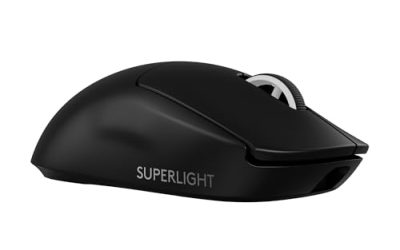
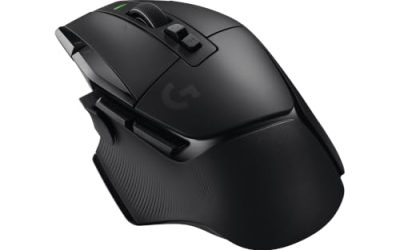
 Logitech G Pro X Superlight 2 Lightspeed WirelessClassic1.57 x 2.5 x 4.92 inches0.1 poundsCheck on Amazon

Top 3 picks at a glance

Quick Picks
As an Amazon Associate we earn from qualifying purchases.
| Product | Best for | Key spec from title |
|---|---|---|
| Logitech G PRO X Superlight 2 | Tournament players who want proven wireless | 60 g, HERO 2 sensor up to 44K DPI |
| Razer Viper V3 Pro | Fingertip and claw players chasing 8K polling | 55 g, Focus Pro 35K optical sensor |
| Pulsar X2V2 | Small-to-medium hands wanting the lightest shell | 53 g, PAW3395 sensor at 26,000 DPI |
| Glorious Model O 2 Wireless | Players who also want Bluetooth for a second device | 68 g, 26K BAMF 2.0 sensor |
How to Choose
Put grip and shape ahead of the gram count
A lightweight shell only helps if your fingers can control it. Symmetrical, low-profile mice like the Viper V3 Pro and Pulsar X2V2 suit claw and fingertip grips, where the fingertips steer and the palm barely touches. Palm grippers usually do better with a fuller shape, even at a few grams more. Hand size matters just as much: the X2V2 comes in Mini and Medium sizes, and picking the wrong one changes your control more than any sensor difference. Measure your current mouse and compare lengths before ordering, because return shipping is a poor substitute for five minutes with a ruler.
Understand what polling rate actually changes
Polling rate is how often the mouse reports its position: 1,000 Hz means every millisecond, while the 8,000 Hz modes on the Superlight 2 and Viper V3 Pro report eight times as often. The gain is smoother cursor micro-movement, most visible on high-refresh monitors, but it is not free. High polling drains wireless batteries much faster and can tax older CPUs. The Pulsar and Glorious here report at 1,000 Hz, which remains the competitive standard. Decide honestly whether your monitor and games will show the difference before paying for the fastest specification on the page.
Balance weight against battery life
Every wireless mouse in this guide hides a battery inside its gram count, so the lightest models tend to run for fewer hours per charge at high polling. The Viper V3 Pro stretches to 95 hours at 1,000 Hz, the Superlight 2 matches that figure, the Pulsar X2V2 lists 70 hours, and the heavier Model O 2 Wireless converts its extra grams into up to 110 hours over 2.4 GHz or 210 hours on Bluetooth with RGB off. If you hate charging, a slightly heavier mouse can be the practical lightweight choice because it never dies mid-match.
Check switches, feet and what is in the box
Click feel decides how a light mouse behaves under fast tapping. Optical switches, used by the Viper V3 Pro and X2V2, actuate with light and avoid the debounce delay of mechanical contacts, while Logitech’s LIGHTFORCE hybrid switches pair optical actuation with a mechanical feel. Glide matters too: all four use PTFE feet, but replacement feet and grip tape are included only with some, and the Viper bundles its HyperPolling dongle in the box while other brands sell high-polling receivers separately. Read the box contents on the listing so the real cost of your setup is clear.
The 4 Best Options
Logitech G PRO X Superlight 2
The Superlight 2 is the safe flagship of this class: 60 g, a shape refined with professional players, and Logitech’s LIGHTSPEED wireless running at up to an 8 kHz report rate. The HERO 2 sensor tracks up to 44K DPI, and the LIGHTFORCE hybrid switches aim to combine optical speed with a familiar mechanical click feel. Battery life is listed at up to 95 hours, charging is over USB-C, and the box includes grip tape and an optional PTFE aperture door. With only five programmable buttons it is built for shooters rather than MMO keybinds, which is exactly the point of the design.
Specs
- Weight: 60 g
- Sensor: HERO 2 optical sensor, up to 44K DPI
- Polling: Up to 8 kHz report rate over LIGHTSPEED wireless
- Switches: LIGHTFORCE hybrid switches
- Buttons: 5 programmable buttons
- Battery: Up to 95 hours, USB-C charging
- Connectivity: LIGHTSPEED wireless (RF) and USB
- Model number: 910-006628 (Black)
Best for: Competitive players who want the most established lightweight wireless mouse in esports.
Watch out for: The symmetrical shell has side buttons on the left only and just five buttons in total, so check your keybind needs before ordering.
ASIN: B09NBWL8J5
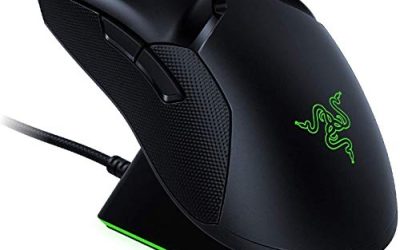
Razer Viper V3 Pro
At 55 g in the white finish listed here, the Viper V3 Pro is the lightest of the big-brand flagships, and it is unapologetically built for fingertip and claw players. The Focus Pro 35K Optical Sensor Gen-2 tracks up to 35,000 DPI with 750 IPS and 70 G acceleration, and it keeps tracking on glass. Razer includes the HyperPolling Wireless Dongle in the box, unlocking a true 8,000 Hz wireless polling rate, while battery life reaches up to 95 hours at the standard 1,000 Hz. Gen-3 optical switches are rated for 90 million clicks. Grip tape is included, which many owners will want on the smooth shell.
Specs
- Weight: 55 g (White listing)
- Sensor: Razer Focus Pro 35K Optical Sensor Gen-2, 35,000 DPI, 750 IPS, 70 G
- Polling: Up to 8,000 Hz wireless with the included HyperPolling Wireless Dongle
- Switches: Razer Optical Mouse Switches Gen-3, rated 90 million clicks
- Buttons: 8 programmable buttons
- Battery: Up to 95 hours at 1,000 Hz
- Connectivity: Razer HyperSpeed Wireless and wired
- Model number: RZ01-05120200-R3U1 (White)
Best for: Claw and fingertip players who want 8K polling without buying a separate dongle.
Watch out for: Battery life drops sharply at 8,000 Hz polling, so plan on charging far more often if you run it at maximum rate.
ASIN: B0CW25XR5S
Pulsar X2V2
The X2V2 is the enthusiast pick: a symmetrical shell at just 53 g in the Medium size listed here, with a Mini version for smaller hands. Its PixArt PAW3395 sensor runs to 26,000 DPI with 650 IPS tracking and 50 G acceleration, paired with optical switches rated for 90 million clicks and a Pulsar Blue encoder for the wheel. Polling is 1,000 Hz over the 2.4 GHz connection, wired play is supported, and the listing states 70 hours of battery life. It skips the flagship brands’ software ecosystems in favour of a focused, no-frills design, which is precisely why this class of player seeks it out.
Specs
- Weight: 53 g (1.87 oz, Medium)
- Sensor: PixArt PAW3395 optical sensor, 26,000 DPI, 650 IPS, 50 G
- Polling: 1,000 Hz / 1 ms
- Switches: Optical switches, rated 90 million clicks
- Encoder: Pulsar Blue Encoder
- Battery: 70 hours
- Connectivity: 2.4 GHz wireless and wired
- Model number: PX2222 (Medium, White)
Best for: Small-to-medium hands that want the lightest shell in this guide with a proven flagship sensor.
Watch out for: Confirm you are ordering the Medium rather than the Mini size, because both share near-identical listings and names.
ASIN: B0CH9Z587R
Glorious Model O 2 Wireless

The Model O 2 Wireless is the heavyweight of this lightweight roundup at 68 g, and it spends those grams on versatility. Its BAMF 2.0 sensor tracks up to 26,000 DPI, and the hybrid connection offers 2.4 GHz wireless for gaming plus Bluetooth 5.2 for a laptop or second machine, switched from the underside. The listing quotes up to 110 hours of battery in 2.4 GHz mode and up to 210 hours over Bluetooth with RGB off, the longest endurance here. Six buttons, an ambidextrous shell, RGB lighting and PTFE feet complete a mouse aimed at players who game and work on the same desk.
Specs
- Weight: 68 g
- Sensor: BAMF 2.0 optical sensor, 26,000 DPI
- Buttons: 6 buttons
- Battery: Up to 110 hours (2.4 GHz) or up to 210 hours (Bluetooth, RGB off)
- Connectivity: Hybrid 2.4 GHz wireless and Bluetooth 5.2, plus wired
- Shape: Ambidextrous
- Feet: PTFE feet
- Model number: GLO-MS-OWV2-MB (Black)
Best for: Players who want one lightweight mouse for gaming and a second Bluetooth device, with the longest battery here.
Watch out for: At 68 g it gives back some of the speed advantage this category exists for, so committed flick-shot players should compare it against the 53-60 g picks first.
ASIN: B0BLF5NH32
Which One Fits Your Situation
You play ranked FPS every night
Take the Logitech G PRO X Superlight 2 or the Razer Viper V3 Pro. Both deliver 8K-class polling, top sensors and 95-hour batteries at 1,000 Hz. The Superlight’s shape is the more forgiving all-rounder, while the Viper’s lower, flatter shell rewards claw and fingertip grips. Pick by grip first; the performance difference between them is smaller than the comfort difference.
Your hands are small and mice always feel bulky
The Pulsar X2V2 was made for you. It comes in a dedicated Mini size as well as the 53 g Medium listed here, so you can match shell length to your hand instead of stretching across a full-size flagship. Its PAW3395 sensor gives up nothing in tracking quality, and the symmetrical shape keeps fingertip control precise.
You share one desk between gaming and work
Choose the Glorious Model O 2 Wireless. Bluetooth pairing covers the work laptop while the 2.4 GHz dongle handles gaming, and the long battery life means it rarely needs the cable. At 68 g it is still far lighter than a typical office mouse, so your aim does not have to readjust every time you switch machines.
You are upgrading from a heavy mouse for the first time
Start with the Superlight 2 at 60 g rather than jumping straight to the lightest shell here. The step down is dramatic enough to feel faster immediately, while the familiar size and five-button layout keep the adjustment period short. If wrist fatigue was your reason for switching, the change in glide effort will be obvious within the first session.
Common Mistakes
- Chasing the lowest gram count while ignoring shell size, then discovering the lightest mouse is also the most cramped for your hand.
- Running 8,000 Hz polling permanently and blaming the mouse when the battery fades in days instead of weeks.
- Assuming every lightweight mouse includes its high-polling dongle; check the box contents, because some brands sell the receiver separately.
- Mixing up the Pulsar X2V2 Mini and Medium listings, which look nearly identical at a glance.
- Judging a new lightweight mouse in the first hour, before your grip and sensitivity settings have adjusted to the lower mass.
Frequently Asked Questions
How light should a gaming mouse actually be?
For most players the useful range is roughly 50 to 70 g. Below that, gains shrink and shells can feel hollow or cramped; above it, fast flicks demand noticeably more effort. The four mice here span 53 g to 68 g, which covers the practical sweet spot. Your grip style and hand size will matter more than the last few grams either way.
Does 8K polling make a real difference?
It smooths cursor movement in very small increments and pairs best with a high-refresh-rate monitor. In ordinary play at 1,000 Hz, both are already reporting every millisecond, so most players will not feel a dramatic change. The clearest difference is battery drain: mice like the Viper V3 Pro quote their 95-hour figure at 1,000 Hz, not at maximum polling.
Are lightweight mice less durable because of their thin shells?
Not necessarily. The mice in this guide use optical or hybrid switches rated up to 70 to 90 million clicks where stated, and their shells are engineered to flex less than their weight suggests. The more common failure points are encoders and cables on wired models. Still, check the switch rating and warranty description on the listing before buying.
Can I use one of these mice for work as well?
Yes, and the Model O 2 Wireless is built for exactly that, with Bluetooth for a second device and up to 210 hours of battery with RGB off. The others work fine over their dongle or cable, but they lack Bluetooth, so swapping between two computers means moving the receiver or plugging in. For a single desk PC, any of the four doubles as a daily mouse.
Related guides
More from Amazon
Programs that pair well with the guide above. Offers and eligibility are set by Amazon and may change.
Free shipping on eligible items, Prime Video and more. Eligible new members can start with a free trial.
Start a Prime free trialAd-free music streaming. Eligible new subscribers can start with a free trial.
Try Music Unlimited freeA Prime membership for ages 18-24 with a trial period. Eligibility is set by Amazon.
See Prime for Young AdultsAudiobooks and podcasts to listen to on the go. Eligible new members can start with a free trial.
Try Audible freeAs an Amazon Associate we earn from qualifying purchases.