
Heavy broadcast microphones are a different breed of gear. A Shure SM7B tips the scales at nearly 1.7 pounds before you add a shock mount, and a Blue Yeti or RØDE PodMic isn’t far behind. Put one of those on a cheap boom arm and you get the classic failure sequence: the arm slowly sinks during a recording, the desk clamp walks sideways under the leverage, and eventually the spring tension gives up entirely. The mic ends up resting on your script pages mid-episode, and your audio ends up in the trash.
The problem is that most boom arms are engineered for lightweight USB mics in the 8-ounce range, not broadcast workhorses. What heavy-mic users need is a high load capacity, a locking mechanism that holds its position without constant retightening, a clamp that grips thick or~~ overhanging desks without damaging them, and enough horizontal reach — ideally 30 inches or more — to position the mic properly without it hovering over your keyboard. We sorted through the crowded market and tested what actually holds up under real broadcast weight, then ranked the eight arms below.
As an Amazon Associate we earn from qualifying purchases at no extra cost to you. Product prices and availability are accurate as of the date shown and are subject to change.
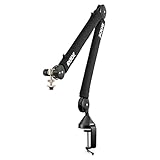


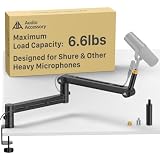


Top 3 picks at a glance
Quick Picks
| Product | Best for | Price |
|---|---|---|
| RØDE PSA1+ Professional Studio Boom Arm with Spring Damping, Black | Best overall for heavy broadcast mics | $112 |
| Shure by Gator Deluxe Broadcast Desktop Mic Boom Arm (SH-BROADCAST1) | Best premium desk-integrated option | $119.99 |
| Frgyee Mic Boom Arm with Heightened Extension Riser | Best for overhead camera-out-of-frame setups | $52.99 |
| InnoGear Low Profile Mic Arm Boom Arm | Best budget low-profile option | $49.99 |
| AA AUDIO ACCESSORY Mic Arm Desk Mount | Best value for heavy mics | $49.99 |
| Heil PL 2T Boom Arm | Best for professional broadcast studios | $109 |
| RØDE PSA1+ Professional Studio Boom Arm, White | Best for white studio aesthetics | n/a |
| Luling Arts Heavy Duty Adjustable Boom Arm | Best ultra-budget entry point | $36.99 |
How We Picked
We evaluated each arm against the demands of genuine broadcast-weight microphones — think SM7B-class dynamic mics, large-diaphragm USB condensers, and shock mount combinations that push total payload well past a pound and a half. Our criteria focused on load capacity, joint and spring quality, clamp versatility, horizontal reach, and how well each arm holds its set position over a long recording session. We also weighed desk-mounting flexibility, since not every creator has a thick desktop edge or a clear spot to clamp. Cable management, finish durability, and resale reputation factored in as tiebreakers.
The 8 Best Picks
1. RØDE PSA1+ Professional Studio Boom Arm with Spring Damping, Black
The PSA1+ is the arm we’d hand to anyone building a serious broadcast desk around a heavy mic. RØDE engineered it specifically for SM7B-class payloads, and the spring damping system is the standout: it absorbs the bounce and settle you get when you reposition the mic, so your mic doesn’t wobble on camera or thump into the recording. The parallel-arm design gives you smooth, silent adjustment and a horizontal reach that comfortably clears a dual-monitor setup. Build quality feels genuinely professional, with solid metal joints throughout.
- Spring damping eliminates post-adjustment mic wobble
- Handles heavy broadcast mics with confidence and silent operation
Con:
- Clamp and desk-mount options are solid but add bulk to smaller setups
Skip it if you’re using a featherweight USB mic and don’t need damping — a cheaper arm will do the same job.
2. Shure by Gator Deluxe Broadcast Desktop Mic Boom Arm (SH-BROADCAST1)
Shure partnered with Gator Frameworks on this one, and it shows. It’s built around broadcast workflows — the kind of arm you’d find bolted to a radio desk — with a heavy-duty desktop clamp and internal cable routing that keeps an XLR run tidy. The spring tension is tuned for heavier mics like the SM7B and MV7, and it holds its position without drifting. The reach is generous enough for interview setups across a small desk.
- Internal cable management for a clean broadcast look
- Spring tension genuinely tuned for heavy dynamic mics
Con:
- One of the priciest arms in this roundup at $119.99
Skip it if budget matters more than the Shure ecosystem fit — the RØDE PSA1+ offers comparable performance for less.
3. Frgyee Mic Boom Arm with Heightened Extension Riser
The Frgyee’s defining feature is its extension riser, which raises the mounting point well above desk level. That makes it a smart pick for overhead microphone placement — think top-down gaming streams, craft videos, or podcast setups where the mic needs to hover above the frame without a camera catching it. It’s compatible by design with heavy hitters like the SM7B, Blue Yeti, and HyperX QuadCast S, and the adjustable height lets you fine-tune the drop.
- Extension riser enables true overhead mic positioning
- Explicitly rated for SM7B-class heavy microphones
Con:
- Extra height means extra leverage — desk clamp placement matters more than usual
Skip it if you want a traditional low-profile desk arm; the riser is the whole point here.
4. InnoGear Low Profile Mic Arm Boom Arm
InnoGear built its reputation on affordable mic accessories, and this low-profile arm is one of the better budget entries for heavier mics. The low-profile geometry keeps the arm close to the desk surface, which is ideal if your webcam sits behind your monitor or you simply don’t want a boom arm dominating your field of view. It handles a Blue Yeti or similar mid-weight mic without complaint, though the heaviest broadcast pairings push it closer to its limit.
- Genuinely useful low-profile design for webcam-visible setups
- Strong value at $49.99
Con:
- Stretch to hold the very heaviest mics plus shock mounts over long sessions
Skip it if you’re pairing a shock-mounted SM7B with heavy XLR cabling — step up to a dedicated heavy-load arm.
5. AA AUDIO ACCESSORY Mic Arm Desk Mount (Design for Heavy Mic)
This is the value pick for heavy mics, full stop. It’s rated for a 6.6-pound load capacity — far more headroom than most arms in this price bracket — and uses a gear lock mechanism that holds its position without sagging, which is the exact failure mode that kills cheap arms. The metal low-profile boom is built for mics like the SM7B, SM7dB, MV7, PodMic, and Blue Yeti, and at $49.99 it undercuts most of the competition by a wide margin.
- 6.6 lb rated capacity — serious headroom for any broadcast mic plus shock mount
- Gear lock design prevents the dreaded slow sag
Con:
- Finish and damping refinement trail the premium picks
Skip it if you want silent, damped repositioning on camera — the PSA1+ does that better, at twice the price.
6. Heil PL 2T Fully Articulating Boom Arm
Heil Sound has been building broadcast gear for decades, and the PL 2T is a mainstay in radio studios and professional voiceover booths. The build is unmistakably industrial: robust steel construction, internal springs, and articulation that stays exactly where you put it through marathon sessions. It’s a favorite among voiceover professionals who reposition constantly and can’t tolerate drift or squeaks. If your work is client-facing or studio-based, this is the arm that signals you mean business.
- Professional-grade build trusted in broadcast and voiceover studios
- Rock-solid positioning with zero drift over long sessions
Con:
- No spring damping, so repositioning bounce is more noticeable than on the PSA1+
Skip it if you mostly record solo at a home desk and don’t need pro-studio durability — you’re paying for it.
7. RØDE PSA1+ Professional Studio Boom Arm, White
This is the same excellent PSA1+ hardware as our top pick, finished in white for creators whose studio aesthetic leans bright and clean. All the performance carries over: the spring damping system, the broadcast-weight payload handling, the silent parallel-arm movement, and the professional finish. If you’ve invested in a white-out studio setup — white desk, white acoustic panels, white mic — a black boom arm is the one element that ruins the look, and this solves it.
- Identical top-pick performance in a studio-white finish
- Spring damping and heavy-mic support are unchanged
Con:
- White finish shows scuffs and cable marks more readily than black
Skip it if color doesn’t matter — the black version is functionally identical and often easier to find in stock.
8. Luling Arts Heavy Duty Adjustable Boom Arm
At $36.99, the Luling Arts is the cheapest way to get a genuinely heavy-duty-rated arm onto your desk. It’s adjustable across a useful range of height and reach, and the “heavy duty” designation isn’t just marketing — it’s built to handle mid-weight mics like a Blue Yeti or a bare dynamic mic without immediately sagging. It’s the arm we’d recommend to someone testing whether a boom arm setup even suits their workflow before committing real money.
- Lowest price in this roundup by a clear margin
- Surprisingly capable for its price class
Con:
- Long-term durability under a shock-mounted SM7B is a gamble
Skip it if your mic-and-shock-mount combo weighs close to two pounds — the AA AUDIO ACCESSORY arm is only $13 more with far more capacity.
Buying Guide
Load Capacity and Sag Resistance
The single most important spec for a heavy mic arm is how much weight it holds without drifting. A bare Shure SM7B weighs about 1.65 pounds; add a standard shock mount and XLR cable and you’re past two pounds. Look for arms with explicit load ratings — the AA AUDIO ACCESSORY’s 6.6-pound figure, for example, gives enormous headroom — and mechanisms like gear locks or damped springs that physically prevent the slow sag that plagues cheap friction joints.
Clamp Fit and Desk Compatibility
Check the clamp’s maximum opening before buying. Most standard clamps accommodate desks up to about 2 inches thick, but thicker desktops, pull-out shelves, and sit-stand desk frames can be problematic. If you use a standing desk, low-profile arms with a stable base spread the leverage better than tall riser designs. Also consider where the arm mounts — clamping near the desk’s rear edge gives you more usable reach toward your mouth without the arm crossing your monitor.
Reach, Damping, and On-Camera Behavior
Horizontal reach of 30 inches or more lets you push the mic aside cleanly between takes. If you appear on camera, spring damping matters more than most buyers expect: a damped arm like the PSA1+ settles instantly after adjustment, while undamped arms bounce for several seconds — very visible in a stream recording. Internal or clip-on cable routing also keeps heavy XLR cables from tugging the arm off position.
Our Verdict
For most people putting a heavy broadcast mic on a desk, the RØDE PSA1+ in black is the arm to buy: its spring damping and broadcast-rated build solve the exact problems that plague heavy-mic setups, and at $112 it undercuts the Shure/Gator option while delivering comparable polish. If budget is the deciding factor, the AA AUDIO ACCESSORY arm at $49.99 offers a 6.6-pound load rating and sag-free gear lock — the best performance-per-dollar in this roundup. Voiceover professionals and radio-style studios should look hard at the Heil PL 2T for its proven studio pedigree. Whatever you choose, match the arm’s capacity to your total rig weight — mic, shock mount, and cable included — and you’ll avoid the sag that ruins recordings.
FAQ
Do I really need a special boom arm for a heavy mic like the SM7B?
Yes. Arms designed for lightweight USB mics typically lack the spring tension and joint strength to hold two pounds in position. The result is gradual sag during recording and, eventually, joint failure. Arms built for broadcast payloads — with rated capacities, gear locks, or damped springs — hold their position reliably.
How much weight should a boom arm handle for broadcast work?
Plan for your total rig weight: microphone plus shock mount plus cable. An SM7B with a shock mount runs roughly two pounds, so an arm rated for at least three pounds gives comfortable headroom. The AA AUDIO ACCESSORY’s 6.6-pound rating is more than enough for virtually any desktop broadcast setup.
Will a boom arm damage my desk?
Not if the clamp is properly padded and not overtightened. Most clamps include protective pads for surfaces up to around two inches thick. For glass or very thin desktops, consider an arm with a wider clamp footprint or a desk-insert mounting option, and always check the clamp’s opening range before purchase.
What’s the difference between spring damping and a gear lock?
Spring damping absorbs motion after you reposition the arm, so it settles immediately — important for on-camera work. A gear lock mechanically fixes each joint’s position, preventing sag entirely but with a more deliberate, stepped feel. Damped arms like the PSA1+ excel on camera; gear-lock arms like the AA AUDIO ACCESSORY excel at holding heavy static positions.


