
The Short Answer
It depends on what you do in the room — but for most people, a dedicated key light is worth it only if you are on camera, on calls, or creating content regularly. If your main concern is general visibility for daily living, cooking, cleaning, or getting ready, a good overhead light does the job for less money and less clutter. The one condition that flips the answer to a clear yes: you need flattering, controllable light on your face from the front. Overhead room lighting almost never provides that, no matter how bright it is.
Overhead lighting is designed to fill a room. A key light is designed to light a person. They solve different problems, and when you compare them directly, the difference shows up immediately on video and in photos, but matters much less for everyday tasks.
As an Amazon Associate we earn from qualifying purchases at no extra cost to you. Product prices and availability are accurate as of the date shown and are subject to change.

What You Actually Get
An overhead room light is your primary ambient source. It sits on the ceiling and pushes light downward across the entire space. A standard LED flush mount like the 12-inch wired models common today puts out 2,400 to 3,600 lumens at 18 to 24 watts, with adjustable color temperature from warm 3000K to daylight 6500K. It is hardwired to a wall switch, often dimmable with a remote, and built to cover 100 to 200 square feet. You install it once and it lights the whole room evenly.
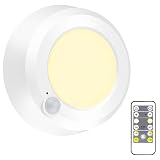
A battery-operated overhead option, such as the 5.6-inch wireless ceiling light format, is much smaller and more targeted. At around 300 lumens and running on batteries with a remote and timer, it is meant for closets, pantries, hallways, bathrooms, or laundry areas where you do not have or do not want to run wiring. It adds useful ambient light in a dark spot, but it is not a room-filling primary fixture.
A key light is completely different. It is a directional, front-facing light placed at or just above eye level, typically 10 to 18 inches in diameter for panel and ring styles or 12 x 8 inches to 20 x 14 inches for rectangular edge-lit panels. Most draw 10 to 45 watts, run on AC power or USB-C, and offer stepless dimming from about 10% to 100% brightness and color tuning from 2700K to 6500K. The stand or desk clamp puts the light 16 to 36 inches from your face, which creates soft, even illumination that overheads cannot replicate from above. The goal is not to light the room. It is to light you, remove under-eye shadows, add a catchlight to the eyes, and give you control over brightness and tone without changing the whole room.
In practice, this means overhead lighting controls the room and key lighting controls the subject. When you rely on overheads alone while on a webcam, the light comes from above your head. That creates shadows under the brows, nose, and chin, washes out skin tone if the color temperature is too cool, and forces your camera to boost ISO, which adds grain. A key light placed at 45 degrees off-camera fills those shadows and lets you keep overheads lower or warmer for comfort.
Pros
- Flattering face lighting: A front-positioned key light softens shadows and evens skin tone. It is the single biggest upgrade for video calls, streaming, and self-taped content, even in a room that already has bright overheads.
- Precise control: You can dial brightness in 1% increments and shift color temperature to match your skin tone and background. Most overheads offer only 3 to 5 preset levels, even when dimmable.
- Camera performance: More light on the face means your webcam or phone can use a lower ISO and faster shutter, which reduces grain and improves sharpness without you having to over-light the entire room.
- Eye comfort and flexibility: You can keep the overhead at a warm, dim 3000K and 30% brightness for a relaxed room while running the key at a neutral 4000K to 4500K for accurate color on camera. You do not have to blast the ceiling fixture to look good on screen.
- No installation for most models: Desk-mounted key lights clamp to a table edge or sit on a weighted base from 2 to 6 pounds and plug into a standard outlet or USB port. No electrician needed, and you can move it between rooms.
- Small footprint options: Compact 7 to 10-inch panels and 10-inch rings fit on a desk without taking much more space than a desk lamp, while still outperforming an overhead 8 to 10 feet away.
Cons
- Single-purpose value: If you are not regularly on camera, a key light sits unused. An overhead upgrade benefits everyone in the household every time the room is used.
- Desk and floor clutter: Even compact models add a stand, arm, or tripod. In small bedrooms or home offices under 100 square feet, that extra footprint matters, and cable management becomes an issue.
- Glare and reflections: A bright panel aimed at your face can reflect in glasses, monitors, and windows behind you. You will spend time angling it to avoid hot spots.
- Power and heat: Larger 18-inch rings and 20-inch panels draw 30 to 45 watts continuously and can add noticeable warmth in a closed room during long sessions. Battery-powered ceiling pucks avoid wiring but need recharging every 30 to 90 days with moderate use.
- Not a room solution: A key light does not replace ambient lighting. It lights a 2 to 4-foot zone in front of it. You still need an overhead or other ambient source so the background does not look like a dark cave on camera.
- Cost for quality: Usable LED key lights start around $35 to $60 for basic models and run $90 to $180 for larger, color-accurate panels with solid stands. Cheap no-name panels often have poor color rendering and flicker at low dim levels.
Who Should Buy It
You will get real, daily value from a key light if you fall into one of these groups:
Remote workers who spend more than 10 to 15 hours per week on video calls will see the fastest return. Clients and managers perceive you as clearer and more professional when your face is evenly lit, and you can keep your room lighting comfortable for the rest of the day. Content creators, tutors, coaches, and job seekers recording interviews will also benefit immediately, since camera quality is directly tied to front light intensity.
It also makes sense if your room has only one harsh overhead in the center of the ceiling, especially cool-white flush mounts at 5000K to 6500K that cast top-down shadows. A $45 to $90 key light lets you leave that overhead at a warmer, dimmer setting and still look natural on camera. People with glasses who can position the light slightly off-axis, or who choose an edge-lit rectangular panel specifically designed to reduce specular reflection, get better results than trying to compensate with a brighter ceiling fixture.
Who Should Skip It
Skip the key light if your priority is general room function. If you need better light for cooking, cleaning, reading, or getting dressed, put your budget into overhead or task lighting first. A 12-inch dimmable flush mount at $28.29 wired and installed in the center of the room will do far more for everyday usability than a directional panel on your desk.
Also skip it if you are on camera only occasionally, you work from a shared or very small space where a stand would be in the way, or you are renting and want the simplest, no-gear setup. In those cases, face a window for daylight calls and use a warm overhead plus a small desk lamp as fill. You can add a key light later if your schedule changes. For utility spaces like closets, hallways, pantries, or a windowless laundry, a wireless battery ceiling light in the $22.99 range that sticks or screws up in minutes and runs on a remote with a motion sensor and timer is more practical than any desk-mounted video light.
Cheaper Alternatives
If a dedicated key light feels like overkill, these options cover most needs at a lower cost or with less gear:
| Option | Cost | Trade-off |
|---|---|---|
| Wired dimmable flush mount ceiling light, 12-inch, 3000K-6500K with remote | $25 to $45 | Fills the whole room evenly but light still comes from above; cannot isolate and flatter the face without also lighting the entire space. Requires hardwiring. |
| Wireless battery ceiling light, 5.6-inch, 300 lumens with remote and timer | $18 to $30 | Easy peel-and-stick or screw install, no wiring. Good for small dark areas like closets and hallways. Too dim and too diffuse to act as a face key light for video. |
| Daylight from a window plus sheer curtain | $0 | Excellent soft front light when available. Inconsistent by time of day and weather; unusable at night and hard to control color and brightness. |
| Small LED desk lamp with adjustable color temperature | $20 to $40 | Can serve as modest fill light at 400 to 800 lumens. Beam is narrower and less diffused than a true key panel, so shadows are harder and coverage is uneven. |
| Compact 10-inch ring or panel key light | $35 to $65 | Closest to a true key on a budget. Smaller size means you must place it closer, 16 to 24 inches, to achieve softness, which can feel intrusive on a small desk. |
As of early 2026, LED efficiency and remote dimming have made both ceiling and desk options more affordable than they were a few years ago, so you can often solve ambient needs and camera needs separately without spending much more than a single premium fixture would have cost before.
FAQ
Can a bright overhead replace a key light for video calls?
Not really. Even a high-lumen flush mount at 3,000+ lumens sits 7 to 9 feet above you. The inverse square law means very little of that light reaches your face compared to a 400 to 1,200-lumen panel at 2 feet. Overhead light also comes from the wrong angle, so you get shadows under the eyes and chin. You can make it work in a pinch by dimming the overhead to about 40% and bouncing a desk lamp off a white wall, but it will not match the evenness of a front-facing key.
What brightness and color temperature should I use for a key light?
For most home offices with light-colored walls, start at 400 to 600 lumens effective at the face and around 4000K to 4500K for neutral skin tone. If your overhead is warm at 3000K, keep the key a bit warmer at 3800K to 4200K so your face does not look blue against the background. Dim until the brightest part of your forehead is not washing out on camera, then adjust temperature until white walls look white, not yellow or gray.
Where should I place a key light relative to my overhead?
Place the key slightly above eye level and 30 to 45 degrees to one side of your camera, 20 to 30 inches from your face. Keep the overhead on but dimmed behind or to the side of you so it lights the room and separates you from the background without competing with the key. Avoid putting the overhead directly behind you, which forces your camera to expose for the bright ceiling and darkens your face.
Is a wireless battery ceiling light worth it if I already have a wired overhead?
Yes, but for different rooms. A wired 12-inch flush mount is the workhorse for bedrooms, kitchens, and living areas. A 5.6-inch battery-operated puck at about 300 lumens is best as supplemental light where running wire is impractical, like inside a closet, over a laundry shelf, under a stairwell, or in a rental hallway. Think of it as task-ambient fill for tight spaces, not a substitute for either a primary overhead or a camera key light.
