
For most streamers, the real choice is not simply “which microphone sounds better?” It is “which microphone will make my voice sound clear in the room I actually have?” In an untreated bedroom, apartment living room, or multipurpose home office, the microphone has to work around hard floors, bare walls, computer fans, HVAC noise, street traffic, pets, and other people in the house.
Condenser microphones can sound open, detailed, and polished, especially when the room is quiet and controlled. Dynamic microphones are often more forgiving when your space is not. The best option depends on how close you can sit to the mic, whether you can control background noise, and how much desk space and gear you want to commit to streaming.
As an Amazon Associate we earn from qualifying purchases at no extra cost to you. Product prices and availability are accurate as of the date shown and are subject to change.


One quick shopping note: an audio condenser microphone is completely different from an automotive A/C condenser. Listings such as the AUTOSAVER88 A/C Condenser for Altima and Maxima at $58.99 or the A-Premium Air Conditioning Condenser for Chevrolet and GMC at $111.99 are vehicle cooling parts, not streaming equipment. For streaming, look specifically for USB or XLR audio microphones.
Top 3 picks at a glance
Quick Verdict
Choose a dynamic microphone if you stream in an untreated room, share your home with family, live near traffic, use a mechanical keyboard, or cannot place acoustic treatment on the walls. Its lower sensitivity generally helps prioritize your voice when you work close to the microphone—usually about 2 to 5 inches away.
Choose a condenser microphone if your room is already relatively quiet, you can add rugs, curtains, bookcases, and soft furnishings, and you want more detail for soft-spoken commentary, singing, voice-over work, or acoustic instruments. A condenser is not automatically “better”; it is simply more revealing. In a reflective room, that can mean more room sound along with more vocal detail.
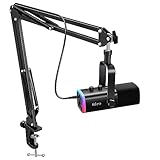
For the average home streamer in 2026, a USB/XLR dynamic microphone is the safer first purchase. A model such as the FIFINE AmpliGame AM8 USB/XLR Dynamic Microphone for Gaming Streaming, listed at $56.99, or the AM8T XLR/USB gaming microphone set at $67.99, represents the kind of accessible dynamic setup that makes sense for a desk-based streaming station. These are examples of the category rather than a verdict on any one microphone.
Side by Side
| Buying Factor | Condenser Microphone | Dynamic Microphone |
|---|---|---|
| Room-noise tolerance | More likely to pick up reflections, keyboard noise, fans, and distant voices. | Usually better at emphasizing a close voice over the surrounding room. |
| Comfort | Lets you sit roughly 6 to 12 inches away, depending on the model and gain. | Works best close—commonly 2 to 5 inches—so boom-arm positioning matters. |
| Durability | More delicate capsule; use care around drops, moisture, and rough handling. | Typically rugged and well suited to busy homes and frequent repositioning. |
| Typical price range | About $50 to $350 for common USB and entry-level XLR options. | About $40 to $400, with capable USB/XLR models often around $50 to $150. |
| Maintenance | Keep dry, covered when unused, and protected from dust and bumps. | Clean the grille and windscreen; generally less fussy for everyday use. |
| Space needed | Can sit on a 4- to 6-inch desk stand, though a boom arm still improves placement. | Often needs a boom arm extending 20 to 32 inches to stay close without blocking the screen. |
| Look | Often has a studio-style metal body, visible shock mount, and larger visual presence. | Usually offers a cleaner broadcast or podcast look, especially on a low-profile arm. |
| Resale | Recognizable studio brands can retain value, but cosmetic damage is more noticeable. | Durable broadcast-style models often resell well if the grille and cable connections are clean. |
| Power and connections | XLR condensers commonly need 48-volt phantom power; USB versions use computer power. | XLR dynamics usually do not need phantom power; USB versions use computer power. |
| Best for | Quiet, softened rooms; detailed voice-over; vocals; music recording. | Untreated room streaming, gaming, podcasts, shared homes, and noisy desktops. |
Where Condenser Wins
A condenser microphone wins when the room supports it. If your streaming room has carpet or a large rug, curtains over the windows, upholstered furniture, filled bookcases, and a door that closes, you may already have enough sound absorption to make a condenser practical. You do not need a professional vocal booth, but you do need to reduce the sharp reflections created by empty walls, laminate flooring, glass, and a bare desk.
The main attraction is vocal detail. Condensers can capture breathiness, softer consonants, subtle tonal changes, and a more airy top end. That can help a calm, quiet-speaking host sound present without having to lean in as closely. For creators who also record narration, tutorials, acoustic guitar, or vocals, one condenser can be a flexible centerpiece for the desk.
They also suit a visually considered home office. A compact USB condenser on a desk stand may occupy a footprint around 4 by 4 inches and stand 6 to 9 inches tall, making it simple to move between work calls and streams. A shock mount can reduce desk-bump noise, although it adds bulk. Expect many small condenser mics to weigh roughly 0.5 to 1.5 pounds before adding the stand or arm.
The trade-off is that a condenser does not know which sound you intended to capture. If the air conditioner clicks on, a dog shakes its collar in the hallway, or someone talks in the kitchen, the microphone may hear it. Software noise reduction can help, but it can also make speech sound processed or clipped when pushed too hard. Improving the room first is usually more effective than relying entirely on filters.
Where Dynamic Microphone for Untreated Room Streaming Wins
A dynamic microphone is the practical choice when your home has unavoidable noise. It generally needs more proximity and sometimes more gain than a condenser, but that close-mic approach is precisely why it works so well for streaming. With the microphone 2 to 5 inches from your mouth and slightly off to one side, your voice becomes much stronger relative to the rest of the room.
This makes a meaningful difference in small apartments. A dynamic mic will not erase a blender, barking dog, or construction outside, but it can reduce how prominent those sounds are compared with a sensitive condenser placed 10 inches away. It is especially useful if your desk faces a bare wall, your computer tower sits nearby, or you stream after other household members are asleep.
Dynamic mics are also better suited to energetic setups. If you move the boom arm for work calls, gaming, and streaming, a rugged metal-bodied microphone is reassuring. Many weigh around 0.7 to 2 pounds, so choose an arm rated for at least 2 to 3 pounds rather than a lightweight arm that slowly droops. A foam windscreen or pop filter helps control plosive “p” and “b” sounds, and costs roughly $5 to $25 if it is not included.
The main limitation is technique. You need to stay close and keep a fairly consistent distance. If you lean back 12 inches in your chair while talking, your voice can become quieter and the room can become more noticeable. Position the microphone just below or beside your mouth, angle it about 30 to 45 degrees off-axis, and avoid speaking directly into the capsule. That placement reduces breath blasts while preserving a natural voice.
Cost Over 5 Years
The microphone itself is only part of the budget. Over five years, an entry-level condenser setup may cost about $70 to $220 if you choose a USB mic, basic desk stand, and pop filter. An XLR condenser setup may land closer to $180 to $550 once you add an audio interface with 48-volt phantom power, an XLR cable, a boom arm, and a shock mount.
A dynamic USB setup can start around $50 to $150, plus $25 to $100 for a dependable boom arm. A dynamic XLR setup may cost approximately $140 to $500 with an interface, cable, arm, and windscreen. Some dynamics need a clean, higher-gain preamp; if an entry-level interface is too quiet, an inline gain booster can add roughly $70 to $150. That extra expense is not universal, but it is worth budgeting for before choosing a low-output XLR dynamic mic.
Room improvements can change the equation. A $40 to $120 rug, $30 to $100 in heavier curtains, and a $50 to $200 boom arm may do more for stream quality than jumping from a $70 microphone to a $250 one. If you rent, choose removable improvements: thick area rugs, movable clothing racks, full bookcases, and freestanding acoustic panels. Avoid treating microphone choice as a substitute for furniture and layout.
Which One for Your Home
Small apartment
Pick a dynamic microphone. Apartments concentrate noise from neighbors, appliances, shared walls, and street activity. Use a boom arm to bring the mic close without crowding a small desk, and keep the back or least-sensitive side aimed toward the loudest part of the room when your microphone’s design allows it. A USB/XLR dynamic gives you an easy computer connection now and a path to an interface later.
Family with kids or pets
Pick a dynamic microphone unless you have a separate, quiet studio. Children playing, pets moving around, and sudden household activity are hard to predict. The more focused close-speaking approach of a dynamic mic is easier to manage than trying to remove every interruption in post-production. Add a boom arm, foam windscreen, and a simple mute control within reach.
Rental
Usually choose a dynamic microphone, then spend modestly on portable room softening. A large rug, curtains, and a padded chair can reduce harshness without nails, adhesive panels, or permanent changes. If your rental is unusually quiet and already furnished with soft materials, a condenser can work well, but test your background noise before buying expensive accessories.
Long-term home
Choose based on the room you are willing to create. A dedicated office with a solid door, rug, curtains, and bookshelves can justify a condenser, particularly if you record music or voice-over. If the room will remain a shared gaming and family space, a dynamic is still the more reliable daily tool. Many established creators eventually own both: a dynamic for live streams and a condenser for controlled recording sessions.
FAQ
Can a condenser microphone work in an untreated room?
Yes, but it will usually capture more of that room. If your room is quiet and you place the microphone close, the result can still be good. Add a rug, curtains, soft furniture, and a boom arm before assuming you need a more expensive microphone.
Do dynamic microphones eliminate background noise?
No. They reduce the relative level of distant sound when used close to your mouth, but loud noises will still be audible. Good placement, sensible input gain, closed windows, and muting during breaks remain important.
Do I need an audio interface for a dynamic microphone?
Not if you buy a USB dynamic microphone. An XLR-only dynamic requires an interface or mixer. A USB/XLR model provides flexibility: connect directly to a computer first, then use XLR later if you want more control over gain and monitoring.
Should I buy acoustic foam before changing microphones?
Not necessarily. Thin foam squares mainly reduce high-frequency reflections and often do little for deeper room problems. Start with practical home items: a thick rug, curtains, upholstered furniture, a filled bookcase, and better microphone placement. For an untreated streaming room, a close-positioned dynamic microphone is often the stronger first upgrade.
Related guides
- Best Key Lights for Glasses Wearers on Budget: Tested and Ranked (2026)
- Best Condenser Microphones for Untreated Room Streaming: Tested and Ranked: 8 Tested (2026)
- Best Elgato Alternative Stream Decks for Twitch: Tested and Ranked: 8 Tested (2026)
- Bestnas Acoustic Treatment for Small Apartment Streaming: Tested and Ranked: 8 Tested (2026)


