
The Short Answer
No, you do not need a ring light if your streaming room is genuinely bright and your key light source is in front of you — but that one condition is where most people get it wrong. If your brightest light is a large window directly behind your monitor and illuminating your face evenly at eye level, you can skip the ring light. If your brightness comes from overhead ceiling lights, a window behind you, or a window to your side, you still need a dedicated front-facing light to avoid unflattering shadows, even in a sun-filled room.
A bright room makes everything visible, but it does not automatically make you look good on camera. Webcams and phone cameras need soft, diffused light hitting your face from the front to produce accurate skin tones and sharp focus. Without it, you will see dark under-eye shadows, blown-out background, and constant auto-exposure hunting as clouds pass. In short: brightness is not the same as good lighting direction.
As an Amazon Associate we earn from qualifying purchases at no extra cost to you. Product prices and availability are accurate as of the date shown and are subject to change.

What You Actually Get
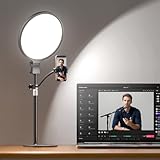
For streamers, podcasters, and remote workers considering a desk-specific option, the current category in 2026 is dominated by compact, clamp-mounted ring lights rather than large 18-inch floor models. Two representative examples illustrate what is on the market right now.
The Weilisi 10.2″ Desk Ring Light with Stand is built for tight desks. It features a 10.2-inch outer diameter ring, a C-clamp base that secures to desks up to about 2.5 inches thick, and an articulated arm with roughly 15 to 20 inches of flexible height adjustment and 360-degree rotation at the head. The arm itself allows you to swing the light over your monitor, angle it down for drawing or crafting streams, or push it flat against the desk when not in use. Weight is typically between 1.8 and 2.4 pounds including the clamp, and power draw is in the 10W to 12W range via USB, with on-board controls for stepless dimming and color temperature from around 3200K warm to 6500K daylight. Retail price is $39.99.
The second common type is the 1300 Lumens Ring Light with Stand for Desk, Computer & Laptop. Despite the name, this is still a desktop-scale unit, usually 9 to 11 inches in diameter, but it emphasizes output and color accuracy. The manufacturer rates it at 1300 lumens maximum with a CRI of 98+, which means colors render without the green or pink cast that cheaper LEDs produce. It includes a flexible gooseneck phone holder integrated into the center column, a weighted clip or clamp for laptop lids and monitors, and touch or inline controls for brightness and temperature. Expect similar USB power at 12W to 15W and a total weight under 3 pounds. Retail price is $45.98.
Both styles solve the same core problem for a bright room: they put a soft, controllable, front-facing source exactly where your camera is. They do not overpower the sun. Instead, they fill in the shadows the sun and ceiling lights leave behind and give your camera a consistent white balance target so your image stays stable when natural light fluctuates.
Pros
- Eliminates overhead shadows without adding clutter. Ceiling lights cast shadows downward that hollow out eyes and under the chin. A ring at eye level fills those shadows with soft, even light, which is the single biggest improvement for face-cam quality in a bright room.
- Locks exposure and white balance. A bright window causes your camera to constantly adjust. A constant front light at 5000K to 5500K gives the sensor a stable reference, so your skin tone stops shifting from warm to cool every time a cloud moves.
- Desk-native design saves space. A C-clamp or laptop clamp with a folding arm takes zero floor space. A 10.2-inch ring can sit 16 to 24 inches from your face and still provide effective fill, which is ideal for small home offices, dorm rooms, and gaming setups where a tripod stand is impractical.
- Precise control for video calls and recording. Stepless dimming from 10% to 100% and bi-color temperature let you match the ring to your existing room light rather than fighting it. You can dial it to 20% fill on a sunny afternoon or 70% key light on a gray morning without moving the hardware.
- Built-in content workflow. The central phone holder, 360-degree tilt, and adjustable height make these lights functional for streaming, podcasts, Zoom presentations, and overhead product shots without needing separate mounts.
- Low power and low heat. At 10W to 15W, these LEDs run cool for 4 to 6 hour sessions and can be powered from a laptop USB-A port, powered hub, or 5V/2A wall adapter without adding noticeable energy cost.
Cons
- Redundant if you truly have front-facing window light. If you stream with a large, unobstructed north-facing window directly behind your camera and within 3 to 5 feet of your face for most of the day, a ring light adds little and may create unwanted catchlights in glasses.
- Small diameter limits softness at distance. A 10-inch ring is soft at 18 inches, but at 36 inches it becomes a harder point source than a 14-inch or larger panel. If your desk is deep and you sit far back, you will need to run it brighter, which can cause eye fatigue.
- Reflection issues for glasses wearers. Rings produce a distinctive circular reflection in lenses and eyes. You can minimize it by raising the light 6 to 8 inches above eye level and angling it down 15 to 20 degrees, but you cannot eliminate it entirely without diffusion.
- Build is light-duty. Flexible goosenecks and plastic joints in the $35 to $50 range will droop over time if overtightened or overloaded with a heavy phone. They are not designed to hold a mirrorless camera or tablet.
- Does not fix a bad background. In a bright room with a window behind you, your face may be perfectly lit while the window is still blown out white. That requires repositioning your desk or adding curtains, not just a front light.
Who Should Buy It
You should buy a compact desk ring light for a bright room if any of these describe your setup:
You stream or take calls with overhead recessed lights as your main source. Even in a bright room, overhead light is the least flattering angle. A desk ring corrects it instantly. You are also a strong candidate if your window is to your side or behind you. Side light creates one bright cheek and one dark cheek on camera, and backlight turns you into a silhouette. A front fill at 30% to 50% brightness balances that ratio without blacking out the room.
It is also worth it if your schedule spans different daylight conditions. If you stream at 2 p.m. one day and 7 p.m. the next, you need a constant you can control, rather than relying on weather. Creators who record tutorials, craft close-ups, or beauty content where accurate skin tone and product color matter will benefit most from a high-CRI option in the $40 to $55 range, since the improved color rendering keeps foundation, fabric, and artwork from looking washed out or yellowed.
Finally, if desk space is tight and you need light plus a phone mount in one footprint, the integrated clamp-and-arm design is more practical than a separate softbox or panel.
Who Should Skip It
Skip the purchase if your desk already faces a large window that provides soft, indirect light straight onto your face for your entire streaming window. Test this properly: sit at your desk at your usual stream time, turn off all ceiling lights, and take a photo with your webcam. If your face is evenly exposed without harsh shadows and your camera is not struggling to expose both you and the background, you have adequate front light already.
You should also skip it if you already own a key light, such as a 12-inch or larger LED panel, softbox, or large ring with diffusion. Adding a second small ring will not improve quality and may create double catchlights. In that case, invest in light placement and diffusion instead of another fixture.
People who are highly sensitive to eye strain or who wear strong prescription glasses and are bothered by circular reflections may prefer a rectangular diffused panel placed off-axis rather than a ring directly around the lens.
Cheaper Alternatives
| Option | Cost | Trade-off |
|---|---|---|
| Reposition desk to face window + sheer white curtains | $0 to $25 for curtains | Free and most flattering when it works, but only consistent mid-day; light changes hourly and disappears after sunset |
| Large white foam board or reflector (20 x 30 inch) | $8 to $18 | Bounces existing window light back onto shadow side with no power needed; requires window light to bounce and careful placement to stay out of frame |
| USB LED panel or bar light clipped to monitor | $19 to $35 | Lower profile than a ring and less reflection in glasses; narrower beam and less even diffusion at close distance |
| Smart bulb in desk lamp with diffusion (frosted shade) | $15 to $30 | Uses lamp you already own and offers tunable color; shade must be large enough to soften light or shadows remain harsh |
| Floor tripod with 12-inch ring or softbox | $35 to $70 | More power and softer light for full-body or standing streams; consumes 2 to 3 square feet of floor space and not ideal for small desks |
If your bright room is bright because of a correctly placed window, the foam board reflector is the best $10 test before buying electronics. Place it just out of frame on the shadow side of your face and see if it lifts the dark side enough for your camera.
FAQ
Will a ring light make my bright room look overexposed?
Not if you use it as fill rather than a key. In a sunlit room, set the ring to a lower brightness, typically 20% to 40% in the afternoon, and set your camera exposure for the room first, then add just enough ring light to lift shadows. If the image looks washed out, dim the ring or move it back 4 to 6 inches rather than dimming the room. The goal is to match, not overpower, daylight.
What color temperature should I set in a bright, natural-light room?
Set the ring to 5200K to 5600K to match daylight from a window. If your room has warm ceiling bulbs at 2700K to 3000K and you cannot turn them off, set the ring to the same warm range so all sources match. Mixing warm ceiling light with daylight-balanced ring light creates uneven skin color that is difficult for auto white balance to correct. When possible, turn off warm overheads and let the ring plus window be your only sources.
Is a 10-inch ring big enough for streaming?
Yes for desk distances of 16 to 28 inches, which covers most webcam and laptop setups. At that range a 10.2-inch ring provides soft, even fill that is noticeably better than ceiling light alone. If you sit 36 inches or more from the camera, or you need to light two people, consider a 12-inch to 14-inch ring or a diffused panel. The larger source maintains softness over distance and covers a wider area without needing to run at 100% brightness.
Where should I place a ring light when I have a window in the room?
Place the ring directly behind or immediately above your camera, centered on your face, and keep the window to your front or front-side. Avoid placing the ring with a bright window directly behind you; that forces the camera to expose for the window and leaves you underexposed regardless of the ring. If you cannot move your desk, add light-filtering curtains to the background window to reduce the brightness gap between you and the background by 1 to 2 stops, then use the ring at eye level to bring your face up to match.
