
Choosing between a boom arm and a desk stand for a broadcast microphone is less about which one looks more “professional” and more about how you actually use your desk. A boom arm keeps the microphone close without forcing you to lean forward, frees valuable work surface, and can make a compact setup feel far more flexible. A desk stand is simpler, faster to set up, and often more stable for a microphone that stays in one spot.
The real decision is whether you want your microphone to move with your routine or remain a fixed part of your room. Streamers, remote workers, gamers, podcasters, and musicians may all use the same broadcast-style microphone, but their homes have different constraints: shallow desks, shared rooms, curious pets, rental-friendly furniture, and a preference for either a clean minimal look or a permanent studio corner.
As an Amazon Associate we earn from qualifying purchases at no extra cost to you. Product prices and availability are accurate as of the date shown and are subject to change.
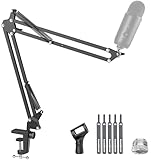

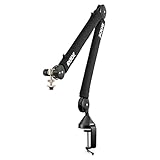
Top 3 picks at a glance
Quick Verdict
Choose a boom arm if you record or speak into a microphone regularly, need more clear desk space, or change between sitting, standing, gaming, and video calls. It is generally the more comfortable choice for sessions lasting over an hour because you can position the capsule roughly 4 to 8 inches from your mouth without crowding your keyboard or monitor.
Choose a desk stand for a broadcast microphone if you want the least complicated setup, have a stable dedicated desk, move equipment often, or do not want to clamp anything to your furniture. A weighted desk stand is also an excellent fit for short voiceovers, occasional meetings, and microphones stored away between uses.
For most permanent home studios, a boom arm is worth the upgrade. For flexible, low-commitment setups, a desk stand remains the practical value choice.
Side by Side
| Buying factor | Boom arm | Desk stand for broadcast microphone |
|---|---|---|
| Comfort | Highly adjustable; brings the mic to your mouth at the right angle. | Best when your seating position and microphone placement rarely change. |
| Durability | Good models last for years, but joints, springs, and clamps are moving parts. | Fewer moving parts; a steel stand and weighted base can be exceptionally durable. |
| Typical price range | About $25 to $150, plus possible adapters or cable accessories. | About $15 to $80 for most tabletop options. |
| Maintenance | May need screw tightening, clamp checks, and occasional cable repositioning. | Usually needs only dusting and an occasional check of the mounting thread. |
| Space needed | Uses desk-edge space and overhead clearance; often reaches 20 to 35 inches. | Uses surface area; many round bases measure 5 to 8 inches across. |
| Look | Studio-like, organized, and easy to keep visually uncluttered when cable-managed. | Simple and understated, though the base remains visible on the desktop. |
| Resale potential | Higher for premium recognizable arms in clean working condition. | Lower individually, though basic stands are easy to keep as backups. |
| Best for | Streaming, podcasting, frequent calls, gaming, and dedicated recording desks. | Occasional recording, portable setups, rentals, and shared desks. |
| Noise control | Can reduce keyboard and desk vibration when paired with a shock mount. | More likely to pick up bumps transferred through the desk surface. |
Where Boom Arm Wins
A boom arm wins first on ergonomics. Broadcast microphones work best when they are placed close to the speaker, often about 4 to 8 inches away, depending on the microphone’s pickup pattern and your voice. With a desk stand, that close placement can put the microphone directly between you and a monitor, keyboard, or notes. A boom arm lets the microphone come in from the side or above, leaving your sightline more open.
It also wins on usable desktop space. A desk stand’s base may occupy only 25 to 50 square inches, but that is often exactly where a laptop, keyboard, notebook, or mouse needs to go. A clamp-on arm typically needs a desk edge between roughly 0.4 and 2.4 inches thick, depending on the clamp design, while its base occupies little of the actual work surface.
Noise isolation is another meaningful advantage. A microphone on a rigid desk stand can capture vibrations from typing, setting down a coffee mug, bumping the table, or moving a keyboard tray. A boom arm does not eliminate noise by itself, but it moves the microphone away from the desk and works especially well with a shock mount. That combination is useful for mechanical-keyboard users, energetic gamers, and homes with hardwood floors where desk vibrations can be more noticeable.
Not all boom arms have to look bulky. Traditional scissor-style models are economical and practical, while low-profile arms tuck beneath monitor height and extend horizontally. The InnoGear Boom Arm Microphone Mic Stand for Blue Yeti Fifine HyperX, Black, at $24.99, represents the accessible end of the category. The FIFINE BM88 Low Profile Microphone Boom Arm Stand for Gaming Streaming, priced at $56.99, suits buyers who prefer a cleaner, lower visual line across the desk. At the premium end, the RØDE PSA1+ Professional Studio Boom Arm with Spring Damping, Black, at $112, illustrates why some buyers pay more for smoother movement and a more refined long-term finish.
Finally, a boom arm is better for multi-use rooms. If the desk is your office in the morning, gaming station at night, and occasional recording spot on weekends, you can swing the microphone out when needed and push it aside when you are done. That flexibility makes the room feel less like a permanent studio.
Where Desk Stand for Broadcast Microphone Wins
A desk stand wins on simplicity. There is no clamp to fit, no arm tension to adjust, and no concern about whether your desk is sturdy enough for an edge-mounted accessory. Place the stand on a stable surface, thread on the microphone or shock mount, connect the cable, and it is ready. For someone who uses a microphone for a few video meetings each month, that directness matters more than elaborate positioning.
It is also the safer option for certain furniture. Lightweight particleboard desks, glass tops, folding tables, and antique wood furniture may not be ideal for a clamped arm. Even when a clamp technically fits, pressure at one point can leave an indentation or create worry in a rental. A desk stand spreads its load across a broad base, particularly models with cast-metal or steel bases weighing roughly 1 to 3 pounds.
Portability favors the desk stand as well. A compact stand that folds down to 8 to 12 inches tall can move from a bedroom desk to a dining table, classroom, rehearsal space, or travel case. A boom arm is portable in theory, but removing the clamp, managing the cable, and readjusting the arm each time makes it less convenient.
Desk stands can also be more predictable with heavy microphones. A quality boom arm should list a weight capacity, and buyers should account for the microphone, shock mount, pop filter, and cable together. A microphone weighing 1.5 pounds can become a 2.5-pound load once accessories are added. A properly weighted desk stand avoids the balancing issue entirely, provided its base is wide enough and the microphone is not positioned too far off-center.
Cost Over 5 Years
Over five years, the cost difference is usually smaller than it first appears. A basic desk stand costs about $15 to $35, while a substantial weighted model may run $40 to $80. If it is kept indoors and the thread is not cross-threaded, it may need no replacement at all. Budget for perhaps $10 to $25 if you later add a small pop filter, thread adapter, or replacement clip.
A boom arm starts around $25, with many solid home-office choices landing between $50 and $100. Add $15 to $50 for a shock mount if your microphone does not include one. Over five years, a lower-cost arm may require a replacement if the clamp loosens, the springs become noisy, or the joints no longer hold a heavier microphone securely. A better-built arm can cost $100 to $150 upfront but may avoid that mid-cycle replacement.
In practical terms, expect a basic desk stand setup to total roughly $25 to $90 over five years. A boom arm setup can total around $45 to $200, depending on whether you add isolation accessories or upgrade once. Neither option uses electricity, so wattage and power consumption do not affect ownership cost. The deciding value is whether the ergonomic and space-saving benefits improve your daily routine.
Which One for Your Home
Small apartment
Choose a boom arm if your desk is also used for dining, studying, or crafts. A low-profile arm is particularly helpful on desks 20 to 24 inches deep because it keeps the microphone from consuming the limited surface in front of you. Choose a desk stand only if you store the microphone after each use or do not have a suitable desk edge for a clamp.
Family with kids or pets
A boom arm is usually the better fit because it keeps an expensive microphone, cable, and stand base farther from reaching hands, wagging tails, and accidental spills. Position it so the arm folds behind the monitor when not in use. If a desk stand is necessary, choose a low, heavy base rather than a tall narrow stand, and keep the microphone toward the back of the desk.
Rental
A desk stand is the lowest-risk choice for a rental, especially with delicate, glass, or inexpensive furniture. It requires no clamp pressure and leaves no possibility of a dent at the desk edge. If you prefer an arm, use a clamp with protective padding and check that the desktop is solid rather than hollow at the mounting point.
Long-term home
For a dedicated office, studio, or gaming room, invest in a boom arm. It creates a cleaner working zone and accommodates future changes, such as a larger monitor, a different microphone, or a new desk layout. In 2026, with more homes accommodating hybrid work and creator tools in the same room, flexible placement is often the feature buyers appreciate longest.
FAQ
Does a boom arm improve microphone sound quality?
Not directly. The microphone itself determines the core sound. However, a boom arm can help you maintain consistent mouth-to-mic distance and can reduce desk-borne vibration, both of which can make recordings sound more controlled.
Can a desk stand hold a heavy broadcast microphone?
Yes, if the stand has a sufficiently heavy, wide base and the microphone is mounted upright and centered. Check the stand’s stated capacity, and include the weight of a shock mount, pop filter, and any extension hardware before buying.
Will a boom arm fit every desk?
No. Measure the desktop thickness, the lip beneath the desk, and the clearance behind it before ordering. Many clamp arms fit tops around 0.4 to 2.4 inches thick, but drawers, cable trays, and structural supports can block the clamp.
Should I use a shock mount with a desk stand?
It is a smart addition if you type while recording, use a desktop with noticeable vibration, or have an easily bumped workspace. For quiet voice calls on a heavy, stable desk, it is helpful but not always essential.
Related guides
- Nas vs External Ssd for Footage Backup: Which Is Right for Your Home
- Condenser vs Dynamic Microphone for Untreated Room Streaming: Which Is Right for Your Home
- Best Key Lights for Glasses Wearers on Budget: Tested and Ranked (2026)
- Best Condenser Microphones for Untreated Room Streaming: Tested and Ranked: 8 Tested (2026)


