Shopping for 5.1 surround sound speakers is a different job from picking a soundbar. You are buying a front left, center, front right, two rear surrounds and a subwoofer, and the real question is how those six pieces get their power and their signal. Some systems bundle everything into a single powered set that plugs straight into a computer or console. Others expect an AV receiver, speaker wire and a willingness to place cables around the room. This keyword rewards buyers who pick the right category first and the brand second.
The six options here split cleanly into three groups: a plug-and-play desktop and living room set, complete speaker packages that still need a receiver, and a bundle that includes the receiver. They are judged on the details stated in their titles, such as speaker types, receiver features and subwoofer power. If you are building a first home theater in 2026, or upgrading from television speakers, the groups below will help you decide how much of the system you really need to buy at once.
Our Top Picks
Top 3 picks at a glance
Quick Picks
As an Amazon Associate we earn from qualifying purchases at no extra cost to you.


| Product | Best for | Key spec from the title |
|---|---|---|
| Logitech Z906 | Plug-and-play setups | 5.1, THX, Dolby, DTS, digital input |
| Yamaha YHT-4970U | Complete system with receiver | Atmos receiver, 4K120, 5 speakers, powered sub |
| Klipsch Reference 5.1 (R-620F) | Floorstanding fronts | 2 floorstanders, 12SW sub, 52C center |
| Energy Take Classic 5.1 | Compact full system | 200W subwoofer |
| Klipsch Reference Pack with Onkyo | One-box bundle | Onkyo TX-NR7100 9.2-channel receiver |
| Klipsch Reference 5.1 (R-625FA) | Home theater upgraders | 2 floorstanders, R-52C center, 2 R-41M |
How to Choose
Powered set versus passive speakers
A powered set such as a computer-style 5.1 system has amplification built into the subwoofer and needs only input cables. Passive speaker packs, like the Klipsch and Energy options, have no amplifier of their own, so you must add an AV receiver with at least five amplified channels plus a subwoofer output. Check this before comparing anything else, because it changes the real cost and the amount of gear you will own. It also decides how easily you can upgrade later: separate components can be replaced one at a time, while an all-in-one set is replaced as a whole.
Receiver features worth checking
If a receiver is involved, look for HDMI eARC, support for 4K at 120 hertz if you game on a modern console, and enough amplified channels to cover the five main speakers. A 9.2-channel receiver has room for later expansion, such as height speakers. Bluetooth is a convenience, not a quality factor, and a receiver without HDMI inputs for several devices will force you to swap cables.
Speaker size, room size and placement
Floorstanding fronts move more air and suit rooms larger than a typical bedroom, while bookshelf speakers need stands or shelves at ear height. The center channel carries most dialogue, so a model that matches the fronts in tone helps voices stay consistent. Rear speakers can be smaller, but they should still be mounted slightly above ear level and off to the sides.
Subwoofer power and where budget models cut corners
A subwoofer power figure like 200W is only a loose guide, because room size and driver quality matter as much. Budget systems usually cut corners on the cabinet material of the subwoofer, the quality of the included wire and the range of the center speaker. Ignore claims about total system watts and focus on the subwoofer, the center channel and the amplifier behind them. If the room is small, a smaller subwoofer placed carefully usually beats a large one pushed into a corner, and you can often fine-tune the result with the receiver’s distance and level settings.
The 6 Best Options
Logitech Z906
This is the plug-and-play choice for someone who wants a complete 5.1 set without buying a receiver. The title lists 5.1 surround, THX certification, Dolby and DTS decoding, a digital audio input and multiple-device setup, which describes a self-contained set that accepts several sources at once. That makes it attractive for a desk, a bedroom or a small living room where one person wants movies, games and music from different devices without a pile of components.
- Strength: Dolby and DTS decoding are built in, so a console or disc player can feed it directly through a digital input.
- Strength: THX certification appears in the title, signaling a standard for home theater sound.
- Trade-off: It is an all-in-one set, so you cannot upgrade individual speakers or the amplifier later.
Skip it if you want modern HDMI inputs, which the title does not list.
Yamaha YHT-4970U
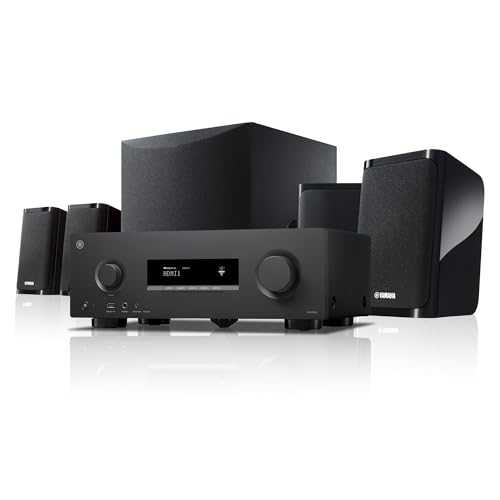
A strong fit for anyone who wants a boxed home theater with a modern receiver. The title lists a 5.1-channel system with a Dolby Atmos capable receiver, 4K120 and 8K video support, five speakers, a powered subwoofer, HDMI eARC and Bluetooth, so it covers current video standards. A buyer upgrading from television speakers gets both the receiver and the speakers without having to pair parts.
- Strength: The receiver supports 4K120 and 8K passthrough, which matters for current game consoles.
- Strength: Five speakers and a powered subwoofer arrive together, so there is no matching of parts.
- Trade-off: The title does not describe speaker size, so cabinet dimensions are worth checking.
Skip it if you prefer large floorstanding speakers.
Klipsch Reference 5.1 Home Theater Pack (R-620F)
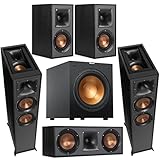
This package suits buyers who want a serious speaker foundation. The title lists two R-620F floorstanding speakers, a 12SW subwoofer, a 52C center channel and R-41M bookshelf speakers for surrounds, which is a classic Klipsch layout built around separate components. It rewards a buyer who is happy to choose a receiver separately and wants to keep the speakers for many years.
- Strength: Floorstanding fronts and a dedicated center channel give the front stage real presence.
- Strength: A named subwoofer model lets you research its specs before buying.
- Trade-off: Passive speakers need a separate receiver, which adds to the total system cost and complexity.
Skip it if you want a single-box solution with no receiver shopping.
Energy Take Classic 5.1
This one is for buyers who want a complete set with modest size and a clear subwoofer spec. The title lists a Take Classic 5.1 speaker system with a 200W subwoofer and describes it as a complete home theater package for surround sound, so it targets first-time builders who want a full surround layout from one box. It is the most modest package in this group in terms of stated hardware.
- Strength: The package is described as complete, with all five speakers and the subwoofer together.
- Strength: A 200W subwoofer is a stated figure, which helps with room-size planning.
- Trade-off: It will still need a receiver, since the title mentions only speakers and a subwoofer.
Skip it if you need a system that includes its own amplification.
Klipsch Reference Theater Pack with Onkyo TX-NR7100
This bundle is the answer for shoppers who want speakers and receiver together. The title lists a Klipsch Reference Theater Pack 5.1 plus an Onkyo TX-NR7100 9.2-channel receiver, which provides amplification and room to expand beyond five speakers. It is aimed at people who would rather buy everything in one go than research receiver compatibility on their own.
- Strength: The receiver and speaker pack arrive as one purchase, avoiding compatibility guesswork.
- Strength: A 9.2-channel receiver leaves room to add more speakers later.
- Trade-off: The title does not specify which speakers are in the pack, so confirm the contents.
Skip it if you want a compact setup, because this is the most expansive package here.
Klipsch Reference Series 5.1 Pack (R-625FA)
A fit for upgraders who want floorstanding fronts with matching center and surrounds. The title lists two R-625FA floorstanding speakers, an R-52C center channel and two R-41M bookshelf speakers, which makes it a similar philosophy to the R-620F pack with a different pair of fronts. It suits a living room that has space for tall speakers on either side of the television.
- Strength: Floorstanding fronts with a dedicated center and two bookshelf surrounds form a full 5.1 layout.
- Strength: Matched series naming suggests the pieces were designed to work together.
- Trade-off: The title as listed does not mention a subwoofer, so verify that one is included.
Skip it if you need a bundle with a subwoofer confirmed in the title.
Which One Fits Your Situation
You want to plug it in and be done
The Logitech Z906 is the simplest route. Its digital input and decoding mean a console, disc player or computer can feed it without a separate receiver, and the listed multiple-device setup means you can keep several sources connected at once.
You game on a current console
The Yamaha YHT-4970U lists 4K120 and 8K support plus HDMI eARC, which fits a high-refresh-rate console setup where video passthrough matters. Because the five speakers and the subwoofer come together, you only need to run the HDMI cable and place the speakers.
You care most about the front stage
Both Klipsch Reference packs with floorstanding fronts suit music and movies in larger rooms. The R-620F pack lists its subwoofer clearly, so it is the safer pick if you need all six pieces confirmed.
You want room to grow
The Klipsch bundle with the Onkyo TX-NR7100 includes a 9.2-channel receiver, which leaves space for height or extra channels later. If you want a smaller starting point, the Energy Take Classic 5.1 and its 200W subwoofer is the modest alternative.
Common Mistakes
- Buying a passive speaker pack without checking for a receiver that has five amplified channels and a subwoofer output, then discovering the extra cost afterward.
- Pairing floorstanding fronts with a tiny center channel, which makes dialogue sound thin by comparison.
- Skipping the receiver specs and discovering later that HDMI eARC or 4K120 passthrough is missing.
- Putting rear speakers at floor level instead of at or above ear height, which flattens the sense of sound moving around you.
- Judging a system by total watts instead of the subwoofer, center channel and amplifier quality.
Related guides
- When I Turn On Record Game In Background On Gamebar. Gamebar Crashes, What Do I Do?
- How To Reduce Background Noise On A Streaming Microphone
- Poly Computer Accessories Company Streaming Evaluation
Frequently Asked Questions
Do I need an AV receiver for 5.1 speakers?
Passive speaker packs need one, because they have no built-in amplifier. A powered set like the Logitech Z906 includes its own amplification and decoding, so no receiver is required. Wiring is limited to a few input cables, which suits renters and anyone who dislikes running wire along baseboards.
Is 5.1 still enough with Atmos around?
Yes, for most rooms. A 5.1 layout covers the front stage, dialogue, surrounds and bass, and a receiver with extra channels can add height speakers later if you want them.
Can I use these speakers with a computer?
Yes, with a few caveats. A powered set with digital input is the easiest option for a computer. Passive systems work too, but they need a receiver or amplifier between the computer and the speakers, and the computer must output multichannel audio over HDMI or a digital connection to use all six channels.
Should I choose floorstanding or bookshelf speakers?
Floorstanding fronts suit larger rooms and bigger sound, while bookshelf speakers save space but need stands. Match the center channel to the fronts so voices stay consistent across the front stage. If your room is under roughly 150 square feet, bookshelf fronts are usually plenty.