
The Short Answer
For most people starting a podcast, streaming channel, or home studio in 2026, USB is still the right call. XLR is worth it under one condition: you already plan to grow into a multi-piece setup — an audio interface, boom arm, and eventually multiple microphones — and you’re willing to spend an extra $80 to $200 beyond the mic itself to get there. If you just need better sound than your headset, a quality USB microphone delivers 90% of the result for half the money and none of the learning curve.
What You Actually Get
Let’s define the difference first. A USB microphone has the preamp and analog-to-digital converter built into the mic body. You plug it into your computer and it works. An XLR microphone outputs a raw analog balanced signal over a three-pin cable, which means the preamp, gain staging, and conversion all happen in a separate audio interface or mixer.
As an Amazon Associate we earn from qualifying purchases at no extra cost to you. Product prices and availability are accurate as of the date shown and are subject to change.

What does that buy you in practice?
Upgrade flexibility. Your microphone stops being the weakest link you’re stuck with. If you buy a $100 XLR dynamic mic today, you can feed it with a $130 interface today and a $600 preamp five years from now, and the mic keeps pace. A USB mic’s internal converters are frozen at whatever quality it shipped with.
Longer cable runs. Balanced XLR signals travel cleanly up to 200 feet. USB is generally reliable only to about 10 to 15 feet without active extension. If your mic lives across the room from your computer — common in voiceover and streaming setups — XLR solves this natively.
Multi-mic recording. Most USB microphones are mono, single-channel devices. The moment you want two people on separate tracks, or a mic plus an instrument, you need an interface anyway. At that point the USB mic’s convenience advantage disappears entirely.
Phantom power and pro accessories. XLR unlocks condenser mics that require +48V phantom power, plus the wider ecosystem of broadcast-grade dynamics used in radio studios.
What you don’t get is automatic sound quality. A $60 dynamic XLR mic through a budget interface will not outperform a well-designed $100 USB mic. The signal chain matters more than the connector.
Pros
- Future-proof signal chain. Upgrade your interface or preamp without replacing the microphone; the XLR connector has been the studio standard for decades and isn’t going anywhere.
- Lower latency monitoring. Quality interfaces offer direct hardware monitoring with round-trip latency typically under 5 milliseconds, which matters for recording while tracking playback.
- Long cable runs. Balanced XLR handles 100+ foot runs with negligible noise; USB struggles past roughly 15 feet.
- Multi-channel growth. Interfaces with 2, 4, or 8 inputs let you add mics, instruments, and guests on separate tracks.
- Better gain control. Physical gain knobs on interfaces give you precise, repeatable levels instead of hunting through software menus.
- Higher resale value. Pro-oriented XLR mics hold value better than consumer USB models.
Cons
- Hidden costs. Beyond the mic, budget roughly $100 to $250 for a competent interface (entry units run $100–$180), an XLR cable ($15–$30), a boom arm ($25–$60), and possibly a cloudlifter-style inline booster ($70–$150) if you choose a low-output dynamic mic.
- Steeper learning curve. Gain staging, phantom power, driver issues, and sample rate settings are all yours to manage. USB mics are plug-and-play.
- More desk clutter. An interface, cables, and power supply take up space and add points of failure.
- No single-purchase solution. You can’t throw an XLR mic in a bag and record at a friend’s kitchen table; you’re bringing the whole chain.
- Diminishing returns for voice work. For spoken word over video calls and streams, listeners rarely hear the difference between a good USB mic and a good XLR chain once compression and noise reduction are applied.
Who Should Buy It
Go XLR if you check at least two of these boxes: you record more than one sound source (two-person podcasts, vocals plus guitar, gaming plus separate chat mic); you want cable runs over 15 feet; you expect to upgrade your interface or preamp within a couple of years; or you’re doing client voiceover work where the extra headroom and monitoring control are billable skills.
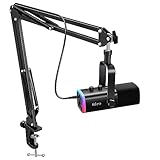
Hybrid mics make this decision easier than it used to be. Something like the FIFINE AmpliGame AM8 ($56.99) offers both USB and XLR outputs in one dynamic microphone, so you can start on USB today and switch to XLR when you buy an interface — no need to buy a second microphone. The AM8T set ($67.99) bundles the same hybrid design with accessories, which trims the add-on cost of going the XLR route later.
Who Should Skip It
Skip XLR if you’re a solo streamer or gamer who wants one cable and zero setup friction, if your total budget is under $150 for everything, or if you record mostly for Zoom calls and Discord where the platform’s own audio compression erases fine differences anyway. A dedicated USB mic — or the hybrid AM8 running in USB mode — will serve you perfectly well.
Cheaper Alternatives
| Option | Cost | Trade-off |
|---|---|---|
| Hybrid USB/XLR dynamic mic (e.g., FIFINE AM8) | $50–$60 | Start simple on USB, upgrade to XLR later without replacing the mic |
| Quality USB-only microphone | $70–$130 | Plug-and-play convenience, but no upgrade path and short cable runs |
| XLR mic plus budget interface bundle | $180–$280 total | Full upgrade flexibility at roughly double the entry price |
| Headset or conference mic | $30–$80 | Zero learning curve, but noticeably thinner, harsher voice quality |
FAQ
Do XLR microphones really sound better than USB?
Not inherently. Sound quality comes from the microphone’s capsule and the preamp/converter in the chain. A great USB mic beats a mediocre XLR mic every time. XLR’s advantage is flexibility and upgradeability, not automatic quality.
How much does a full XLR setup cost beyond the microphone?
Plan on $100 to $250 in supporting gear: an entry audio interface ($100–$180), an XLR cable ($15–$30), and a boom arm or desktop stand ($25–$60). Low-output dynamic mics may also benefit from an inline booster around $70–$150.
Can I use an XLR microphone without an audio interface?
Not directly into a computer. You need something to supply preamp gain and convert the signal — an audio interface, USB mixer, or an XLR-to-USB adapter. Hybrid mics with dual outputs are the exception, since they include USB conversion internally.
Is a hybrid USB/XLR microphone a good compromise?
Yes, and it’s often the smartest first purchase. You get plug-and-play USB today and a genuine XLR path for tomorrow. Models like the FIFINE AmpliGame AM8 and AM8T deliver this for $57 to $68, which is less than many USB-only microphones.

