
Setting up audio for streaming usually starts with one purchase: a microphone. The second decision is harder, because it shapes your whole desk. Do you plug that microphone into a simple XLR audio interface, or do you route everything through a USB mixer designed for streaming audio control? An interface like the Focusrite Scarlett Solo converts one mic cleanly and gets out of your way. A streaming mixer like the FIFINE Ampligame SC3 or PUPGSIS Gaming Audio Mixer puts faders, soundboards, and voice-changing effects at your fingertips. Both send audio to your PC over USB, but they solve different problems, and picking the wrong one costs you either money or flexibility.
This guide breaks down the tradeoffs in sound quality, control, desk space, and long-term cost so you can match the gear to the way you actually stream.
As an Amazon Associate we earn from qualifying purchases at no extra cost to you. Product prices and availability are accurate as of the date shown and are subject to change.


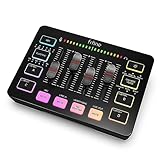

Top 3 picks at a glance
Quick Verdict
If you record solo with one microphone and want the cleanest possible sound per dollar, buy an XLR audio interface. The Focusrite Scarlett Solo line has been the default recommendation for years for good reason: preamps that outperform its price, a footprint under seven inches wide, and drivers that just work. If you stream with game audio, chat, music, and a mic all at once — and you want to adjust volumes live without opening software menus — a USB streaming mixer is the better control hub. Budget models start around $36, so the entry cost is lower, too.
The short version: an interface wins on audio quality and simplicity; a mixer wins on real-time control and versatility.
Side by Side
| Factor | XLR Audio Interface | USB Streaming Mixer |
|---|---|---|
| Comfort of use | Set gain once, forget it; changes happen in software | Physical faders and knobs for live mixing mid-stream |
| Audio quality | Generally cleaner preamps and lower noise at the price point | Good enough for streaming; more circuit stages can add slight noise |
| Price range | Roughly $100–$300 for solid 1–2 channel units | Roughly $35–$200; entry models well under $60 |
| Maintenance | Almost none; firmware updates occasionally | Faders and pots can collect dust; occasional contact cleaning |
| Space needed | Very small; about 1.6 x 5.8 inches for a Scarlett Solo | Larger; typically 8–12 inches wide to fit faders and pads |
| Look | Minimal, studio-style, understated | Flashy, with RGB lighting that suits gaming setups |
| Resale value | Holds value well; established brands sell used easily | Weaker resale; niche category with fast model turnover |
| Latency handling | Direct hardware monitoring with near-zero delay | Varies by model; many offer direct monitoring too |
| Extras | Focus on conversion quality, little else | Soundboards, voice changers, mute buttons, Bluetooth input |
| Best for | Solo streamers, podcasters, and voice-over work | Multi-source streamers who mix live |
Where Xlr Interface Wins
Pure audio quality per dollar. The Focusrite Scarlett Solo 3rd Gen at $119.99 delivers 24-bit/192 kHz conversion and a preamp with around 50 dB of gain — clean enough that most listeners hear the microphone, not the electronics. Moving to the 4th Gen at $159.99 adds roughly 9 dB more preamp gain (69 dB total), which matters if you run a lower-output dynamic mic like an SM7B-class model.
Simplicity. An interface has one job. Plug in the mic, set gain with one knob, and you’re done. There’s no routing matrix to learn, no companion app that updates and breaks your settings, and fewer failure points. For someone who streams a few nights a week and doesn’t want a second hobby in audio engineering, that matters.
Longevity and resale. Interfaces from established brands hold value remarkably well. A used 3rd Gen Solo typically resells for $70–$90, and 2-in/2-out interfaces have been essentially standardized for a decade, so nothing about the format is going obsolete. USB-C is now the standard connection on current models, keeping them future-proof through at least the rest of the decade.
Desk real estate. At roughly 1.6 x 5.8 inches and under 1.2 pounds, a Solo disappears beside a monitor arm or mounts under a shelf. If your desk doubles as a work-from-home station, that’s a real advantage.
Where Usb Mixer for Streaming Audio Control Wins
Live control without software diving. When your game gets loud during a tense moment, a physical fader lets you duck your mic or game audio instantly. The FIFINE Ampligame SC3 at $52.99 includes an independent fader layout plus individual gain and volume controls, so every source gets a dedicated hand position. No Alt-Tabbing, no menus.
Built-in entertainment features. Streaming mixers ship with soundboards, effect buttons, and voice changers out of the box. The PUPGSIS Gaming Audio Mixer, at $35.99, includes a soundboard and voice changer aimed directly at creators who want to entertain chat rather than chase audiophile fidelity. Getting that feature set from separate hardware would cost several times more.
Multi-source routing. A streaming mixer typically accepts your mic, game audio, music, and a chat app simultaneously, with separate outputs for what you hear versus what your audience hears. Replicating that with a basic interface requires virtual audio cable software and a steeper learning curve.
Lower cost of entry. At $35–$55, budget streaming mixers cost less than half of even the cheapest quality interface. For a streamer testing whether the hobby sticks, that’s a meaningful difference.
Set dressing. RGB lighting and a control surface look the part on camera. If your stream’s aesthetic leans gaming rather than studio, a mixer reinforces it.
Cost Over 5 Years
XLR interface route: Start with a Scarlett Solo 3rd Gen at $119.99, or the 4th Gen at $159.99 if you plan to run a gain-hungry dynamic mic. Add an XLR cable ($15–$25) and a boom arm ($25–$60). Total first-year cost lands around $160–$245. Over five years, expect zero to one firmware update and no replacements — these units commonly run a decade. Effective cost: roughly $35–$50 per year, and you can typically recoup $70–$90 at resale.
USB mixer route: A PUPGSIS at $35.99 or SC3 at $52.99 gets you started, and most units include needed cables. First-year cost: $36–$55 plus a boom arm if your mic needs one. The catch is upgrade churn — budget mixers tend to be replaced rather than repaired, and faders wear with heavy use. Assume one replacement or upgrade within five years for a daily streamer. Effective cost: $18–$25 per year, but with lower resale recovery, call it $20–$30 per year all-in.
Interestingly, the cheaper category isn’t always cheaper long-term if you outgrow it. Many streamers buy a budget mixer, then add an interface eighteen months later — ending up with both expenses.
Which One for Your Home
Small Apartment
Space and neighbors both argue for an interface. The Scarlett Solo’s 1.6-inch depth fits the narrowest desk shelf, and its clean preamps let you use a dynamic mic that rejects room echo in an untreated apartment. Put the savings from skipping a mixer toward acoustic panels.
Family with Kids or Pets
Downstairs-facing knobs and faders are irresistible to small hands and gravity-bound paws. An interface mounted out of reach with gain set once survives this environment better. That said, a $35.99 PUPGSIS mixer is a low-stakes gamble if it does get knocked off the desk — budget mixers are almost disposable, which has its own logic in a chaotic household.
Rental
Neither option requires drilling or permanent installation, so the choice comes down to portability and value preservation. An interface keeps its resale value when you move and your setup changes. A mixer’s flexible routing also adapts well if you shift from a bedroom desk to a living room corner. Either works; the interface protects your investment better.
Long-Term Home
If you’re building a dedicated streaming corner that will evolve over years, start with the interface. A Scarlett Solo 4th Gen at $159.99 pairs with any XLR mic you’ll ever own, and you can add a separate streaming controller or mixer later without replacing anything. Seriouos hobbyists who know they’ll mix multiple sources live should just start with a mid-tier mixer in the $100–$200 range and skip the budget tier entirely.
FAQ
Can I use an XLR interface and a USB mixer together?
Yes, and many streamers do. The interface handles the microphone signal for quality, while the mixer manages game, chat, and music levels. It requires virtual audio routing software and more cable management, but it’s a common intermediate setup.
Do I need a mixer just to use an XLR microphone?
No. An XLR interface provides the preamp and conversion a mic needs. A mixer only becomes necessary when you want physical control over multiple audio sources at once.
Will a cheap streaming mixer hurt my audio quality?
Somewhat, but usually not enough for viewers to notice over a compressed stream. Most platforms process audio at 128–160 kbps, which masks the difference between a $40 mixer and a $150 interface more than you’d expect. The bigger gap is in preamp noise floor with quiet dynamic microphones.
What about phantom power?
Condenser microphones need 48V phantom power, which the Scarlett Solo provides on its XLR input. Not all budget streaming mixers do — if you own or plan to buy a condenser mic, verify phantom power is listed before purchasing a mixer.
Related guides
- Led Panel vs Ring Light for Streaming Glasses Glare: Which Is Right for Your Home
- Hard Drive vs Ssd for Long Term Footage Backup: Which Is Right for Your Home
- Acoustic Foam vs Polyester Panels for Streaming Room: Which Is Right for Your Home
- Stream Deck vs Keyboard Shortcuts for Scene Switching: Which Is Right for Your Home
