
If you’re stepping up from a USB microphone to XLR, you’ve probably already discovered that the interface market is crowded, confusing, and full of specs that sound important but aren’t. The most common mistakes are easy to spot: buying more inputs than you’ll ever use, spending money on phantom power “headroom” you don’t need for a single dynamic mic, or chasing 32-bit float recording when your actual bottleneck is a cheap boom arm. Others grab the cheapest box available, then wonder why their headset monitoring has audible hiss during a live stream. The truth is that for streaming and podcasting specifically, only a handful of factors genuinely affect your day-to-day result. This guide walks through what those are, then maps them against real products at different price points so you can spend exactly what your setup requires — and not a dollar more.
Top 3 picks at a glance


Decide These 3 Things First
Before comparing any products, answer these three questions. They eliminate half the market immediately.
As an Amazon Associate we earn from qualifying purchases at no extra cost to you. Product prices and availability are accurate as of the date shown and are subject to change.

1. How many XLR inputs do you actually need? A solo podcaster or streamer needs exactly one. A two-person podcast needs two. If you host a roundtable show with three or four in-studio guests, you need four — but resist the temptation to buy “just in case” inputs. Each extra input adds $30–80 to the price and physical bulk to your desk. The Focusrite Scarlett Solo covers one mic; the M-Audio M-Track Duo covers two; a four-input unit starts around $200.
2. What kind of microphone are you pairing with it? Dynamic mics like the Shure SM58 or MV7 need lots of clean gain (roughly 55–60 dB) because they output a weak signal. Condenser mics need 48V phantom power and far less gain. If you’re buying a budget interface for a low-output dynamic mic, check the maximum gain figure carefully — it’s the spec most often compromised in sub-$70 units.
3. What are you connecting to, and do you need mobile options? All four reference products here connect via USB to a PC or Mac. But if you also want to record to a phone or iPad — useful for remote guests or on-location episodes — you need explicit USB-C mobile support with appropriate power handling. The MAONO P2, for example, is marketed specifically for hybrid PC/phone/iPad use, which is rare at its $99.99 price point.
Size and Desk Footprint
Audio interfaces are small, but “small” varies meaningfully. Desktop units in this category typically measure between 4 and 8 inches wide and weigh between 0.8 and 2 pounds. The Scarlett Solo is famously compact at roughly 5.5 x 1.75 x 3 inches and about 1 pound, making it easy to mount behind a monitor or tuck beside a stream deck. Two-channel units like the M-Track Duo run around 6.9 x 4 x 1.9 inches — still desk-friendly, but you’ll want to account for cable bend radius behind the unit; leave 3 inches of clearance at the rear for XLR connectors, which protrude noticeably. If your desk is shared with a stream deck, microphone arm base, and lighting, measure your available surface before buying. A rule of thumb: budget 8 x 6 inches of clear space for any single- or two-channel interface, including cabling.
Build Material and Construction
Nearly every interface under $150 uses a painted steel or aluminum chassis with plastic end panels — and that’s fine. What matters more is the quality of the connectors and knobs, because those are the failure points. Look for metal XLR jacks with positive locking (a properly seated XLR should not pull out with a light tug), and gain knobs with light detente resistance rather than loose, free-spinning pots. Check whether the unit is bus-powered (draws power over USB, no wall brick needed) — all four reference products are, which means fewer cables and reliable operation on laptops. Avoid anything with a wall-wart power supply at this price tier unless it’s required for a feature you specifically need. Also note USB connector type: USB-C, as on the current Scarlett Solo 3rd Gen, is more durable and reversible than older Micro-B ports, which had a documented habit of loosening after a year of daily plugging.
Performance: Gain, Latency, and Monitoring
This is where your money actually goes. Three numbers matter:
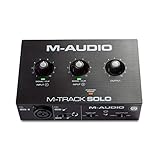
Maximum mic gain. Budget interfaces typically offer 50–57 dB; better ones reach 56–60 dB. If you use a low-output dynamic mic with quiet speech habits, aim for at least 56 dB so you’re not permanently pinned at maximum gain with noise creeping in. The Scarlett Solo’s 3rd Gen preamp spec sits comfortably in the right range for dynamic mics; some ultra-budget units like the M-Track Solo require pairing with a higher-output mic or an inline booster.
Latency. For streaming, you need to hear yourself in headphones without distracting delay. Anything under roughly 5 ms round-trip at a 48 kHz / 128-sample buffer feels instantaneous. All modern USB interfaces achieve this; the differentiator is driver stability on Windows. Focusrite and M-Audio both publish dedicated ASIO drivers, which is what you want for OBS.
Direct monitoring. Non-negotiable for live streaming. This routes your mic straight to your headphones with zero latency, bypassing the computer entirely. All four reference products include it, but verify any alternative you consider — some bare-bones units omit it.
Comfort note: if you stream for multi-hour sessions, prefer a large, smooth headphone volume knob you can adjust without looking, and a physical mic mute or monitor-mix control. Fumbling with software menus mid-broadcast is a real quality-of-life problem.
Price Tiers: What Each Level Buys You
Budget ($49–70): The M-Track Solo ($49) and M-Track Duo ($69) live here. You get solid converters, 16-bit/48 kHz-class audio that is indistinguishable from pricier units in a finished podcast, and direct monitoring. Compromises: lower max gain, plastic-heavy construction, and minimal bundle software.
Mid-range ($100–150): The MAONO P2 ($99.99) and Scarlett Solo 3rd Gen ($119.99). You gain better preamp headroom, USB-C connectivity, mobile-device support (P2), and stronger bundled software plus industry-standard driver support (Scarlett). This is the sweet spot for most streamers.
Premium ($200+): Four or more inputs, onboard DSP, loopback channels for mixing game and chat audio into your stream. Only worth it for multi-host shows or production-heavy streams.
Warranty and Support
Standard coverage in this category is a 1- to 3-year manufacturer warranty. Focusrite offers a 3-year warranty on the Scarlett line, which is notably above average and reflects confidence in the hardware. M-Audio typically provides 1 to 3 years depending on region — check the terms for your country before purchase. MAONO’s coverage runs about 12 months with support handled primarily through their direct channels. Whichever you buy, register the product immediately; warranty claims almost always require proof of purchase and registration. Also confirm replacement parts availability: a lost USB cable shouldn’t render a $120 interface useless.
Delivery, Setup, and First-Run Checks
Interfaces ship small and light (1–2 pounds boxed), so shipping damage is rare, but inspect the unit on arrival: knob shafts should feel firm, XLR jacks should grip a connector securely, and there should be no rattle when you tilt the unit. Setup is genuinely simple on all modern units — plug in USB, connect mic, select the device in your OS sound settings, and set OBS or your podcast software to the same device. Budget 30–45 minutes for your first session including driver installation and a test recording. If a unit requires more than that, something is wrong; bus-powered interfaces are designed for plug-and-play.
Spec Checklist
| Spec | Budget ($49–70) | Mid ($100–150) | Premium ($200+) |
|---|---|---|---|
| XLR inputs | 1–2 | 1–2 | 4+ |
| Max mic gain | 50–56 dB | 56–60 dB | 60+ dB |
| Phantom power (48V) | Yes | Yes | Yes |
| Direct monitoring | Yes | Yes | Yes |
| USB connector | USB-C or Micro-B | USB-C | USB-C |
| Mobile (phone/iPad) support | Rare | Sometimes (e.g., MAONO P2) | Common |
| Warranty | 1–2 years | Up to 3 years | 2–3 years |
| Weight | 0.8–1.2 lb | 1–1.3 lb | 2–4 lb |
Red Flags
- No direct monitoring. Software-only monitoring introduces lag that makes live streaming miserable.
- Maximum gain under 50 dB with a dynamic mic — you’ll hear hiss at high settings.
- Micro-USB or proprietary power connectors. Replacement cables get harder to find every year.
- Vague or missing gain specs. Reputable manufacturers publish preamp gain figures; if a listing doesn’t, assume the number is unflattering.
- “Studio quality” claims with no listed sample rate or bit depth. Anything marketed this way deserves scrutiny.
- Bundled software that requires paid subscriptions to be useful — free trials are fine, required subscriptions are not.
- Reviews mentioning USB dropouts within the first six months. This usually indicates a failing port or poor driver support and won’t fix itself.
FAQ
Do I need phantom power for a dynamic microphone?
No. Dynamic mics generate their own signal and are unaffected by 48V phantom power — leaving it on won’t harm most modern dynamics, but it isn’t needed. You only need phantom power for condenser microphones. Since virtually every interface includes it anyway, treat it as a given rather than a deciding factor.
Is a $49 interface really good enough for a podcast?
For finished, edited podcast audio, yes — the M-Track Solo will capture clean 24-bit recordings that listeners cannot distinguish from pricier hardware. Where budget units fall short is maximum gain (matters with low-output dynamics) and build durability under daily plugging and unplugging. If you record weekly or more, the $100–120 tier is worth the stretch.
Can I use an XLR interface with OBS for streaming?
Yes. The interface appears as a standard audio device; add it as an audio input source in OBS, enable direct monitoring on the interface itself for zero-latency self-monitoring, and install the manufacturer’s ASIO or Core Audio driver if you experience sync issues. Total setup time is usually under 15 minutes.
Should I buy an interface in 2026 or wait for USB-C standardization to settle?
Buy now if you need it. USB-C is already the dominant connector on new interfaces, and audio interfaces don’t follow fast upgrade cycles the way cameras or phones do — a well-chosen unit today will remain current for five to ten years. Waiting for “better” hardware costs you months of recording quality for marginal future gains.
