
The Short Answer
Do you need a boom arm for a heavy broadcast microphone? It depends on one condition: if your microphone weighs more than about 1.5 pounds and you plan to use it at a desk for more than an hour at a time, yes, you need a dedicated heavy-duty boom arm.
Standard mic stands and lightweight arms rated for 1 to 1.5 pounds will sag, drift, or transmit every desk vibration when paired with a true broadcast dynamic like an Electro-Voice RE20 (1.69 pounds / 26.4 ounces), Shure SM7dB (1.14 pounds but 1.7 pounds with mount), or Neumann BCM 104 (1.32 pounds). For these mics, a cheap arm is not just inconvenient, it risks tipping your desk mount and damaging the microphone. If you only record occasionally with a lighter condenser or you use a floor stand in a treated room, you can skip it.
As an Amazon Associate we earn from qualifying purchases at no extra cost to you. Product prices and availability are accurate as of the date shown and are subject to change.

What You Actually Get
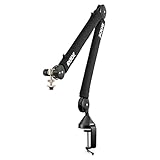
A heavy-duty broadcast boom arm is not the same as a $25 podcasting scissor arm. It is a counterbalanced, articulating arm designed to suspend 1.5 to 5 pounds of microphone and shock mount weight silently and stay exactly where you put it.
Here is what that means in practical terms for buyers considering models like the RØDE PSA1+ Professional Studio Boom Arm or the Shure by Gator Deluxe Broadcast Desktop Mic Boom Arm (SH-BROADCAST1) as of 2026:
Weight capacity and balance: Quality arms for broadcast mics are typically rated for 2.4 to 7 pounds. The RØDE PSA1+ is rated up to 2.42 pounds (1,100 grams) when properly tensioned, which covers an SM7B with mount plus a basic shock mount. The Shure by Gator SH-BROADCAST1 is rated up to 7 pounds, giving you headroom for heavier setups including large shock mounts, pop filters, and inline preamps like a Cloudlifter. Both use internal springs rather than exposed elastic bands.
Reach and rotation: Most professional arms offer 32 to 38 inches of horizontal reach and 33 to 36 inches of vertical reach with 360-degree rotation at the base and at the elbow. That is enough to swing the mic from an off-camera resting position to directly in front of your mouth without moving the clamp, and to fold flat against a desk when not in use. The PSA1+ provides a 33-inch horizontal reach and 34-inch vertical reach; the SH-BROADCAST1 extends to about 36 inches horizontally.
Mounting: Both include a heavy-duty desk clamp for desks 0.5 to 2.2 inches thick and a threaded desk insert for permanent installation through a 0.75 to 1 inch grommet hole. Clamp footprints are roughly 2 x 2.5 inches, but you need at least 2 inches of solid, flat desk edge to get a secure grip. Hollow IKEA-style desks may require the insert or a reinforcing plate.
Noise isolation: This is the primary reason broadcast arms cost more. Instead of simple friction joints, they use spring damping, precision bushings, and Neoprene dampers to decouple the mic from keyboard clicks, mouse thumps, and desk bumps. Cable management is also internal or along a channel with Velcro wraps, so the XLR cable does not slap against the arm or create leverage that pulls the mic out of position.
Threading: Both ship with standard 5/8-inch thread with a 3/8-inch adapter included, so they fit virtually any US broadcast shock mount and mic clip without extra hardware.
Pros
- Holds position without sagging. Internal spring tension and locking knobs keep a 1.5 to 3 pound mic exactly where you set it. No gradual drooping during a two-hour stream or podcast that forces you to hunch forward.
- Protects your desk and gear. A properly rated clamp distributes 7 to 10 pounds of leverage force safely. Lightweight arms can mar your desk edge, loosen over time, or tip over when a heavy mic is extended fully.
- Significantly less handling noise. Damped springs and rubber-isolated joints prevent vibrations from traveling up the arm into the microphone capsule, which is critical for sensitive broadcast dynamics that reveal every desk bump.
- Ergonomic placement. You can position a heavy mic 2 to 4 inches from your mouth at the correct 45-degree off-axis angle while keeping your desk clear for a keyboard, stream deck, and notes. No neck strain from leaning into a short desktop stand.
- Clean, quiet operation. Quality arms move silently with one hand and stay silent. No squeaks, clicks, or spring twang audible on mic when you reposition between segments.
- Long-term durability. All-metal construction with replaceable bushings typically lasts 5 to 10 years of daily use, versus 6 to 12 months for budget arms before joints loosen.
Cons
- Price is high for a mount. Expect to pay $99 to $130 for a true broadcast-rated arm. At $112 for the RØDE PSA1+ and $119.99 for the Shure by Gator SH-BROADCAST1, the arm can cost nearly as much as some microphones.
- Requires a sturdy desk. Clamping 3 pounds at 36 inches creates substantial torque. Thin, hollow-core, glass, or beveled-edge desks may flex, creak, or not clamp securely at all without reinforcement or drilling.
- Large footprint and permanent feel. Even folded, the arm occupies 4 to 6 inches of desk edge and adds visual bulk. It is not portable and takes 10 to 15 minutes to install and tension correctly.
- Overkill for lightweight mics. If you use a 0.5 to 0.8 pound condenser or USB mic, you are paying for weight capacity you will never use. A lighter arm will perform fine.
- Tension adjustments are required. You must adjust spring tension with an included Allen key or thumbscrew to match your exact mic weight. If you swap mics frequently, you will be readjusting each time.
Who Should Buy It
You should buy a heavy-duty boom arm if you fit any of these profiles:
Owners of classic broadcast dynamics: If you use an Electro-Voice RE20, RE320, Shure SM7B/SM7dB, Rode Broadcaster, or Neumann BCM 705, these mics were designed to be suspended. Their weight and side-address design make a boom arm the intended mounting method.
Daily podcasters, streamers, and voice actors: If you are on mic 5 to 20 hours per week at a desk, the ergonomic benefit and noise isolation alone justify the cost. Being able to push the mic away with one hand and bring it back to the exact same position is a workflow advantage.
Users in untreated rooms or shared spaces: If your desk is also your keyboard and mouse platform, a damped boom arm isolates the mic from surface noise far better than any desktop tripod that sits directly on the vibration source.
Anyone using additional inline gear: If you have added a shock mount (0.3 to 0.7 pounds), pop filter, and an inline activator, your total suspended weight easily exceeds 2 pounds even if the mic alone is lighter.
Who Should Skip It
You can skip a heavy broadcast boom arm if:
You use a floor stand or overhead rig: If you already have a proper floor-standing boom with a weighted base or a ceiling-mounted pantograph, you do not need a desk arm. Those solutions handle heavy loads better and keep your desk completely clear.
Your mic is under 12 ounces: Lighter condensers like the Audio-Technica AT2020 (12.2 ounces), Rode NT1 (10 ounces), or most USB mics do not generate enough torque to require spring damping. A well-reviewed $35 to $55 mid-range arm rated to 2 pounds will be stable enough.
Your desk cannot support it: If you have a glass desk, a standing desk with a thin beveled edge, or a rental desk you cannot clamp or drill, a heavy arm will do more harm than good. Use a low-profile desktop stand with an isolation pad or a separate mic stand behind the desk instead.
You record infrequently: If you record voice-overs a few times per month for less than 30 minutes, storing a heavy mic on a boom permanently may not be worth the expense or desk space.
Cheaper Alternatives
| Option | Cost | Trade-off |
|---|---|---|
| Budget Scissor Arm (rated to 2-3 lbs) | $25 – $45 | Holds lighter broadcast mics temporarily but sags with 1.7+ lb loads; exposed springs transmit noise and squeak; typically 28-30 inch reach; shorter lifespan. |
| Low-Profile Desktop Stand with Weighted Base | $30 – $60 | Extremely stable for heavy mics, no clamping needed; but picks up all desk vibrations and occupies 7-9 inches of desk space; puts mic too low without a riser. |
| Floor Mic Stand with Boom (tripod base) | $45 – $90 | Handles any broadcast mic weight safely and isolates from desk completely; but has a large floor footprint, harder to position precisely at a desk, and not ideal for small rooms. |
| Mid-Range Arm with External Springs | $55 – $85 | Supports up to 4 lbs for less money, but louder spring noise, bulkier look, and cable is usually external; requires more frequent retightening. |
FAQ
Will a heavy broadcast microphone break a regular boom arm?
It can damage a lightweight arm over time and may damage your desk. Most regular arms use a single weak spring and plastic joints rated for about 1.5 pounds. Suspending a 1.7-pound RE20 plus a 0.5-pound shock mount at full 30-inch extension exceeds that rating by 30 to 50 percent. The arm will slowly drift, the clamp will loosen, and the tilt joint can crack. If the mic falls, it can dent the mic, bend the grille, or pull your audio interface off the desk via the XLR cable.
What weight rating do I actually need?
Add the weight of your microphone, shock mount, and any attached accessory, then add 20 percent headroom. For example, an SM7dB at 1.14 pounds plus a Gator or Rycote shock mount at 0.6 pounds equals 1.74 pounds. You want an arm rated to at least 2.1 pounds. This is why the PSA1+ at 2.42 pounds is fine for that exact setup, but leaves little margin. If you plan to add a heavier mount later, the 7-pound rating of the SH-BROADCAST1 provides more future-proofing.
Can I use a boom arm with a standing desk?
Yes, but check your desk edge first. Many standing desks have a crossbar or a chamfered edge that prevents a clamp from getting a flat grip. Measure the thickness and material. You need 0.75 to 2 inches of solid wood, MDF, or bamboo. For hollow or thin tops, use the included threaded insert and drill a 0.75-inch hole, or add a 6 x 6 inch steel reinforcement plate under the clamp to spread the load. Also keep cables slack to allow 20 to 28 inches of vertical desk travel without tugging.
Does a boom arm improve sound quality?
Not directly, but it prevents sound problems. The capsule sounds the same regardless of mount. What changes is what the mic does not pick up: keyboard noise, desk bumps, and handling rumble. A damped broadcast arm with internal cable routing also lets you maintain the correct mic distance of 2 to 6 inches consistently, which has a larger impact on tone and proximity effect for broadcast dynamics than any mount alone. For heavy mics, isolation is essential to get the clean, low-end voice these mics are known for.
