
Most people shopping for a boom arm fixate on the wrong number. They look at the arm’s maximum reach or how cool it looks on a desk, buy it, and then watch their $400 Shure SM7B slowly sag until it rests on the desk. Choosing the wrong weight capacity is the most common and most frustrating mistake in microphone setup, and it is also the easiest to avoid if you understand what the numbers actually mean.
A second mistake is trusting the advertised capacity at face value without accounting for your full load. Your microphone’s weight is not just the mic itself. Add a shock mount, pop filter, and XLR cable, and you have added 4 to 10 ounces. A third mistake is confusing clamping strength with load capacity. An arm might hold 4 pounds in a lab, but if its desk clamp is weak or its joints use plastic friction locks, it will still drift under a heavy broadcast mic.
As an Amazon Associate we earn from qualifying purchases at no extra cost to you. Product prices and availability are accurate as of the date shown and are subject to change.


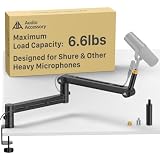
Getting weight capacity right is not about buying the strongest arm you can find. It is about matching the arm’s real-world holding power to your microphone’s true weight, your desk setup, and how you actually use the mic day to day. Here is how to do it correctly.
Top 3 picks at a glance
Decide These 3 Things First
Before you compare specs, lock in these three decisions. They determine what capacity range you should even be looking at.
1. What is your true loaded weight? Weigh everything that will hang on the arm. Look up your mic’s official weight, then add accessories. A bare Rode PodMic is about 1.87 pounds (850g), a Blue Yeti is about 1.2 pounds (545g), and a Shure SM7B is about 1.44 pounds (655g) without a mount but closer to 1.7 pounds with its included bracket and windscreen. A metal shock mount adds 0.3 to 0.6 pounds, and a pop filter adds another 0.15 to 0.25 pounds. If your total is over 2.2 pounds, you are in heavy-mic territory and need to filter for arms rated at 3.5 pounds or higher.
2. Where and how will you mount it? A C-clamp that needs a 0.75 to 2.25-inch thick desk edge behaves very differently from a through-desk mount or a heavy floor tripod. Low-profile arms sit closer to the desk and put less leverage on the joint, while overhead 35-inch arms create more torque and need higher capacity and stronger springs. If your desk is glass, particle board, or has a lip, you may need a weighted base or tripod stand instead of a clamp.
3. How much movement do you need? A podcaster who sets the mic once and leaves it can get by with a friction-lock arm. A streamer or gamer who swings the mic in and out dozens of times a day needs internal springs or concealed gas-spring mechanisms that hold position without constant retightening. More movement means you should buy 20 to 30 percent more capacity than your loaded weight to account for dynamic load when you reposition.
Size and Reach vs. Leverage
Reach directly affects how much stress your mic puts on the arm. This is basic leverage: a 1.5-pound mic at full horizontal extension exerts far more torque on the base and elbow joints than the same mic tucked close to the riser.
Most desk boom arms fall into three size classes. Compact or low-profile arms offer 18 to 22 inches of horizontal reach and about 28 to 32 inches of vertical reach. Standard arms offer 28 to 35 inches of horizontal reach. Extra-long or floor-standing tripod booms can reach 36 to 48 inches but rely on a tripod footprint of roughly 27 x 27 inches.
For weight capacity, shorter is more stable. If you have a heavy mic over 1.8 pounds, choose a low-profile arm with under 30 inches of reach unless you absolutely need the distance. That shorter lever arm lets the internal springs work well within their limit and prevents the slow downward drift that plagues longer arms carrying heavy payloads. If you need 34 inches of reach for a wide desk, step up to an arm rated for at least 4.4 to 6.6 pounds, even if your mic only weighs 2 pounds.
Material and What Holds the Weight
The advertised load capacity is meaningless if the materials cannot maintain tension. Focus on what actually holds the weight at each pivot.
Arm tubing: Look for powder-coated steel or aluminum alloy tubing with a diameter of 0.75 to 1 inch at the main sections. Thin-walled plastic or mixed-plastic arms flex under loads above 1.5 pounds and are a common reason for sag.
Springs vs. gas piston: Budget arms use exposed coil springs or elastic bands. They work for mics under 1.5 pounds but lose tension over 6 to 12 months with heavy use. Mid-range and premium arms use enclosed internal springs or a hydraulic gas-spring cylinder rated for thousands of cycles. An arm with internal springs will list its capacity as a range, for example 0.8 to 4.4 pounds, which means it can be tuned to counterbalance different weights. That adjustability is critical for heavy mics.
Joints and locks: The two failure points are the elbow joint and the base swivel. For mics over 2 pounds, avoid arms that rely solely on a hand-twist friction collar. You want a gear-lock, tooth-lock, or Allen-key tension system with metal-on-metal contact. A quality lock will hold its angle without requiring you to overtighten to the point of stripping.
Construction and Mount Stability
An arm is only as strong as its mount. Even a 6.6-pound rated arm will wobble if the clamp is poor.
C-clamp mounts: The standard for desks. A good clamp opens to at least 2.25 to 2.5 inches to fit most desktops, has a large surface pad of 2 x 3 inches or more, and includes a rubber or silicone gasket to prevent desk damage and slipping. Clamp inserts for thinner desks should be included. Expect a quality C-clamp to add 0.8 to 1.2 pounds of its own weight but provide the most rigid connection.
Through-desk or grommet mounts: Ideal for heavy mics because the bolt goes through a 0.4 to 0.6-inch hole and distributes weight vertically. If your desk has a cable grommet hole, this is the most sag-proof option for mics over 2 pounds and is worth drilling if you own your desk.
Weighted desktop or tripod bases: For renters or glass desks where clamps are not allowed, a tripod floor stand with adjustable height from 36 to 58 inches and a base spread of 26 inches or more is the stable alternative. These do not have a weight capacity issue in the same way, but check the boom’s own limit, usually 2 to 3.5 pounds.
Cable management also matters for capacity. Cables that hang freely add drag and pull. Arms with integrated cable channels or Velcro guides keep the XLR and USB cable weight centered along the arm instead of pulling down on the mic end.
Comfort and Performance in Daily Use
Weight capacity is not just about holding still. It is about how the arm feels when you move it and how quiet it stays.
Counterbalance and sag: A properly matched arm should hold position at any point in its arc without creeping after 10 seconds. If you let go and the mic drops even half an inch, the arm is underspec or its springs need tightening. Many mid-range arms include a tension screw at the elbow and base. Turn it clockwise in quarter-turn increments to increase holding force for heavier mics.
Noise: Undersized arms transmit more keyboard and desk vibration and create spring creaks when repositioned. Arms with internal springs and bushings rated for heavier loads tend to be quieter because they are not straining. Pair any arm over $35 with a shock mount to isolate handling noise, especially for condenser mics like the Blue Yeti.
Rotation and ergonomics: Look for 360-degree base rotation and at least 180 degrees of tilt at the mic end, plus 90-degree arm folding for storage. For streaming, a low-profile arm that folds flat to about 3 to 4 inches above the desk keeps sightlines clear when not in use.
Price Tiers and What Capacity You Get
Price correlates strongly with true holding power as we head into 2026, though branding can inflate cost without adding capacity.
Budget: $18 to $35. Typical rated capacity of 1.5 to 3.3 pounds. Tubing is thinner, springs are often exposed, and clamps are smaller. Fine for USB mics like the Blue Yeti, FIFINE models, or any mic under 1.4 pounds without heavy accessories. Do not use this tier for a Shure SM7B, SM7dB, Electro-Voice RE20, or Rode Broadcaster.
Mid-range: $40 to $70. The sweet spot for most creators. Rated capacity of 3.3 to 6.6 pounds, internal springs, metal gear locks, and larger C-clamps with desk protection. This tier reliably holds an SM7B with a shock mount and pop filter and offers tool-free or Allen-key tension adjustment. If you own one versatile arm for multiple mics, buy here.
Premium: $80 to $150+. Rated capacity of 4.4 to 8.8 pounds, gas-spring or dual-spring systems, all-metal construction, and through-desk mounting options. Buys you silent operation, lifetime spring tension, and the ability to hold heavy broadcast chains with a large shock mount and inline preamp like a Cloudlifter (adds 0.4 pounds). Worth it for daily professional use or mics over 2 pounds total load.
As a rule, buy an arm rated for at least 1.5 times your loaded mic weight. If your chain weighs 2 pounds, look for a 3-pound minimum rating. That buffer accounts for accessory creep and spring fatigue over time.
Warranty and Support
Warranty length tells you how much the manufacturer trusts its springs and joints. Budget arms typically offer 30 days to 12 months. Mid-range arms from established brands commonly offer 12 to 24 months. Premium broadcast-style arms often offer 3 to 5 years, sometimes limited lifetime on mechanical parts.
Check what is covered. Springs, gas cylinders, and clamp mechanisms should be explicitly included. Keep your receipt and note whether the warranty requires registration within 14 to 30 days. Also confirm availability of replacement parts: tension screws, clamp pads, and 3/8-inch to 5/8-inch thread adapters should be replaceable without buying a whole new arm.
Delivery and Assembly
Most boom arms ship in a box roughly 19 x 10 x 3 inches and weigh 2.5 to 4.5 pounds. Assembly is usually 5 to 15 minutes and requires no tools beyond an included Allen key, though some clamps need a Phillips screwdriver to secure the pad.
Before ordering, measure three things: desk thickness, clearance under the desk for the clamp screw (needs 4 to 5 inches), and distance from the mount point to your mouth. Verify the product lists thread compatibility. Nearly all mics and mounts use 3/8-inch or 5/8-inch threads, and a good arm includes both adapters in the box. If you plan to mount a heavy mic, assemble the arm on the desk first, then add the mic last to avoid tipping while you tighten.
Spec Checklist
| Spec | Budget | Mid | Premium |
|---|---|---|---|
| Advertised Load Capacity | 1.5 – 3.3 lbs (0.7 – 1.5 kg) | 3.3 – 6.6 lbs (1.5 – 3.0 kg) | 4.4 – 8.8 lbs (2.0 – 4.0 kg) |
| Recommended Mic Weight | Up to 1.4 lbs bare | Up to 2.2 lbs loaded | Up to 3.5 lbs loaded |
| Reach (Horizontal) | 18 – 28 in | 28 – 35 in | 28 – 35 in low-profile or 36 – 48 in tripod |
| Spring System | Exposed coil or elastic | Enclosed internal spring, adjustable | Gas-spring or dual internal spring |
| Joint Lock Type | Friction collar | Gear-lock / tooth-lock, metal | Precision gear-lock with tension dial |
| Mount Type Included | C-clamp only, up to 2.0 in | C-clamp + grommet mount, up to 2.5 in | C-clamp + through-desk + adapter set |
| Material | Mixed steel and plastic | All steel or aluminum alloy | Thick steel / aluminum, powder coated |
| Ideal For | Light USB mics, occasional use | Shure SM7B/MV7, Rode PodMic, Blue Yeti with accessories | EV RE20, SM7B + Cloudlifter + heavy mount, daily pro use |
| Price Range | $18 – $35 | $40 – $70 | $80 – $150+ |
| Warranty | 30 days – 12 months | 12 – 24 months | 2 – 5 years |
Red Flags
Walk away if you see any of these warning signs, regardless of price.
- No listed load capacity or a vague phrase like heavy duty without a number in pounds or kilograms. A legitimate arm always lists a specific range.
- Capacity listed exactly equal to a popular mic’s bare weight, for example 1.5 pounds for an SM7B setup that actually weighs 1.9 pounds loaded. That leaves zero margin and guarantees sag.
- Plastic elbow joints or plastic C-clamps on an arm claiming over 3 pounds. Metal is non-negotiable above that load.
- No mention of thread size or adapter. If 3/8-inch and 5/8-inch are not listed, you may be forced to buy parts separately.
- Customer photos showing droop, desk damage, or the arm held up with zip ties or rubber bands. This indicates spring failure at the advertised weight.
- Maximum desk thickness under 1.75 inches if you have a modern standing desk or butcher-block top. The clamp will not fit.
- Exposed springs with no tension adjustment screw. You cannot tune it as the springs stretch.
FAQ
How do I calculate the weight my boom arm needs to hold?
Add the official weight of your microphone to every accessory that hangs on the arm. Include the shock mount, pop filter, windscreen, and the portion of the XLR or USB cable that rests on the arm, typically 2 to 4 ounces. Then multiply that total by 1.5. For example, a 1.44-pound SM7B plus a 0.4-pound shock mount and 0.15-pound pop filter totals 1.99 pounds. Multiplied by 1.5, you should shop for an arm rated to at least 3.0 pounds. Round up to the next available rating, so a 3.3-pound or 4.4-pound arm is the safe choice.
Is a 6.6-pound capacity arm overkill for a Blue Yeti or other USB mic?
It is more than you need, but it is not a disadvantage. A higher-rated arm with internal springs will hold a 1.2-pound Yeti with zero drift and less need for tightening, and it gives you headroom if you later upgrade to a heavier dynamic mic. The trade-off is cost and sometimes a stiffer feel that needs the tension loosened for light mics. If you plan to keep the Yeti long term, a 2.5 to 4.4-pound rated arm is more than sufficient and often smoother to adjust.
Why does my boom arm sag even though my mic is under the rated weight?
Three common reasons. First, you are over the real loaded weight once accessories are added. Second, the arm is at full extension, which increases leverage beyond what the rating assumes at mid-extension. Try tucking the base closer or reducing reach by 4 to 6 inches. Third, the joints were not tensioned for the load. Tighten the elbow and base screws with the included Allen key in quarter-turns until the arm holds without drifting, and ensure the desk clamp is fully tight with the rubber pad seated flat.
Do I need a low-profile or a standard boom arm for a heavy mic?
For heavy mics over 1.8 pounds loaded, a low-profile arm is usually more stable on a standard 28 to 30-inch deep desk because it keeps the weight closer to the fulcrum and reduces torque. It also keeps the arm out of your camera frame for video. Choose a standard 30 to 35-inch arm only if you need to mount at the back edge of a large desk or share one mic between two people. In that case, prioritize an arm with a 4.4-pound or higher rating, internal springs, and a through-desk mount for rigidity.
