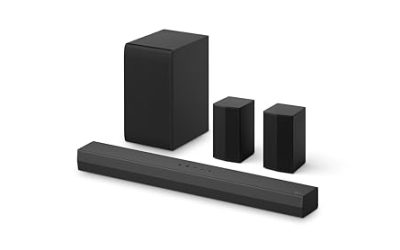
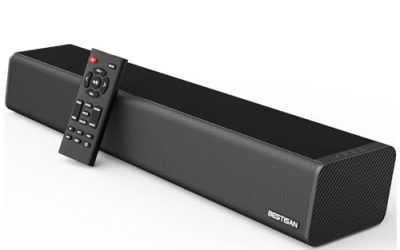
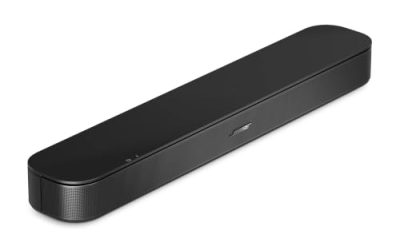
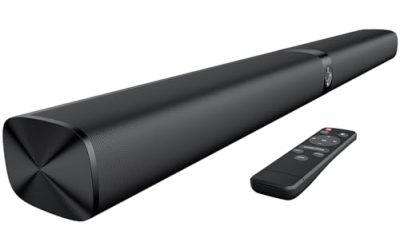
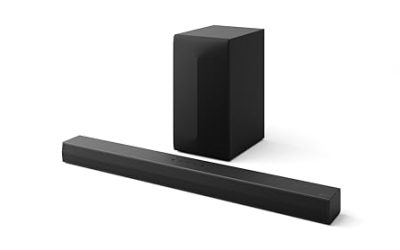
A 2.1 soundbar is the simplest upgrade you can make to a flat-panel television: two channels of stereo in the bar, plus a dedicated low-frequency channel handled by a subwoofer. The “2.1” label is a promise about layout, not about quality, and that is where shoppers get tripped up. Some 2.1 systems ship a separate wireless subwoofer that can sit across the room, while others fold the woofer into the bar itself. The right choice depends on how much floor space you can spare, how thin your walls are, and whether bass or dialogue matters more in your living room.
This guide is for buyers who want a clean, low-clutter step up from TV speakers without committing to a full surround setup, rear speakers or an overhead-height system. If you watch a mix of streaming shows, sports and the occasional action movie, and you want one bar, one sub and a single HDMI cable, the eight models below cover the realistic range for 2026, from compact desk-friendly bars to wall-shaking combos. Everything here is judged from the listed specs, since a spec sheet is the only thing two competing boxes reliably have in common.
Our Top Picks
Top 3 picks at a glance
Quick Picks
As an Amazon Associate we earn from qualifying purchases at no extra cost to you.




| Product | Best for | Key spec from the title |
|---|---|---|
| Samsung HW-B550F | Dialogue-focused TV watching | 2.1 ch, DTS Virtual:X, Voice Enhance Mode |
| JBL Bar 2.1 Deep Bass (MK2) | Big bass for movies and music | Wireless 6.5-inch subwoofer, 300W max output |
| LG S40T | LG TV owners | TV Synergy, Wow Interface, AI Sound Pro |
| LARKSOUND 2.1 | Tight spaces, no separate sub | 16-inch bar, built-in subwoofer, HDMI ARC |
| Toshiba C210WR | Feature-rich value pick | Dolby Audio, DTS Virtual:X, Bluetooth 5.4 |
| Creative Stage Pro | Desk or console setups | Dolby Audio, SuperWide, HDMI ARC |
| Philips B5306 | Roku TV owners on a budget | Roku TV Ready, 40W max power |
| Philips B5309 | Louder rooms | DTS Virtual:X, 240W max power |
How to Choose
Subwoofer: wireless, wired or built in
The defining decision in a 2.1 system is where the bass comes from. A wireless subwoofer, like the one listed with the JBL, LG, Toshiba and both Philips models, can sit beside a couch or in a corner, where low frequencies reinforce each other. It needs a power outlet, though, so plan for a cable run on that side of the room. A built-in subwoofer, as on the LARKSOUND, keeps everything in one chassis and removes the second box, but a woofer inside a 16-inch bar cannot move as much air as a standalone driver. Buyers in apartments often prefer the smaller footprint and quieter floor vibration; buyers with a dedicated living room usually want the separate sub.
Connections and TV compatibility
HDMI ARC is the connection to look for. It sends audio from the TV to the bar over one cable and lets your TV remote control volume. Several models here list it explicitly (LARKSOUND, Creative, both Philips). If a listing does not name it, confirm that the bar has an HDMI or optical input that your television can actually output, because a few older sets only offer optical. Bluetooth is a useful extra for streaming music from a phone; Toshiba lists Bluetooth 5.4, which is the newest version named in this group. Also match the bar to the TV brand when synergy features are advertised, such as LG TV Synergy, since those extras only work between compatible devices.
Processing modes and what they really do
Virtual surround labels such as DTS Virtual:X or Dolby Audio describe software that widens the soundstage from two front channels. They help in a modest room and do nothing to replace physical rear speakers. Treat them as a nice-to-have. Dialogue modes (Voice Enhance, Night Mode) and EQ presets are more practical day to day: a Night Mode that tames explosions helps in a shared home, and a clear-voice setting rescues mumbled streaming dialogue. Compare how many presets are listed (LARKSOUND names 4 EQ modes, Toshiba names 6) and whether the remote makes switching easy.
Power ratings, size and where budget models cut corners
Wattage figures are almost always peak or maximum numbers, so compare them only within one brand’s own lineup. A 240W maximum rating (Philips B5309) versus 40W (Philips B5306) tells you the first is built for a larger room; it does not tell you it is six times louder. Ignore headline wattage on its own and judge by driver and subwoofer size where listed, such as the 6.5-inch sub on the JBL. Budget 2.1 bars usually save money on cabinet material, remote quality and connection variety, so look for at least one digital input and a remote that controls volume without needing the TV.
The 8 Best Options
Samsung HW-B550F
This is a 2.1 channel bar with a subwoofer that adds DTS Virtual:X, Voice Enhance Mode, Bass Boost and Adaptive Sound to the usual stereo layout. It suits people who mostly watch talk-heavy content and want dialogue to sit above the background music in a show. The adaptive mode is meant to adjust output to what is playing, which saves fiddling with presets.
- Strength: Voice Enhance Mode targets spoken-word clarity directly.
- Strength: Bass Boost gives a quick lever when action scenes feel thin.
- Trade-off: The title lists no wattage figure, so judge loudness cautiously for a very large room.
Skip it if you want a room-filling party speaker or need a dedicated Bluetooth-focused music system; its feature list leans toward TV viewing.
JBL Bar 2.1 Deep Bass (MK2)
The headline here is the wireless 6.5-inch subwoofer paired with a 300W maximum output rating, which makes this the bass-first model in the group. It fits buyers who stream movies and play music from a phone, since Bluetooth is listed, and who have the floor space for a standalone sub.
- Strength: Larger wireless subwoofer than most bars in this tier.
- Strength: Wireless sub placement flexibility lets you avoid awkward cable runs across the room.
- Trade-off: The title names Bluetooth but no virtual surround format, so soundstage width is not advertised.
Skip it if you live in a thin-walled apartment where heavy low-end will bother neighbors, or if you want a feature list full of processing modes.
LG S40T
LG pairs a 2.1 channel bar and wireless subwoofer with TV Synergy, a Wow Interface and AI Sound Pro. It is aimed at households already running an LG television, where the matched software features make the most sense, and at people who want the set to handle sound adjustments with minimal menu diving.
- Strength: TV Synergy and Wow Interface target tight integration with a compatible LG set.
- Strength: AI Sound Pro suggests automatic adjustment based on the content.
- Trade-off: The title does not list HDMI ARC or Bluetooth, so confirm inputs against your TV.
Skip it if your television is another brand, because the synergy perks are the main reason to choose it over cheaper alternatives.
LARKSOUND 2.1 Sound Bar
At 16 inches, this is the compact option, with a built-in subwoofer and a 110W rating. It fits a bedroom, dorm or small den where a second box is a nuisance, and its list of 4 EQ modes, Night Mode and HDMI ARC covers the basics.
- Strength: One-piece design means no wireless sub to place or plug in.
- Strength: HDMI ARC and Night Mode cover everyday living-room needs.
- Trade-off: A woofer built into a short bar will not rumble like a separate 6-inch-class sub.
Skip it if you want cinema-level low-end or plan to use it in a large open room.
Toshiba C210WR
Toshiba stacks a wireless subwoofer with Dolby Audio, DTS Virtual:X, Easy Control, 6 EQ modes and Bluetooth 5.4. It is the “most boxes ticked” pick for shoppers who like having both major audio formats named on the spec sheet and a newer Bluetooth version for phone streaming.
- Strength: Both Dolby Audio and DTS Virtual:X are listed, which helps with varied sources.
- Strength: Six EQ modes give wide room for tuning.
- Trade-off: The title offers no wattage or HDMI ARC mention, so verify the connection you need.
Skip it if you prefer a brand with a long-established audio reputation and do not care about processing format labels.
Creative Stage Pro
Creative lists Dolby Audio, SuperWide, HDMI ARC, cinematic audio and deep bass with a subwoofer. It fits buyers who also use a desk or a console setup, where Creative’s focus on PC and gaming audio makes sense, and who still want a proper TV connection.
- Strength: HDMI ARC plus Dolby Audio covers modern TV hookups.
- Strength: SuperWide processing aims at a broader soundstage in tight spaces.
- Trade-off: The listing is truncated, so confirm subwoofer type and wattage before buying.
Skip it if you want a minimal, plug-and-forget box and do not care about processing modes.
Philips B5306
This is the modest-output model: 2.1 channel, wireless subwoofer, Bluetooth, HDMI ARC and a 40W maximum power rating, with a Roku TV Ready label. It suits small to mid-size rooms and Roku TV owners who want a simple pairing.
- Strength: Roku TV Ready branding signals a straightforward match with compatible sets.
- Strength: Wireless sub, Bluetooth and HDMI ARC all appear in the title.
- Trade-off: The 40W maximum rating is the lowest in this group, so it is a small-room choice.
Skip it if you have a large living room or like to turn the volume up for movies.
Philips B5309
The bigger sibling lists 240W maximum power, DTS Virtual:X, a wireless subwoofer, Bluetooth and HDMI ARC. It is aimed at buyers who found the B5306 too gentle and want more headroom without leaving the Philips family.
- Strength: 240W maximum power gives much more headroom than its sibling.
- Strength: DTS Virtual:X adds virtual width on top of the same connection set.
- Trade-off: Does not name the Roku-ready label, so smart-TV integration is less obvious.
Skip it if you are tight on space or only need background volume for a bedroom.
Which One Fits Your Situation
A small apartment with shared walls
Go with the LARKSOUND. Its built-in subwoofer and Night Mode keep the footprint small and the late-night volume sane, and HDMI ARC means one cable to the TV.
A large living room with movie nights
The JBL Bar 2.1 Deep Bass (MK2) with its 6.5-inch wireless sub and 300W maximum rating is the natural choice, with the Philips B5309 as a more feature-labeled alternative.
An LG television owner
Take the LG S40T. TV Synergy and Wow Interface only pay off between compatible devices, and that is the best reason to buy matched gear.
A Roku TV in a bedroom
The Philips B5306 is built for exactly this: modest output, wireless sub, HDMI ARC and the Roku TV Ready label.
Common Mistakes
- Treating peak wattage as a loudness guarantee and comparing it across brands.
- Forgetting that a wireless subwoofer still needs a wall outlet.
- Buying without confirming the TV has an output (HDMI ARC or optical) that the bar accepts.
- Expecting virtual surround labels to replace rear speakers.
- Putting the subwoofer in a cabinet or behind a couch, which muffles the bass.
Related guides
- When I Turn On Record Game In Background On Gamebar. Gamebar Crashes, What Do I Do?
- How To Reduce Background Noise On A Streaming Microphone
- Poly Computer Accessories Company Streaming Evaluation
Frequently Asked Questions
What does 2.1 actually mean?
The first number is the count of main audio channels, here left and right. The “.1” is a low-frequency channel, which a subwoofer reproduces. A 2.1 system has no rear or height channels.
Do I need HDMI ARC?
It is the most convenient connection because it carries audio over the same cable as your TV’s HDMI port and lets one remote control volume. If your TV only offers optical, a bar with an optical input works, but you may lose some convenience.
Is a built-in subwoofer enough?
For small rooms and casual viewing, yes. For action movies in a bigger space, a separate wireless subwoofer gives noticeably more low-end potential based on driver size.
Will virtual surround sound like real rear speakers?
No. Formats such as DTS Virtual:X widen the front soundstage through processing, which can help, but physical rear speakers still create a genuinely different sense of space.