
The best guitar wireless systems in 2026 are the Shure GLXD16+ for pedalboard-focused stage use, the Line 6 Relay G10S/G10SII for ultra-low latency and simple docking, the Boss WL-20/WL-60 for cable-free rehearsal with built-in cable tone simulation, and the Sennheiser EW-D and XSW-D for UHF stability in crowded RF environments.
As an Amazon Associate we earn from qualifying purchases at no extra cost to you.

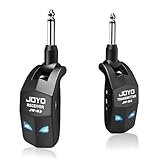


Top 3 picks at a glance
How to Choose: The 7 Specs That Actually Matter
Ignore marketing claims about “HD sound” and focus on measurable trade-offs. For rehearsal and stage use, these seven criteria decide whether a system stays transparent or gets in the way:
- Latency: Total time from string pluck to amp input. Anything under 4ms is imperceptible. Over 8-10ms starts to feel spongy, especially when combined with digital amps and pedals.
- Wireless range (line-of-sight vs. real stage): Manufacturers quote 50-100m line-of-sight. A real stage with bodies, walls, and Wi-Fi cuts that by 40-60%.
- Frequency band and stability: 2.4 GHz systems are license-free and globally usable but compete with Wi-Fi and Bluetooth. UHF systems like Sennheiser EW-D (470-550 MHz range, varies by region) avoid 2.4 GHz congestion but require frequency scanning.
- Battery life and charging method: Built-in lithium-ion vs. AA batteries changes your backup plan. Docking chargers are convenient, but AA means you can swap in 30 seconds mid-set.
- Connector fit: Strat-style recessed jacks, active pickups, and tremolo cavities reject bulky transmitters. Low-profile right-angle or cable-style transmitters solve this.
- Pedalboard usability: Does the receiver fit a standard pedalboard, power from 9V DC, and provide a tuner or buffered output?
- Tone preservation: How the system handles impedance, passive pickup loading, and cable capacitance simulation.
Head-to-Head Comparison: Top Systems for 2026
These are established product families still current and widely available in 2026. Specs are manufacturer-rated; real-world range will be lower.
| System | Band | Latency | Rated Range | Battery Life (TX) | Receiver Format | Best For |
|---|---|---|---|---|---|---|
| Shure GLXD16+ | 2.4 GHz (auto frequency management) | 4.0 ms | 30 m / 100 ft | Up to 12 hours (SB904 lithium-ion) | Pedal with built-in tuner | Touring pedalboards, interference-heavy venues |
| Line 6 Relay G10S / G10SII | 2.4 GHz (24-bit, FHSS) | 2.3 – 2.9 ms | 40 m / 130 ft | Up to 8 hours (built-in lithium-ion) | Desktop/pedalboard dock with cable tone switch | Low latency, plug-and-play rehearsal to club stage |
| Boss WL-20 / WL-20L | 2.4 GHz (14 channels, auto-select) | 2.3 ms | 15 m / 50 ft | Up to 12 hours (built-in lithium-ion) | Stompbox-size (no dock) | Simple rehearsal, small stages, no dock needed |
| Boss WL-60 | 2.4 GHz (14 channels + cable tone) | 2.3 ms | 20 m / 65 ft | Up to 25 hours (2x AA) | Pedalboard receiver with DC in | Players who want AA flexibility on pedalboard |
| Sennheiser EW-D Instrument Set | UHF (470-550 MHz, 56 MHz bandwidth, 2240 tunable frequencies) | 1.9 ms | 100 m / 328 ft | Up to 8 hours (BA 70 lithium-ion) / AA option | Half-rack / pedalboard mountable | Large stages, congested 2.4 GHz venues |
| Sennheiser XSW-D Instrument Base Set | 2.4 GHz (adaptive) | Under 4 ms | 75 m / 250 ft | Up to 5 hours (built-in lithium-ion) | Compact receiver, USB charge | Budget-friendly stage and content creation |
What the numbers mean on stage
Latency is additive. If your wireless is 4.0ms, your digital modeler adds 2.0ms, and you stand 5 meters from your amp (sound travels ~3ms per meter), your total is already ~9ms. That is why the 1.9ms of the Sennheiser EW-D and 2.3ms of the Boss and Line 6 systems matter more for digital rigs than for a simple tube amp setup. Range is also not just distance. A 30m-rated Shure GLXD16+ will reliably cover any stage, but its dual-antenna diversity and automatic RF management keep it linked when a 2.4 GHz crowd of phones and routers would drop a basic single-antenna system at 10m.
Tone Preservation: Impedance and Cable Tone
A passive guitar pickup expects to see a high-impedance load and the capacitance of a cable (typically 80-120 pF per meter). Cheap wireless systems buffer the signal to low impedance, which can make a passive single-coil sound brighter and harsher than with a cable.
Systems that preserve tone do one of two things:
- Transparent buffering: Shure GLXD16+ and Sennheiser EW-D present a consistent high-impedance input and flat frequency response from 20 Hz to 20 kHz, so your pedals and amp see the same signal as a short high-quality cable.
- Cable tone simulation: Boss WL-20/WL-60 and Line 6 Relay G10S include a switch to emulate the high-frequency roll-off of a 3m or 10m cable. Use OFF for true transparency with single coils if you want more sparkle, or SHORT/LONG if your presets were built with a cable and now sound too bright.
For active pickups (EMG, Fishman Fluence) or acoustic preamps, cable capacitance does not matter. Choose any system with headroom above +6 dBu input and set the transmitter gain so the loudest strum does not clip. The WL-20L and XSW-D offer a high-headroom variant specifically for active electronics.
Connector Fit and Guitar Compatibility
This is where many buyers get caught. The plug-in “stick” transmitters like the Line 6 Relay G10T and Boss WL-20 transmitter are wide and will not fit recessed Strat jacks, some Ibanez JS bodies, or guitars with side-mounted Electrosocket jacks. They also can hit a Strat tremolo arm or Les Paul pickguard.
Fix without buying another system:
- Use a short 10-15cm male-to-female extension cable from the transmitter to the guitar if your transmitter is the stick type. This adds negligible capacitance.
- For recessed jacks, choose a system with a bodypack transmitter and short instrument cable: Shure GLXD16+ (bodypack with TA4F), Sennheiser EW-D (bodypack with 3.5mm locking), or Boss WL-60 (bodypack with 1/4 inch).
- Check active electronics clearance: right-angle plugs often fit better than straight plugs on offset jack plates.
Pedalboard Usability and Power Budget
For rehearsal, a desktop dock is fine. For a live pedalboard, the receiver must run from your isolated supply and mute reliably.
Shure GLXD16+ and Boss WL-60 are true pedalboard receivers: standard 9V DC input (usually center-negative, 250-400 mA), buffered output, and tuner. Line 6 G10S can be board-mounted but ideally stays in its dock. The Boss WL-20 receiver is pedal-sized but charges via USB, not DC, so it cannot be power-chain integrated.
Worked calculation: Will your power supply handle a wireless receiver?
Before adding a receiver, total your board’s current draw. Most isolated supplies provide 500mA per 9V tap, or 2000mA total across 8 taps.
Example board: Tuner (35mA) + Overdrive (15mA) + Delay (150mA) + Reverb (180mA) + Shure GLXD16+ receiver (350mA) = 730mA total.
If your supply is rated for 1000mA total, you are within budget but you cannot share a single 500mA tap for the reverb and the receiver. Give the GLXD16+ its own 500mA tap, and put the low-draw overdrive and tuner on a shared tap. Exceeding a tap’s rating causes voltage sag, which on a digital receiver means dropouts, not just noise.
Battery runtime is also predictable: The Boss WL-60 on two 2500mAh AA NiMH batteries at ~110mA draw yields roughly 22 hours (2500mAh / 110mA = 22.7h). Alkaline AA at 2800mAh but higher internal resistance yields closer to 18-20 usable hours. Always carry a spare pair; lithium-ion systems like the Line 6 G10T cannot be swapped mid-show and must be fully docked for ~2 hours.
Frequency Stability in Crowded Venues
In 2026, every venue has 20+ 2.4 GHz networks. 2.4 GHz systems survive by frequency-hopping. Quality matters:
- Automatic management: Shure GLXD16+ scans and hops across the entire 2.4 GHz band without user action. This is why it costs more – usually $350-$500 range – but stays linked when a basic 2.4 GHz unit drops.
- Manual channel select: Boss WL-20 and WL-60 offer 14 channels with auto-select at power-on. If you get dropout, power-cycle to re-scan. Keep Wi-Fi routers at least 3m from the receiver.
- UHF advantage: Sennheiser EW-D avoids 2.4 GHz entirely. It scans UHF and finds a clean 200 kHz channel. In the US and EU this usually costs $500-$700 for a full set but is the most stable choice for festivals and corporate event venues with heavy Wi-Fi.
If you play mostly rehearsal rooms and bars with a single router, any modern 2.4 GHz system is fine. If you play hotels, conference centers, or festivals, prioritize UHF or Shure’s managed 2.4 GHz platform.
Decision Matrix: Match Your Situation to the System
| Your Situation | Pick This Class | Why |
|---|---|---|
| Home rehearsal, 1-2 guitars, no pedalboard | Boss WL-20 or Sennheiser XSW-D | Lowest setup time, built-in charging, cable-tone switch compensates for bedroom brightness. Usually $150-$250. |
| Pedalboard with tuner and 9V supply, club gigs | Shure GLXD16+ or Boss WL-60 | 9V DC powered, bodypack fits any guitar, tuner saves space, AA or SB904 means no mid-set charging panic. |
| Digital modeler (Helix, Quad Cortex, Kemper) + IEMs | Line 6 Relay G10S or Sennheiser EW-D | Lowest latency (1.9-2.9ms) keeps total latency under 8ms when stacked with modeling. |
| Crowded RF venue / playing near Wi-Fi walls | Sennheiser EW-D (UHF) | Escapes 2.4 GHz congestion entirely. Requires 30-second frequency scan. |
| Multiple guitars, fast swaps | Any bodypack system + extra transmitters | Leave a bodypack on each guitar; mute receiver while swapping. Stick transmitters require unplugging each time. |
| Active pickups or acoustic preamp | Boss WL-20L / Shure GLXD with pad | Higher input headroom prevents clipping on hot preamps. |
Setup for Zero Dropouts and Best Tone
Follow this order every time you power up:
- Scan first, then power amp: Turn on the receiver before the transmitter so it can find a clean channel, then engage the amp. This prevents pops.
- Place the receiver correctly: Keep it on top of your pedalboard, not on the floor behind it, with antennas vertical and line-of-sight to where you stand. Metal pedalboards block signal if the receiver is underneath.
- Set gain properly: Strum hard and watch the transmitter LED. Solid green is good, red is clipping. With Sennheiser and Shure, use the gain buttons to leave 6-12 dB headroom.
- Enable cable tone if presets sound harsh: If you built tones with a 6m cable, turn on cable tone emulation to match that darker response. If you built tones wireless, leave it off.
- Charge discipline: Lithium-ion transmitters lose capacity if stored empty. After rehearsal, return them to the dock. For AA systems, use quality NiMH and charge the spares the night before.
FAQ
Will a wireless system affect my tone vs. a cable?
A good modern system measures flat from 20 Hz to 20 kHz with under 0.05% distortion, so the difference is not frequency loss but impedance. With passive pickups and cable tone OFF, you will hear slightly more high-end. With cable tone ON, it is nearly indistinguishable from a 3m cable.
Can I use a guitar wireless for bass?
Yes, all systems listed cover 20 Hz to 20 kHz and handle bass. For 5-string low B, ensure the receiver is set to flat response and not a guitar-cab-sim output.
How many wireless systems can run at once?
On 2.4 GHz, expect 4-6 simultaneous systems from the same family before they compete. For a full band with multiple guitars and wireless mics, move mics and one guitar to UHF to split the load.
Is 2.4 GHz legal everywhere?
Yes, 2.4 GHz is license-free globally. UHF frequencies depend on country – Sennheiser EW-D lets you select the legal band for your region during setup.


