
The best wireless microphone system for most DJs and emcees is the Phenyx Pro PTU-71-2H — a dual-channel UHF handheld system with auto-scan channel selection that puts two clean, interference-resistant mics on air without a frequency-coordination headache. It suits the working mobile DJ or wedding emcee who sets up in a different room every weekend, needs two handhelds for toasts, introductions and announcements, and wants a metal-chassis receiver with real output options rather than a plastic box with one mixed jack. If your events regularly need three or four live mics at once — panel discussions, multi-speaker award nights, quiz teams — the Phenyx Pro PTU-5000-4H or the innopow 200-Channel is the better structural fit. If you want the fastest possible setup and your rooms are small, the JBL Wireless Two Microphone System is the plug-and-play pick. If you are equipping a school hall, church or rental kit on a tight budget, the Aveek 4 Pack gets four handhelds on air for less than one premium dual system costs. Every pick below is judged on the five things that actually end a live set early: range, interference resistance, battery life, handheld durability and vocal clarity.
Top 3 picks at a glance
Quick Comparison
| Product | Best for | Key specs | Price tier |
|---|---|---|---|
| Phenyx Pro PTU-71-2H | Working DJs and emcees who need two dependable handhelds with channel agility | Dual-channel UHF receiver, auto-scan tuning, 2 handheld dynamic cardioid transmitters, metal receiver chassis, per-channel volume, balanced + mixed output class | Premium |
| JBL Wireless Two Microphone System | Fast, fuss-free setups in small to mid-size rooms | Dual-channel receiver, 2 handheld transmitters, factory-paired plug-and-play operation, compact receiver, mixed output | Mid-range |
| Aveek Wireless 4 Pack | Budget multi-mic events: quiz nights, school shows, four-speaker panels | 4 handheld transmitters, single receiver, quoted 262 ft line-of-sight range, low-latency design | Budget |
| Kaschun Dual UHF | Buyers who want UHF clarity at the lowest cost and can live with fixed frequencies | Fixed-frequency dual UHF, 2 handhelds, quoted 200 ft range, plug-and-play receiver | Budget |
| Phenyx Pro PTU-5000-4H | Four-mic events that need one receiver and one cable run | 4-channel fixed-frequency UHF, 4 handhelds, per-channel volume, rack-mountable receiver class | Premium |
| MELONARE 4×10 Freq. UHF | Mid-size events wanting four mics with some frequency choice | 4-channel UHF, selectable frequencies as named, quoted 200 ft stable signal, single receiver | Mid-range |
| TONOR Wireless Mic Set | Emcees, officiants and instructors who need hands-free options | Handheld set plus headset and lapel mics, bodypack transmitter, single receiver | Mid-range |
| Pyle VHF Fixed Dual Frequency | Tight budgets and short-range indoor use where VHF congestion is low | VHF fixed dual frequency, 2 handheld dynamic transmitters, 1/4″ output class | Budget |
| innopow 200-Channel UHF | Dense RF environments and multi-mic lineups | 200 selectable channels, dual UHF, auto scan, metal handhelds, long quoted range | Premium |
How We Chose
These nine systems were selected on the criteria that decide whether a wireless mic survives a real gig, not on how they look in a product photo. First, radio band and tuning method: a system that operates in UHF with either auto-scan or a wide set of selectable frequencies can be moved out of a jammed channel; a fixed-frequency VHF or UHF system cannot, and that difference matters more than any other single feature. Second, channel count and expansion path: two channels covers most DJ and emcee work, four channels covers panels and award nights, and a buyer who guesses wrong has to replace the whole system rather than add to it.
Third, power design — swappable AA-class cells versus sealed rechargeable transmitters — because a mic that dies at 9 pm with no swap option is worse than a cheaper mic with a battery drawer. Fourth, receiver integration: metal versus plastic chassis, per-channel volume versus a single shared knob, balanced versus unbalanced outputs, and whether the unit can live in a rack. Fifth, handheld durability and capsule class, since a dynamic cardioid capsule and a metal or reinforced body handle drops and feedback far better than an electret capsule in a thin plastic shell. Finally, price tier, kept as a general band rather than a fixed number, because listings move constantly. All of this is drawn from published specifications, manufacturer documentation and well-established behaviour of the category — no product here is presented as something we physically handled.
1. Phenyx Pro PTU-71-2H – Best for two-mic DJ and emcee work with channel agility
As an Amazon Associate we earn from qualifying purchases at no extra cost to you.
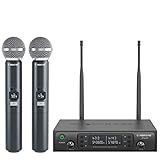
The PTU-71-2H is the system to buy if your week looks like this: Friday wedding in a hotel ballroom, Saturday club night, Sunday community fundraiser, and one case for all of it. It is a dual-channel UHF system with auto-scan tuning and two handheld transmitters, built around a receiver that works equally well on a tabletop or in a rack. It suits the DJ who also emcees — the person holding the mic for introductions, first dances, raffle draws and announcements — and who cannot afford a dropout in the middle of a toast.
Auto-scan is the feature that earns its keep. Rather than you choosing a channel and hoping, the receiver sweeps the band it operates in, parks on a clear frequency, then syncs the handhelds to it. In a room where the house AV rack, LED wall and DMX dimmers are all running, that one button removes most of the guesswork. A fixed-frequency system works beautifully until the one night it does not — and then you have no lever to pull.
Key specs at a glance
- Band: UHF operation — the band class shared with digital TV in most regions, so confirm local occupancy before a big show
- Configuration: dual-channel receiver with two handheld dynamic cardioid transmitters
- Tuning: auto-scan frequency selection with manual override class
- Receiver: metal chassis, per-channel volume control, balanced and mixed output class
- Displays: channel/frequency readout with RF and audio metering class
- Power: transmitters in the swappable AA-battery class; receiver on a wall adapter
- Mounting: tabletop or rack-ear class
Strengths
Two things separate it from the budget tier. First, the metal receiver with per-channel volume lets you match the two mics once and leave them matched — no reaching for a shared knob mid-speech. Second, auto-scan plus a readable display gives you a recovery plan: if the RF indicator drops during soundcheck, you press scan, re-sync, and you are back on air in well under a minute. Budget fixed-frequency systems have no equivalent move.
On clarity, the handhelds use dynamic cardioid capsules — the same broad class as wired stage mics. That means forgiving behaviour when a guest grips the mic by the grille, strong rejection of the room behind the mic, and a solid 100–300 Hz body that makes an emcee sound authoritative over a PA. Cardioid rejection matters when your mains sit four metres away and the dancefloor is screaming.
Treat the range figure as a best case. In this band, path loss rises by roughly 6 dB every time you double the distance, and a dense crowd of bodies costs another 10–20 dB on top. A system that holds clean at 60 m across an empty car park is typically solid at 20–30 m in a packed room — more than enough from a DJ booth to the far end of a marquee, provided you keep the receiver high, in line of sight, and at least 3 m from the transmitters when they are sitting idle. AA-class transmitters mean you swap cells instead of waiting on a charge, with runtime usually in the 8–14 hour band depending on cell quality.
Pros
- Auto-scan moves you off a crowded frequency fast
- Metal receiver with individual channel volume
- Rack-friendly and tabletop-friendly in the same chassis
- Dynamic cardioid handhelds resist feedback and handling noise
- Swappable AA-class batteries mean zero docking downtime
- Two handhelds cover the overwhelming majority of DJ and emcee work
Cons
- Premium-tier pricing for only two channels
- Shared UHF band means local TV occupancy still deserves a check
- AA cells are an ongoing cost and a pre-show checklist item
- No bodypack, lavalier or headset option in this configuration
- Two channels is a hard ceiling — four-mic events need a second system
How it compares
Against the innopow 200-Channel, the PTU-71-2H trades frequency agility for simplicity: the innopow gives you far more tuning steps and metal handhelds, but it is a heavier, more complex system to learn. Against the JBL Wireless Two Microphone System, the Phenyx Pro wins on recoverability — JBL wins on speed out of the box. Against the Kaschun Dual UHF, this is essentially the same two-mic concept with all the recovery options the Kaschun lacks. If you never play dense RF environments and never need more than two mics, the Kaschun saves real money. If you do, the PTU-71-2H is the one that will still work in year three.
2. JBL Wireless Two Microphone System – Best for the fastest possible setup
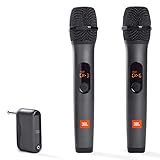
The JBL system is the one you hand to a colleague who has never touched a wireless rig. It is a dual-channel receiver with two handheld transmitters, designed so the mics and receiver arrive matched and simply work when you switch them on. It suits the DJ who wants a dedicated ceremony or announcements rig, a backup kit that lives in the van, or a small bar and restaurant setup where a 90-second changeover is the whole game.
Key specs at a glance
- Configuration: dual-channel receiver with two handheld transmitters
- Pairing: factory-paired operation — no scanning, syncing or channel selection step
- Band: a license-free fixed band class; the listing emphasises simplicity rather than frequency agility
- Receiver: compact tabletop chassis with a mixed output
- Brand support: JBL is an established pro-audio brand with published documentation and service infrastructure
- Power: transmitter battery class typical of handheld systems, receiver on a wall adapter
Strengths
The value here is not a specification — it is the absence of a specification burden. There is no scan button to misunderstand, no group/channel table to consult, no sync procedure to fumble in the dark. Power on, wait a second, talk. For a ceremony where you are also running a processional playlist, that cognitive load saving is worth more than an extra 50 ft of quoted range.
JBL’s tuning philosophy also tends to favour a polished, slightly forward vocal tone, which suits spoken word and sung toasts over a DJ system. The receiver is small enough to sit on top of a controller case or tuck beside a mixer, and the two transmitters are light enough for a guest to hold for a five-minute speech without fatigue. Because the system is factory-paired, there is also no way for a well-meaning helper to knock it out of sync by pressing the wrong button — a real failure mode on systems with open menus.
The trade-off is frequency agility. When the system is locked to its factory set, a venue with strong competing RF in the same band leaves you with fewer options than an auto-scan system would give you. In practice, this rarely bites in small and mid-size rooms with modest wireless density; it bites in hotel ballrooms with in-house AV, multiple stages and a wall of LED fixtures. Range is likewise a “good room” specification — expect solid performance within a normal room and a stage-to-back-of-floor distance, and expect the crowd to eat into it.
Pros
- Genuinely plug-and-play — no scan or sync ritual
- Compact receiver that fits almost anywhere
- Speech-friendly tone out of the box
- Backed by a major audio brand with real documentation
- Ideal as a second or backup system
Cons
- Little to no frequency agility if the band is crowded
- Two channels only, with no expansion path
- Not aimed at rack installation
- Fewer output and routing options than the premium tier
- Battery handling is basic — plan your own spares routine
How it compares
Next to the Phenyx Pro PTU-71-2H, the JBL is faster and simpler but far less recoverable: when interference appears, the Phenyx Pro has a scan button and the JBL mostly does not. Next to the TONOR set, the JBL is the better pure handheld choice, while TONOR adds a bodypack with headset and lapel options for hands-free work. Buy the JBL if your priority is a system that a non-technical person can operate correctly, every time.
3. Aveek Wireless Microphone System 4 Pack – Best for budget multi-mic events

Four handhelds on one receiver, with a quoted 262 ft line-of-sight range and a low-latency design — that is the Aveek pitch, and for the money it is a lot of coverage. It suits quiz nights, school productions, community theatre, church panel discussions, four-person award ceremonies and rental kits where you would rather send out four cheap mics than one expensive one.
Key specs at a glance
- Configuration: four handheld transmitters with a single multi-channel receiver
- Quoted range: up to 262 ft in ideal line-of-sight conditions
- Latency: marketed as low latency, which matters for any mic used near a live monitor or in-ear mix
- Band: UHF-class operation typical of the budget multi-mic category
- Receiver: single-chassis, shared output path class
- Price tier: budget
Strengths
The economics are the headline: four live handhelds for less than the price of one premium dual-channel system. For an event where four people need to speak and nobody needs a broadcast-grade capsule, that is the correct answer, and it is not close.
Four channels in one receiver also simplifies your life. One power supply, one output cable to the mixer, one place to look when something is wrong. There is no interconnecting of two systems, no risk of two receivers fighting over the same frequency, and no extra rack space. Setup is a single soundcheck pass: bring all four mics up one at a time, confirm each on its own receiver channel, then bring them all up together and listen for the noise floor rising.
That last test is the one that matters on any four-mic budget system. When several transmitters are live at once, their carriers mix inside the receiver’s front end and produce intermodulation products — ghost signals that can land on another channel’s frequency. The practical rules are simple: keep handhelds at least a metre apart when they are all switched on, never leave four mics powered up in a pile on a table, and avoid switching on a mic right next to a receiver antenna. Follow those and a budget four-channel system behaves far better than its price suggests. The 262 ft figure should be read as an empty-parking-lot number; inside a room with people, expect a fraction of it, which is still plenty for a hall or marquee.
Pros
- Four handhelds for the price of one premium channel pair
- Single receiver, single cable, single power supply
- Low-latency design suits use alongside monitors
- Excellent for rentals, schools and community events
- Quoted range is generous for the tier
Cons
- Budget build quality — switches and battery doors are the first failure points
- Four simultaneous carriers demand more careful RF discipline
- Shared receiver features instead of per-channel luxury
- Capsules are serviceable, not inspiring
- Limited expandability if you later need better tone
How it compares
Against the MELONARE 4×10, the Aveek wins on price and loses on frequency choice — the MELONARE gives you selectable frequencies to move a clashing channel, while the Aveek expects you to work with what you get. Against the Phenyx Pro PTU-5000-4H, the Aveek is the budget version of the same idea: four mics, one receiver, but without the premium receiver chassis, metering and rack mounting. If your four-mic events are occasional and informal, the Aveek is the sensible buy.
4. Kaschun Wireless Microphone System – Best for the cheapest route into UHF

The Kaschun system is a fixed-frequency dual UHF set with two handheld microphones and a quoted 200 ft range, and its whole appeal is that it delivers UHF’s interference profile at a budget price. It suits the solo DJ, the pub quiz host, the village hall committee and anyone whose events happen in one or two familiar venues where the RF environment is already known.
Key specs at a glance
- Configuration: dual UHF handheld system, fixed frequency
- Quoted range: up to 200 ft in favourable conditions
- Tuning: none — the operating frequency is set at the factory
- Setup: plug-and-play receiver, no scan or sync step
- Band: UHF, which generally offers more usable channels and shorter antennas than VHF
- Price tier: budget
Strengths
Fixed frequency is usually described as a limitation, and it is — but it has one genuine advantage. Nothing can be misconfigured. There is no scan that might land on a marginal channel, no sync that might fail, no menu that a helper might wander into. The system either works in the room or it does not, and you find that out in five seconds at soundcheck rather than at the worst moment of the night.
UHF at this price is the real story. Compared with VHF, the UHF band generally offers more usable channels, shorter and more robust antennas, and a cleaner path through the noise floor in venues full of switching power supplies, dimmers and LED drivers. For a two-mic setup in a room you know, that is a meaningful upgrade over the cheapest VHF options at a similar price.
Two practical habits make a fixed-frequency system far more reliable. First, test it in the actual venue before the event, not at home — RF conditions change with the building, the floor and even the time of day. Second, if you ever buy a second identical system as a spare, confirm the two units do not share the same factory frequency, because two systems on the same channel will fight each other and neither will sound right. Where a fixed system struggles is a room with an existing in-house wireless rig, a nearby TV transmitter or a stage full of high-current lighting: if the clash appears, your only fix is to move the receiver a metre or two and hope. Budget tier pricing in this category usually sits well under what a single premium handheld costs, so the risk is low.
Pros
- UHF performance at the lowest realistic price
- Nothing to misconfigure — power on and talk
- Two handhelds cover standard DJ and emcee duties
- Simple receiver, simple cabling
- Low financial risk for a first wireless system
Cons
- No channel change if interference appears
- Fixed frequency must be checked at each new venue
- Budget chassis and switchgear
- Two channels with no upgrade path inside the system
- Quoted 200 ft assumes clean line of sight
How it compares
Against the Phenyx Pro PTU-71-2H, the Kaschun is the same two-mic idea stripped of its recovery options: no auto-scan, no per-channel receiver luxury, no rack mounting. Against the Pyle VHF set, the Kaschun is the better buy for most users, because UHF’s channel availability and shorter antennas beat VHF’s long-wavelength advantages in a typical indoor event. Choose the Kaschun when your venues are known, your budget is fixed and you accept that a clash is unfixable.
5. Phenyx Pro PTU-5000-4H – Best for four-mic events on one receiver

The PTU-5000-4H is a four-channel fixed-frequency UHF system with four handheld microphones and a receiver built to live in a rack. It suits the DJ who has drifted into event production: award nights, panel discussions, multi-speaker ceremonies, school assemblies, church services with several readers. Anywhere four people might hold a microphone in the same hour, this is the structural answer.
Key specs at a glance
- Configuration: four handheld transmitters with one 4-channel UHF receiver
- Tuning: fixed frequency — four factory-set channels designed to coexist
- Receiver: metal chassis class, per-channel volume, rack-mountable
- Outputs: mixed and per-channel output class for feeding a mixer or a recorder
- Displays: per-channel RF and audio metering class
- Power: swappable AA-battery class transmitters
- Price tier: premium
Strengths
One receiver for four mics changes your whole setup routine. One power supply, one rack space, one cable run to the mixer, and per-channel metering that tells you instantly which mic is live and which is not. On a four-speaker panel, that metering alone is worth the premium: you can see at a glance whether the third speaker remembered to switch on.
Because the four channels are factory-set as a group, they are chosen to avoid intermodulation with each other — which is exactly the problem that sinks improvised multi-mic setups. Four transmitters on air at once generate a spray of mixing products; a receiver pair designed as a set handles that far better than four separate systems stacked together. Per-channel volume also lets you match four different voices, which matters when one speaker is a whisperer and the next is a shouters.
Installation habits make a large difference. Keep the receiver out of the same rack bay as high-current dimmers and power amplifiers, mount antennas at the front of the rack rather than buried inside a metal case, and keep at least 3 m between the receiver antennas and any transmitter sitting idle. If the rack is fully enclosed metal, a front-mount antenna kit class is the difference between a system that works and one that hisses. As with any fixed-frequency set, verify local TV occupancy at the venue rather than at home, since UHF channel availability changes by postcode. Battery discipline matters more here too: four transmitters means four battery drawers to check, so build a routine — fresh cells at load-in, spares in the case, and a note of the swap time on your run sheet.
Pros
- Four channels, one receiver, one cable run
- Factory-set channels designed to coexist without intermodulation problems
- Per-channel volume and metering
- Rack-mountable metal chassis
- Matched capsules give consistent tone across all four mics
- Fast setup — no scanning or syncing per channel
Cons
- Fixed frequency limits your escape route in a crowded band
- Premium pricing
- Four channels occupy more spectrum than two
- Heavier and bulkier to transport than a dual system
- Four AA-class transmitters mean four battery routines
How it compares
Against the MELONARE 4×10, the Phenyx Pro gives you a premium receiver chassis, better metering and a stronger brand support story, while the MELONARE gives you selectable frequencies to dodge a clash. Against the Aveek 4 Pack, this is the professional version of the same four-mic concept: you pay more for the receiver, the rack mounting and the consistency. If your four-mic work is frequent and paid, the PTU-5000-4H is the one that will still be in your rack in five years.
6. MELONARE 4×10 Freq. UHF Wireless Microphone System – Best for four mics with an escape route

The MELONARE system pairs four UHF channels with selectable frequencies and a quoted 200 ft stable-signal range. As the “4×10” naming suggests, it offers a set of selectable frequencies per channel rather than a single fixed one, which puts it in a useful middle ground: more flexible than a fixed-frequency set, simpler and cheaper than a full auto-scan premium system. It suits the mid-size event operator — the DJ running a school awards evening, a community group, a small conference — who wants four mics and a way out if one channel misbehaves.
Key specs at a glance
- Configuration: four-channel UHF receiver with four handheld transmitters
- Tuning: selectable frequencies per channel, as named by the manufacturer
- Quoted range: up to 200 ft stable signal in favourable conditions
- Receiver: single chassis, multi-channel, shared output path class
- Band: UHF
- Price tier: mid-range
Strengths
The escape route is the point. If one of the four channels lands on interference, you can move it — and on a fixed-frequency system you cannot. Over a season of events in unfamiliar venues, that single capability probably saves you one bad night, which is more than the price difference.
Four mics in one receiver also keeps the rig tidy and the soundcheck short. The critical discipline with a system like this is to test all four channels together, not one at a time. Intermodulation products only appear when multiple transmitters are live, so a channel that sounds pristine on its own can be noisy the moment its neighbour switches on. Bring up all four, listen to the noise floor with nobody speaking, then speak on each mic in turn and check that the others stay quiet. If the noise floor rises noticeably, move one channel a few steps and repeat.
Range expectations follow the usual rules: the 200 ft figure assumes clean line of sight, and a room full of people will reduce it substantially. For a hall, marquee or conference room, that is still ample. Keep the receiver elevated, keep the antennas clear of metal and screens, and keep handhelds at least a metre apart when idle. Mid-range pricing in this category generally lands between budget four-packs and premium rack systems, which makes it the sensible choice for anyone who needs four mics regularly but cannot justify a premium chassis.
Pros
- Selectable frequencies give you a fix when a channel clashes
- Four channels on one receiver at a mid-range price
- Simple setup compared with full auto-scan systems
- Good fit for schools, community events and small conferences
- Quoted range is adequate for typical indoor venues
Cons
- Selectable frequencies are not always coordinated as a group
- Receiver features are shared rather than per-channel luxury
- Build quality sits between budget and premium
- Manual channel changes take longer than pressing scan
- Not rack-mount oriented
How it compares
Against the Aveek 4 Pack, the MELONARE costs more but gives you frequency choice and a slightly more solid receiver — the right upgrade if you have been burned by an unchangeable channel. Against the Phenyx Pro PTU-5000-4H, it trades rack mounting, metering and brand support for the ability to move a channel, and it costs less. Buy the MELONARE if flexibility matters more than chassis quality; buy the Phenyx Pro if the reverse is true.
7. TONOR Wireless Microphone System – Best for hands-free emcee and officiant work

TONOR’s set is the odd one out in a good way: alongside handheld mics it includes headset and lapel options on a bodypack transmitter. It suits the emcee who needs both hands free, the wedding officiant reading from a folder, the fitness instructor, the auctioneer, the tour guide, the presenter who walks the room with a clicker in one hand and notes in the other.
Key specs at a glance
- Configuration: single receiver with handheld, headset and lapel microphone options
- Transmitters: handheld class plus a bodypack class transmitter for the headset/lapel
- Band: license-free wireless band class typical of this category
- Receiver: compact tabletop chassis with a mixed output
- Price tier: mid-range


