
okshelf speakers for high-end listening are the KEF LS50 Meta for imaging, the Bowers & Wilkins 705 S3 for detail and scale, the Dynaudio Special Forty for a rich, natural balance, and the Neumann KH 120 II for accurate powered monitoring without an external amplifier.
Premium bookshelf speakers are not interchangeable choices. Cabinet rigidity affects clarity, driver material changes the character of treble and midrange, and amplifier matching determines whether a compact speaker sounds effortless or strained. The right model also depends heavily on whether it will play in a small desk setup, a treated listening room, or a medium-sized living room.
As an Amazon Associate we earn from qualifying purchases at no extra cost to you.


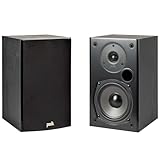
Top 3 picks at a glance
Quick comparison of the leading choices
| Speaker | Design and driver approach | Amplification | Best room size | Typical market range |
|---|---|---|---|---|
| KEF LS50 Meta | Coaxial Uni-Q driver, metamaterial tweeter absorber, rigid curved cabinet | Strong integrated amplifier recommended; roughly 60–150 watts per channel | Small to medium | Usually $1,200–$1,600 per pair |
| Bowers & Wilkins 705 S3 | Separate carbon-dome tweeter and Continuum-cone mid/bass driver | Quality amplifier with good current delivery; roughly 50–150 watts per channel | Small to medium | Usually $2,000–$2,600 per pair |
| Dynaudio Special Forty | Esotar Forty soft-dome tweeter and long-throw hybrid-cone woofer | Preferably 80 watts or more per channel into 4–6 ohms | Small to medium | Usually $2,500–$3,500 per pair |
| ELAC Carina BS243.4 | Air Motion Transformer tweeter and aluminum-cone woofer | Moderate-to-powerful integrated amplifier; roughly 50–120 watts per channel | Small to medium | Usually $800–$1,200 per pair |
| Neumann KH 120 II | Powered two-way monitor with waveguide and onboard DSP | Amplifiers built in; balanced analog inputs | Small to medium | Usually $1,500–$2,000 per pair |
KEF LS50 Meta: the best choice for imaging
The KEF LS50 Meta is the strongest all-round recommendation when precise stereo placement matters most. Its coaxial Uni-Q driver places the tweeter at the acoustic center of the mid/bass driver, so voices and instruments appear to come from stable, sharply defined positions rather than from two separate boxes.
This design is especially effective for nearfield listening at a gaming desk or a compact entertainment setup. Dialogue remains centered even when you move slightly off-axis, while stereo effects spread beyond the cabinet edges. The curved, heavily braced enclosure also limits cabinet coloration, helping low-level details remain audible.
The trade-off is amplifier demand. Its relatively modest sensitivity and impedance dips mean a small, inexpensive amplifier may produce acceptable volume but lack control during dense orchestral music, electronic bass, or action-game soundtracks. A clean amplifier rated around 60 watts per channel or more is a sensible starting point; a high-current 100-watt design gives additional headroom in a medium room.
Bowers & Wilkins 705 S3: the most explicit and spacious
The 705 S3 offers a more forward presentation than the KEF, with strong treble articulation and an unusually open sense of height from its separate, top-mounted carbon-dome tweeter. The Continuum mid/bass cone keeps vocals and acoustic instruments detailed without using the bright, etched character associated with some older metal-driver speakers.
Its cabinet is narrow and carefully shaped, but the external tweeter housing is not merely decorative: separating the tweeter from the main cabinet reduces some diffraction and helps create a broad vertical image. The speaker rewards careful placement. Mount it on rigid stands with the tweeters approximately at ear height, and begin with modest toe-in. Excessive toe-in can make the upper midrange sound too direct.
The 705 S3 is a good match for listeners who want microdetail, crisp percussion, and a large soundstage. It is less forgiving than the Dynaudio or Neumann when paired with a thin-sounding amplifier or placed close to a bare wall.
Dynaudio Special Forty: the best tonal balance for long sessions
The Dynaudio Special Forty is the more relaxed and substantial-sounding option. Its soft-dome tweeter delivers treble detail without drawing attention to itself, while the long-throw mid/bass driver produces a generous lower midrange that gives cellos, male vocals, guitars, and piano convincing weight.
Its cabinet construction uses a curved front profile and layered finishing intended to reduce unwanted resonances. The result is not the most surgically outlined image in this group, but it is highly cohesive. Music sounds connected across the crossover rather than divided into “woofer” and “tweeter” regions.
Do not choose it for a low-powered compact amplifier simply because it is a bookshelf speaker. The Special Forty benefits from current and headroom, particularly in a medium room. An amplifier capable of delivering around 80–100 watts per channel into a difficult load is a safer match than a basic 30-watt receiver.
ELAC Carina BS243.4: the value-oriented premium alternative
The ELAC Carina BS243.4 uses an Air Motion Transformer tweeter, whose folded diaphragm moves air with a larger effective radiating area than its physical size suggests. This helps it sound fast and open, with particularly clear cymbals, strings, and spatial effects.
Its aluminum-cone woofer gives bass notes a clean attack, though the presentation can be less warm than the Dynaudio. This makes the Carina a useful choice for a system that already has a slightly rich amplifier or a subwoofer. It also offers a practical route into high-end listening without the price of the larger European designs.
For a gaming setup, the Carina works well when paired with a subwoofer crossed over around 70–80 Hz. That relieves the small woofer from deep bass duty and improves dynamic headroom, especially at desk distance.
Neumann KH 120 II: the easiest high-end system to integrate
The Neumann KH 120 II is different from the passive speakers above because its amplifiers are built into the cabinet. It is designed as a compact nearfield monitor, but its controlled directivity and onboard DSP make it an excellent premium listening speaker for a desk, studio, or small media room.
Its main advantage is consistency. You do not have to guess whether an amplifier is underpowered, and the rear controls or software-based alignment can compensate for boundary proximity. The tonal balance is neutral rather than romantic: bass is tight, vocals are honest, and treble is detailed without deliberately adding sparkle.
The main limitation is connectivity. You will usually need a DAC, audio interface, monitor controller, or preamp with balanced outputs. A simple analog volume control between the source and speakers is preferable to repeatedly adjusting the computer’s digital output level at very low settings.
How cabinet construction changes what you hear
- Rigid curved cabinets: These reduce panel vibration and stored energy, improving vocal clarity and image focus. KEF and Dynaudio are good examples of this approach.
- Separate tweeter housings: A tweeter placed above the main enclosure can reduce diffraction and increase perceived openness, as with the Bowers & Wilkins 705 S3.
- Ported cabinets: Rear ports can extend bass, but they need space from the wall. Start with at least 20–30 cm of clearance and reduce the distance if bass sounds too thin.
- Sealed or DSP-controlled designs: These often provide more predictable bass near a wall, although maximum low-frequency output may be lower without electronic assistance.
Amplifier matching: a practical power calculation
Speaker sensitivity is normally measured at 1 watt and 1 meter. Every doubling of amplifier power adds approximately 3 dB, while doubling listening distance loses roughly 6 dB in free space. Consider an 85 dB-sensitive speaker in a medium room:
- 1 watt produces about 85 dB at 1 meter.
- At 2 meters, output falls to approximately 79 dB.
- Reaching 95 dB peaks requires about 16 times the power, or roughly 16 watts.
- Allowing 10 dB of musical headroom requires around 160 watts for brief peaks.
This does not mean you must buy a 160-watt amplifier. Room reflections, stereo pair gain, and normal listening levels reduce the requirement. It does explain why a nominally “50-watt” amplifier can sound strained with demanding speakers: the number may describe an easy test load rather than the current required during bass transients. For the KEF LS50 Meta or Dynaudio Special Forty, prioritize a stable amplifier with strong power reserves over a high wattage figure achieved only at one impedance.
Choose by room and listening position
| Your situation | Best direction | Placement and setup |
|---|---|---|
| Desk, 0.8–1.2 m listening distance | KEF LS50 Meta or Neumann KH 120 II | Raise tweeters to ear level; use modest toe-in; keep the speakers symmetrical. |
| Small room, 2–3 m distance | KEF LS50 Meta or ELAC Carina | Leave 20–30 cm behind rear ports and add a subwoofer if deep bass is important. |
| Medium room, high-volume listening | Dynaudio Special Forty or Bowers & Wilkins 705 S3 | Use rigid stands and an amplifier with substantial current delivery. |
| Wall-adjacent setup or uncertain amplifier matching | Neumann KH 120 II | Use the onboard boundary controls or DSP rather than relying on placement alone. |
| Long sessions with varied music | Dynaudio Special Forty | Choose a neutral-to-slightly warm amplifier and avoid excessive toe-in. |
Frequently asked questions
Do I need a subwoofer with these bookshelf speakers?
You do not necessarily need a subwoofer, but adding one can improve dynamic headroom and reduce deep-bass demands. The ELAC Carina BS243.4 works well with a subwoofer crossed over around 70–80 Hz, especially in a gaming setup. This allows its small woofer to focus less on deep bass and can make demanding soundtracks and effects easier to reproduce.
Which speaker is easiest to use on a desk?
The Neumann KH 120 II is the easiest to integrate on a desk because its amplifiers are built in and its onboard DSP can compensate for boundary proximity. The KEF LS50 Meta is also effective for nearfield listening because its coaxial driver provides stable imaging. The Neumann usually requires a DAC, audio interface, monitor controller, or preamp with balanced outputs.
How should I position the Bowers & Wilkins 705 S3?
Place the 705 S3 on rigid stands with its tweeters approximately at ear height, then begin with modest toe-in. Excessive toe-in can make the upper midrange sound too direct. The speaker benefits from careful placement and is less forgiving when used with a thin-sounding amplifier or positioned close to a bare wall.
Which model is most forgiving for long listening sessions?
The Dynaudio Special Forty is the most relaxed and substantial-sounding option for long sessions. Its soft-dome tweeter provides detail without drawing attention to itself, while its long-throw mid/bass driver gives vocals, guitars, piano, and other instruments convincing weight. Its cohesive presentation is less surgically outlined than the KEF but avoids making the sound seem divided between woofer and tweeter.
What do I need to control the volume of the Neumann KH 120 II?
The Neumann KH 120 II can use a DAC, audio interface, monitor controller, or preamp with balanced outputs. A simple analog volume control between the source and speakers is preferable to repeatedly adjusting a computer’s digital output at very low settings. Because the speakers have built-in amplifiers, you do not need a separate power amplifier.
Final verdict
Choose the KEF LS50 Meta if imaging and nearfield precision are your priorities. Choose the Bowers & Wilkins 705 S3 for an energetic, highly detailed presentation, or the Dynaudio Special Forty for the most relaxed and musically weighty balance. The ELAC Carina BS243.4 delivers much of the premium experience at a lower market range, while the Neumann KH 120 II is the most rational choice when built-in amplification, neutrality, and placement correction matter more than traditional hi-fi styling.


