
Most people outfitting a streaming room buy acoustic panels the same way they buy RGB lighting: they pick whatever looks good in the product photos, order a big pack, and stick it on the wall behind their microphone. Two weeks later the room still sounds echoey, and they assume panels “don’t work.” The truth is more annoying: foam panels work fine — if you buy the right thickness, buy enough of them, and put them in the right places. The most common mistakes are buying 1-inch panels when the echo problem needs 2 inches, covering a whole wall in a decorative pattern instead of targeting reflection points, and confusing “soundproofing” with “sound treatment.” Foam panels will not block sound from leaving your room — your roommates will still hear you yelling at a game at 1 a.m. What they do is absorb reflections inside the room, which is exactly what your microphone and your ears care about.
This guide walks through what actually matters when choosing acoustic panels for a streaming room, with real numbers so you can compare listings without guessing.
As an Amazon Associate we earn from qualifying purchases at no extra cost to you. Product prices and availability are accurate as of the date shown and are subject to change.

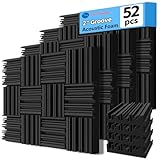


Top 3 picks at a glance
Decide These 3 Things First
Before you look at a single product listing, answer these. They determine everything downstream.
1. What’s your actual problem? If your stream audio sounds roomy or hollow, you have excess reverberation, and absorption panels solve it. If the neighbors complain about noise, that’s sound isolation, and foam won’t fix it — you’d need mass-loaded vinyl, sealed doors, or window inserts. Most streamers have the first problem. If you’re unsure, clap once in your room: a audible ring or flutter echo lasting more than about half a second means you need absorption.
2. How much wall and ceiling area can you treat? A typical streaming room is 10 by 12 feet with an 8-foot ceiling — roughly 350 square feet of surface area. A useful target for voice work is treating 15–25% of that, which works out to about 50–90 square feet of panel coverage. A 52-pack of 12″ x 12″ panels covers 52 square feet, which lands right in the practical range for a first pass.
3. What’s your budget, honestly? Decent treatment starts around $35 for a starter pack and runs to $200+ if you add bass traps and thicker panels. Decide the number now so you don’t blow it on looks.
Panel Size and Thickness: The Single Biggest Factor
Thickness is where budget panels quietly fail you. Sound absorption happens as sound waves pass into the material and lose energy to friction; low and mid frequencies need depth to do that.
- 1-inch panels (like the common 1″ x 12″ x 12″ wedge packs): Absorb higher frequencies reasonably well — roughly 500 Hz and up — but do almost nothing below 250–300 Hz. For a voice-only streamer in a small, carpeted room, this can be enough to clean up reflections. Price: usually $35–40 per 52-panel pack.
- 2-inch panels (12″ x 12″ x 2″ groove or wedge styles): Extend meaningful absorption down to roughly 125–250 Hz, which covers most of the mud in a typical voice recording. If your room sounds “boxy,” this is the fix. Expect $21–70 depending on pack size and density.
- 4-inch panels and bass traps: Needed if you’re tracking music or your room has audible bass buildup in corners. Corner bass traps run $30–60 each.
Panel footprint matters less than thickness for performance — 12″ x 12″ tiles are the standard and let you place absorbers precisely instead of covering a wall wholesale. If you see 24″ x 24″ panels, they cover faster but make precise placement harder.
Material and Density
Nearly all streaming-room panels are open-cell polyurethane foam. What varies is density and fire rating.
- Density: Heavier foam absorbs more. A quality 2″ x 12″ x 12″ panel weighs roughly 0.15–0.25 lb; if a whole 52-pack of 1″ panels ships in a box light enough to feel like packaging peanuts, absorption will be weak. Compare the shipping weight listed on the box, not just the photo.
- Fire rating: Cheap foam can be flammable. Look for UL 94 HF-1 or a stated fire-resistant treatment, especially if panels sit near hot studio lights or an amp. Reputable listings state this; silence is a bad sign.
- Fabric-wrapped fiberglass or mineral wool panels: These outperform foam at equal thickness (a 2″ fiberglass panel absorbs like 3–4″ of foam) and start around $40–70 each. They look more professional on camera but cost more and arrive in boxes, not envelopes.
Construction: Wedges, Grooves, and Adhesives
Surface pattern is mostly cosmetic, but not entirely. Wedge and pyramid patterns add a small amount of extra surface area and slightly improve high-frequency absorption. Groove (slotted) designs look cleaner on camera and perform nearly the same. Textured “3D” panels are fine but don’t pay a premium for pattern — pay for thickness and density.
Mounting is the underrated detail. Many packs include double-sided adhesive squares (300 pieces is typical for a 52-pack). Adhesive works on painted drywall and is removable if you pull slowly, but it can peel paint on cheaper flat paint and won’t stick to textured walls in cold rooms. Alternatives: push pins (works with most foam), command-style strips, or a simple plywood frame panel for larger setups. If you’re a renter, budget $10–15 for removable mounting tape regardless of what’s included.
Performance in a Streaming Context
Manufacturers rarely publish real absorption coefficients, and you shouldn’t trust the ones printed on generic listings. Instead, use practical markers:
- A 52-pack of 1″ panels placed at first-reflection points (side walls beside your desk, the wall behind your monitor, and the ceiling above you if you can) will audibly tighten your mic sound in a 100–150 sq ft room.
- Placing panels matters more than quantity. The spot that matters most: the wall directly in front of you, at mouth height, about 2–3 feet from your microphone. Second: side walls at ear height. Third: the wall behind you.
- Combine foam with a soft surface floor and curtains before buying more panels — a rug and heavy drapes can equal 20–30 square feet of panel coverage.
Price Tiers
- Budget ($20–40): 1-inch packs in the 12–52 panel range. Fine for echo reduction in small rooms and voice-only streaming. The Foroomaco 2″ 12-pack at $21.49 is a budget outlier worth noting — thicker panels at a 1-inch price, just fewer of them.
- Mid ($40–75): 2-inch packs of 40–52 tiles, denser foam, better color consistency. The TroyStudio 2″ 52-pack at $66.99 typifies this tier.
- Premium ($75–300+): Fabric-wrapped fiberglass panels, corner bass traps, or hybrid kits. Buy here if you’re doing music production, voiceover work, or your stream audio is a professional deliverable.
Warranty and Delivery
Acoustic foam ships compressed and usually expands to full thickness within 24–72 hours after unboxing. Read the listing: some sellers promise recovery within a set window or offer a replacement if panels don’t rebound. Look for at least a 30-day return window; many sellers offer 12-month warranties against manufacturing defects like inconsistent density or torn edges. Check panel thickness tolerance — quality listings state ±0.2 inches or better. Also verify the pack count matches the tile size; some listings bundle smaller 6″ tiles to inflate the “piece count.”
Spec Checklist
| Spec | Budget | Mid | Premium |
|---|---|---|---|
| Thickness | 1 inch | 2 inches | 2–4 inches or fiberglass |
| Pack size / coverage | 12–52 tiles, 12–52 sq ft | 40–52 tiles, 40–52 sq ft | Per-panel, 2–24 sq ft each |
| Price per pack | $20–40 | $40–75 | $75–300+ |
| Material | Polyurethane foam | Denser polyurethane foam | Fiberglass/mineral wool, fabric-wrapped |
| Mounting | Adhesive squares included | Adhesive included, pins recommended | Mounting hardware or frames |
| Best for | Voice streaming, small rooms | Serious streaming, music listening | Recording, voiceover, mixed use |
| Return/warranty | 30-day return | 30-day return + 12-month defect warranty | Multi-year warranty typical |
Red Flags
- “Soundproofing” on foam packaging. Foam absorbs sound inside a room; it does not block transmission. Any listing claiming soundproof foam at $36.99 is using sloppy marketing.
- No stated thickness in the title or bullets. If you have to dig for it, it’s probably 1 inch or less.
- Absorption coefficients with no test standard cited. Real lab data comes with a reference to ASTM C423 or similar. Numbers without a source are decoration.
- Pack counts padded with tiny tiles. “96 pack” made of 6″ x 6″ squares covers half the area of a 24-pack of 12″ tiles.
- No fire rating mentioned. Especially important if panels go near lights or electronics.
- Photos that look identical across a dozen brands. Many budget foam listings are the same factory product relisted; compare on shipping weight and stated density instead of branding.
FAQ
How many acoustic panels do I need for a streaming room?
For a typical 10′ x 12′ streaming room, start with 40–60 square feet of panel coverage placed at reflection points: the wall in front of you, both side walls at ear height, and the wall behind your microphone. A 52-pack of 12″ tiles covers 52 square feet, which is a solid first pass. Add more only if the room still sounds live after placement.
Are 1-inch or 2-inch acoustic panels better for streaming?
For voice streaming, 1-inch panels reduce echo and flutter adequately in small, furnished rooms. Two-inch panels absorb more mid and low-mid energy and noticeably reduce boxiness, especially in rooms with hard floors or bare walls. If your budget allows, 2-inch panels are the better single purchase.
Do acoustic foam panels actually soundproof a room?
No. Foam absorbs reflections inside the room to improve how your microphone sounds, but it does not stop sound from traveling through walls. If noise leaking in or out is your problem, you need door seals, mass-loaded barriers, or construction-level fixes — not more foam.
How do I mount panels without damaging the wall?
Most foam panels include double-sided adhesive squares, which work on smooth painted drywall and remove with slow, steady peeling. For rentals or textured walls, use push pins or removable mounting strips — budget about $10–15 for a 52-pack. Avoid spray adhesives and construction glue; they will pull off paint and drywall paper on removal.
By 2026, acoustic treatment has become one of the cheapest quality upgrades a streamer can make — a $40–70 pack of 2-inch panels, placed thoughtfully, will improve your audio more than a $300 microphone upgrade. Buy for thickness and density, place panels at reflection points, and skip anything marketed as soundproofing.


