
When setting up a home studio, a dedicated streaming desk, or a professional video conferencing space, the most common mistake is buying the brightest light possible, pointing it directly at your face, and hoping for the best. The result is almost always a washed-out complexion, harsh shadows on the back wall, and severe eye strain. Conversely, buying an underpowered light forces your camera to artificially boost its gain, turning your clean video feed into a grainy, noisy mess.
Understanding how to choose key light lumen output for video requires looking past raw marketing numbers and understanding how light actually interacts with camera sensors, diffusion materials, and your physical environment. In 2026, as high-definition 4K webcams and mirrorless cameras become the baseline standard for remote work and content creation, matching your key light’s output to your specific workspace is more critical than ever. This guide will cut through the confusing jargon to help you calculate exactly how much light you need, how to identify high-quality fixtures, and how to avoid the common pitfalls of cheap studio lighting.
As an Amazon Associate we earn from qualifying purchases at no extra cost to you.


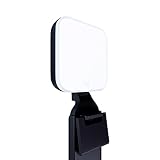

Top 3 picks at a glance
Decide These 3 Things First
Before you start comparing product listings or calculating wattage, you must define the physical parameters of your filming environment. Every lighting decision you make will stem from these three foundational variables.
- Your Camera’s Sensor Size and Lens Aperture: Small camera sensors, such as those found in standard integrated laptop webcams or budget external cameras, have tiny physical pixels that struggle to capture light. They require a much higher ambient and key light lumen level to produce a clean image. If you are shooting on a high-end mirrorless camera with a fast lens (e.g., a prime lens set to f/1.8 or f/2.0), the camera is highly sensitive to light. In this scenario, a lower-lumen key light will suffice, whereas a basic webcam might require double the light output to avoid digital noise.
- The Distance from Light to Subject: Light intensity drops off dramatically over distance according to the inverse-square law. A key light placed 2 feet from your face will feel incredibly bright and require very little power (often only 250 to 500 lumens). If you push that same light back to 5 or 6 feet to keep it out of your camera’s field of view, you will need a fixture capable of pushing 1,500 to 2,800 lumens to achieve the exact same exposure on your skin.
- Your Ambient Light Control: Are you filming in a windowless basement where you have absolute control over the darkness, or are you in a home office with a massive south-facing window? If you have to compete with natural daylight, your key light must be exceptionally powerful to balance the exposure. To match or overpower indirect daylight pouring through a window, you will need a key light capable of delivering at least 2,000 to 3,000 lumens. If you shoot exclusively in a controlled, dark room, a softer 500 to 800-lumen light is often more than enough.
Factor 1: Panel Size and Diffusion Surface Area
A common misconception is that a lumen is a lumen, regardless of the fixture. In reality, a 2,000-lumen light emitted from a tiny 2-inch square bulb will be incredibly harsh, blinding, and cast sharp, unflattering shadows. That same 2,000-lumen output spread across a large, edge-lit 11″ x 15″ panel is incredibly soft, wrapping gently around your features and hiding skin imperfections.
When selecting a key light, look for panels that offer built-in multi-layer diffusion. Premium models use edge-lit LED technology, where the LEDs point inward toward a reflective backplate and pass through several layers of diffusion glass. This design eliminates “hot spots” (the visible, blinding dots of individual LEDs). For a standard desk setup, a panel size of at least 10″ to 13″ diagonally (like the Raleno 13-inch Soft Light Panel) is the sweet spot for creating a soft, professional look without taking over your entire desk space.
Factor 2: Chassis Material and Thermal Management
High-lumen LED lights generate a significant amount of heat. If an LED panel cannot dissipate this heat efficiently, the LEDs will degrade rapidly, leading to color shifting, dimming, and eventual hardware failure. Cheap lights rely entirely on thin plastic housings with no ventilation, which can warp or emit chemical odors when run at maximum brightness for extended video sessions.
Look for key lights constructed with aluminum alloy backplates or full metal chassis. Aluminum acts as a passive heatsink, drawing heat away from the LED chips without requiring noisy internal fans that your microphone will pick up during a recording. A premium light like the Elgato Key Light features a solid metal chassis and a highly efficient passive cooling design, allowing it to output a continuous 2,800 lumens of light while remaining completely silent and cool to the touch.
Factor 3: Color Accuracy (CRI and TLCI)
Brightness is useless if it makes you look green, grey, or sickly. This is where the Color Rendering Index (CRI) and Television Lighting Consistency Index (TLCI) come into play. These metrics scale from 0 to 100, measuring how accurately a light source reveals the true colors of objects and human skin tones compared to natural sunlight.
Never buy a key light for video that does not explicitly state its CRI and TLCI ratings. For professional, healthy-looking skin tones, you need a minimum CRI of 95 and a TLCI of 96 or higher. Cheap, unbranded lights often have CRIs in the 80s, which lack the red spectrum wavelengths necessary to make human skin look vibrant and natural. Additionally, ensure the light offers adjustable color temperatures, ranging from a warm 2800K (ideal for evening streams) to a cool 6500K (ideal for matching bright daylight).
Factor 4: Power Source and True Wattage Capacity
The method by which a key light draws power dictates its maximum lumen output. This is the biggest physical bottleneck to watch out for when shopping online. Many budget lights are powered via a standard USB-A cable connected to a computer or a phone charger brick.
A standard USB 2.0 or 3.0 port on a computer only outputs 2.5 to 4.5 watts of power. Even a modern USB-C port without Power Delivery is limited. Because of this, USB-powered lights (such as the Logitech Litra Glow) are physically capped at around 250 to 800 lumens. While perfect for close-up desk use (within 1.5 to 2 feet of your face), they cannot light a larger studio space. For true, high-output lighting (1,500 to 3,000 lumens), you must choose a light powered by a dedicated AC wall adapter drawing 30 to 45 watts of power.
Factor 5: Mounting Footprint and Desk Space
A key light is only as good as your ability to position it correctly. The ideal position for a key light is roughly 45 degrees to the side of your camera and tilted down at a 45-degree angle toward your face. To achieve this, you need a robust mounting solution.
Budget kits often include lightweight, three-legged floor tripods. While functional, these tripods have a massive physical footprint, requiring up to 3 feet of open floor space behind your desk. For home offices and tight setups, look for lights that include heavy-duty desk clamps with telescoping poles. These clamps attach directly to the back edge of your desk, freeing up valuable floor and desktop real estate. Ensure the mount has a sturdy ball head or tilt joint made of metal, as cheap plastic joints will slip over time under the weight of the light panel.
Factor 6: Price Tiers and Value Expectations
The video lighting market is highly saturated, with prices ranging from under twenty dollars to several hundred. Understanding what you get at each price bracket will help you budget effectively.
- Budget ($30 – $70): Lights in this tier, such as the NiceVeedi 2-Pack or the Raleno Soft Light, are usually made of plastic and may rely on USB power or basic external power bricks. They offer decent color accuracy but lower maximum brightness (typically 400 to 1,000 lumens). They are excellent for casual Zoom calls, remote students, and beginner content creators working in controlled lighting environments.
- Mid-Range ($70 – $150): Here, you begin to see metal construction, reliable AC power adapters, larger panel sizes, and integrated wireless or app controls. These lights comfortably output 1,000 to 1,800 lumens with excellent color fidelity (CRI 95+). They are the sweet spot for professional remote workers and consistent video creators.
- Premium ($150 – $300+): This category includes industry standards like the Elgato Key Light. You are paying for premium build quality (all-metal chassis, heavy-duty desk clamps), advanced Wi-Fi and app integration (allowing you to adjust brightness and color temperature directly from your computer or a Stream Deck), and massive, clean light output (2,500 to 3,000+ lumens) with zero flicker across all dimming levels.
Spec Checklist
Use this quick-reference table to compare key specifications across the three main market tiers before making your final purchase decision.
| Specification | Budget Tier ($30 – $70) | Mid-Range Tier ($70 – $150) | Premium Tier ($150 – $300+) |
|---|---|---|---|
| Lumen Range | 250 to 1,000 lumens | 1,000 to 1,800 lumens | 1,800 to 3,000+ lumens |
| Power Draw | 5W to 15W (Often USB) | 15W to 30W (AC Adapter) | 30W to 45W+ (Dedicated AC) |
| CRI / TLCI | 90 to 95 CRI | 95+ CRI / 96+ TLCI | 97+ CRI / 98+ TLCI |
| Chassis Material | ABS Plastic | Plastic with Metal Accents | Premium Aluminum Alloy |
| Control Methods | In-line physical controller | On-board buttons or basic remote | Wi-Fi, Bluetooth, PC/Mac App |
| Mounting Included | Lightweight floor tripod | Desktop stand or basic clamp | Heavy-duty, extendable desk clamp |
Red Flags
When shopping for a key light, watch out for these common warning signs of poorly designed or deceptively marketed products:
- The “USB-Powered 2000+ Lumen” Claim: If a product listing claims a light outputs 2,000 or more lumens but runs off a standard USB-A port, the math does not add up. A standard USB port cannot supply enough wattage to generate that level of brightness. This is a deceptive marketing tactic where manufacturers list the raw, theoretical maximum of the LED chips rather than the actual output of the fixture.
- No Mention of CRI or TLCI: If a manufacturer boasts about brightness, wattage, and cheap prices but completely hides the CRI rating, avoid it. This almost always indicates a low-quality light source that will make your skin look pale, green, or artificially orange on camera.
- Flicker at Lower Brightness Levels: Cheap LED lights use low-quality Pulse Width Modulation (PWM) to dim the LEDs. While your eyes might not notice it, your camera’s sensor will capture this as rapid, distracting horizontal lines or a subtle strobe effect in your video feed. Look for reviews mentioning “flicker-free” operation.
- Unvented Plastic Enclosures: Avoid high-power (15W+) lights housed in completely sealed plastic cases. Without ventilation slots or a metal backplate to dissipate heat, the internal temperature will spike, drastically shortening the lifespan of the electronics and potentially creating a fire hazard on your desk.
FAQ
How many lumens do I actually need for a standard desk setup?
For a typical desk setup where the light is mounted on the back of your desk (about 2 to 3 feet from your face), a key light outputting 800 to 1,500 lumens is ideal. This range provides plenty of brightness to expose your face cleanly without causing eye strain or requiring you to squint. If you have a bright window behind or beside you, you will want a light capable of 2,000 to 2,800 lumens to balance the exposure.
What is the difference between lumens and lux?
Lumens measure the total amount of light emitted by a source in all directions. Lux measures how much of that light actually hits a specific surface at a given distance (one lux equals one lumen per square meter). When choosing a key light, lumen output tells you the raw power of the light, but the size of the panel and the distance you place it from your face will determine the actual lux (brightness) hitting your skin.
Can I use a standard ring light instead of a dedicated panel?
While ring lights are popular, they are not always the best choice for a primary key light. Because the light source is a thin circle, it creates a very distinct, ring-shaped reflection in your eyes (called ring-light eyes) and in eyeglasses. Large, rectangular or square soft panels distribute light more evenly across your face, mimic natural window light, and create a much more professional, less distracting reflection.
Why does my video look grainy even when my key light is at 100% brightness?
If your video is still grainy, your camera’s internal settings are likely set to automatic, causing it to artificially boost its gain (ISO) unnecessarily. Alternatively, if you are using a tiny USB-powered light, it may simply not be outputting enough physical lumens to satisfy your camera’s sensor. Try moving the light closer to your face, disabling auto-exposure in your webcam software, manually lowering the ISO, or upgrading to a dedicated, AC-powered key light with a higher lumen output.


