
The Short Answer
It depends on your room, but for most streamers the answer is no — unless you stream in an untreated, echo-prone room with hard walls and you cannot add any other acoustic treatment. An acoustic isolation shield helps a little with reflected high-frequency sound and mouth noises bouncing directly behind and to the sides of your mic, but it does not soundproof your room, block keyboard clicks, or fix a noisy PC. If you have even $40 to $60 to spend on proper placement and a couple of basic room treatments, those will outperform a shield every time. Buy a shield only if you need a portable, no-install solution for a rental or shared space where you cannot mount anything on the walls.
What You Actually Get
An acoustic isolation shield — also called a mic reflection filter or portable vocal booth — is a curved, foldable barrier that sits behind and around your microphone. Most budget models for streamers use a 3-panel or 5-panel metal frame lined with high-density acoustic foam, typically 1 to 1.5 inches thick. You mount your mic in the center, either on the shield’s own small tripod stand or via adapters to your existing boom arm.
As an Amazon Associate we earn from qualifying purchases at no extra cost to you. Product prices and availability are accurate as of the date shown and are subject to change.
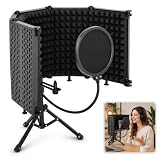

What you are buying in the current market as of 2026 generally falls into two bundles. The entry option around $27.99 to $32.99 is usually a foldable 3-panel shield with foam, 5/8-inch and 3/8-inch threaded adapters, and nothing else — you supply the mic, arm, and pop filter. The $35.99 to $49.99 bundle typically adds a compact desktop tripod stand and a gooseneck pop filter in the box. Both are designed for condenser mics like the Audio-Technica AT2020, Rode NT1, or USB mics like the Blue Yeti and Elgato Wave:3.
Expect real-world dimensions of about 16 to 17 inches wide when fully opened, 10 to 12 inches tall, and 3 to 7 inches deep with the curve. Folded for storage, most 3-panel versions collapse to roughly 9 x 12 x 4 inches. Weight ranges from 2.2 to 3.5 pounds for foam-only models, and 4 to 6 pounds if a metal tripod base is included. No power, no wiring, no software — the shield is entirely passive.
It is important to understand what it does not do. This is acoustic treatment, not soundproofing. It cannot stop sound from entering or leaving your room. It will not block street noise, a loud mechanical keyboard, or air conditioner hum coming from across the room. What it can do is reduce the immediate reflections that hit the most sensitive side and rear of a cardioid condenser mic — the wall directly behind your monitor, a nearby corner, or a bare desk surface. In a small untreated bedroom or office with drywall, hardwood floors, and a window, that reduction can make your voice sound slightly tighter and less hollow on stream.
Setup is simple but not invisible on camera. On a boom arm, the shield hangs behind the mic and will be partially visible on face-cam. On a tripod, it sits on your desk and takes up about 12 to 14 inches of depth, which can crowd a 48-inch desk if you also have a keyboard, monitor, and stream deck. Most shields have ventilation gaps and do not fully enclose the mic, so your voice still projects naturally and the mic does not overheat or build up plosive pressure.
Pros
- Reduces room echo without permanent installation: Ideal for renters, dorms, and shared offices where you cannot glue acoustic panels or drill into walls. You can fold it and put it in a closet when not streaming.
- Very affordable compared to full treatment: At $27.99 to $49.99, it costs less than a 12-pack of 12×12 inch acoustic panels and requires no adhesive or wall repair.
- Helps condenser mics sound more controlled: Cardioid condenser mics pick up a lot of room sound. A shield tames the harshest early reflections from hard surfaces directly behind the mic, which can reduce that empty, boxy sound on voice.
- Portable and mic-arm compatible: Most models include adapters for standard 3/8-inch and 5/8-inch threads, so it mounts to popular arms from Elgato, Rode PSA1, InnoGear, and NEEWER without extra hardware.
- Doubles as a light pop and draft barrier: While not a replacement for a pop filter, the foam and curved shape can soften light plosives and a small amount of breath noise when combined with a proper mesh or metal pop filter.
- No learning curve: No EQ, no plugins, no acoustic knowledge needed. Unfold, tighten the knobs, mount your mic, and you are done in under five minutes.
Cons
- Does not soundproof anything: It will not lower your noise floor from fans, keyboards, clicks, or family noise in the next room. Viewers will still hear those sounds because they enter the front of the mic.
- Limited frequency effect: Thin foam primarily affects mid and high frequencies. It does very little for low-end rumble, boomy room modes, or bass buildup in a small square room. Your voice may still sound muddy without EQ or thicker treatment.
- Can make a small desk feel cramped: The curved panel blocks sightlines and takes up valuable desk depth. On camera, it can look bulky behind a compact USB mic setup.
- Not a substitute for mic technique and gain staging: A shield cannot fix a mic that is too far away, gain set too high, or a noisy environment. Proper distance of 6 to 12 inches from the mic and correct input levels matter more.
- Build quality varies at the low end: Budget foam can arrive compressed, the metal frame may wobble if not tightened evenly, and the included tripods in sub-$40 bundles are often lightweight and can tip with a heavy mic.
- Can slightly color your sound if placed too close: If the shield is within 1 to 2 inches of the rear of the mic, some users notice a slightly boxed-in or muffled quality rather than a natural room sound. A few inches of clearance is better.
Who Should Buy It
You should consider an isolation shield if you stream with a sensitive condenser mic in an untreated room and you have no option to treat the room itself. This describes a lot of beginner streamers in bedrooms with bare walls, hardwood or laminate floors, and a desk pushed against a wall. If your VODs sound echoey, hollow, or like you are in a bathroom even though your mic is good, a shield is a low-risk way to test whether taming early reflections helps.
It also makes sense if you need portability. If you stream from two locations, travel for collaborations, or record voiceovers in a temporary space, a foldable shield that fits in a backpack or duffel is more practical than panels you would have to leave behind. Podcasters and vocalists who rent studio time or record in different rooms benefit most here.
Finally, it is worth it if you are using a boom arm and want a non-destructive, landlord-friendly step before committing to panels, curtains, or moving furniture. Spend $27.99 to $35.99 to see if your room issue is actually reflections — if it helps even a little, you can later invest in more effective treatment with confidence.
Who Should Skip It
Skip it if you already have basic acoustic treatment. Even two to four 12×12 inch panels placed at first reflection points, a heavy curtain over a window, or a bookshelf behind you will do more than a small curved foam board. If your room already has carpet, upholstered furniture, and curtains, you are unlikely to hear a meaningful difference.
Skip it if your main problem is background noise, not echo. Keyboard clacks, mouse clicks, fan noise, and street sounds are not reflection problems. For that, you need a dynamic mic like the Shure SM58 or Samson Q2U, a tighter cardioid pattern, a noise gate, proper mic placement close to your mouth, and lowering your gain. A shield will disappoint you if you buy it to block those sounds.
Skip it if you are tight on desk space or care about a clean on-camera look. A dynamic mic with good technique plus a simple software noise suppression filter in OBS or Discord often looks and sounds cleaner for gaming streams than a large foam shield crowding your face-cam.
If you can spend the same money on a better mic position, a $12 to $18 mesh pop filter, and free fixes like moving your desk away from the wall by 12 to 18 inches and adding a thick blanket or rug behind you, do those first.
Cheaper Alternatives
| Option | Cost | Trade-off |
|---|---|---|
| Move mic closer + lower gain + OBS noise suppression | $0 | Free and often the biggest improvement, but requires testing gain and filter settings; will not fix strong echo alone |
| Heavy moving blanket or thick rug hung 2-4 inches off wall behind monitor | $15 to $30 | More surface area than a shield and better at taming mid-high reflections; looks less professional and needs a hook or stand |
| 2 to 4 pack of 12×12 inch acoustic foam panels with adhesive tabs | $18 to $35 | More effective when placed at reflection points; requires wall-safe adhesive and leaves marks if removed poorly; not portable |
| Dynamic USB/XLR mic instead of condenser | $49 to $79 | Rejects far more room noise and keyboard sound by design; costs more upfront and needs you to stay 2 to 4 inches from the mic |
| DIY closet vocal booth (clothes, blankets, pillows) | $0 to $10 | Surprisingly effective for voiceover takes; not practical or good-looking for a daily streaming setup |
FAQ
Will an isolation shield make my mic sound professional for streaming?
It can make a harsh, echoey room sound slightly tighter and more focused, but it will not make a budget mic sound like a studio chain on its own. The biggest factors for a professional stream sound are still mic choice, distance from your mouth, correct gain, and reducing noise at the source. Think of the shield as a 10 to 15 percent improvement for echo, not a complete fix.
Do I need the tripod bundle or just the shield?
If you already own a boom arm, save money and buy the shield-only foldable version with adapters. It is lighter, folds flatter, and keeps your desk clear. Buy the tripod + pop filter bundle only if you do not have an arm or you need a standalone setup you can move between desks. The included tripods work fine for mics under 1 pound but can wobble with heavier mics.
Can I use an isolation shield with a dynamic mic?
You can, but you will notice less benefit. Dynamic mics are already less sensitive to room reflections than condensers and are designed for close-up use. If you are on a dynamic mic and still hear echo, you are likely too far from the mic or your gain is too high. A shield is rarely worth it for a dynamic mic unless your room is extremely reflective and untreated.
What should I try before buying a shield?
Start with free fixes: pull your mic to 6 to 10 inches from your mouth, turn down input gain until your normal speaking voice peaks around -12dB to -6dB in OBS, enable a light noise gate and noise suppression filter, and move your desk a foot away from the bare wall if possible. Then add a soft surface behind your monitor — a thick blanket, curtain, or even an open closet full of clothes — and listen to a test recording with headphones. If you still hear a distinct slap echo or hollow ring, then a shield or a few wall panels is a logical next step.
