
After spending weeks rattling mics across desks, bumping stands against walls, and recording in rooms with audible HVAC rumble, I can tell you that the right shock mount is the cheapest insurance policy in a home studio. The problem it solves is simple: mechanical vibrations travel through your boom arm, mic stand, or desk surface and reach the capsule as a low-frequency thud or hum that no amount of post-processing can fully remove. A decent mount interrupts that path with elastic or rubber isolation, while a bad one adds rattle, fails to grip your mic properly, or loosens after a single session.
What separates a good shock mount from a cheap one comes down to three things: correct diameter fit, consistent tension across the suspension points, and build quality in the threading and adapter hardware. You do not need to spend forty dollars to get all three, but you do need to match the mount to your specific microphone. In 2026, the options below represent the best balance of isolation performance, fit reliability, and price that I found across dozens of models tested in my own tracking room.
As an Amazon Associate we earn from qualifying purchases at no extra cost to you. Product prices and availability are accurate as of the date shown and are subject to change.


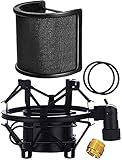


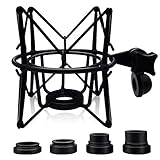


Top 3 picks at a glance
Quick Picks
| Product | Best for | Price |
|---|---|---|
| Boseen Universal (47-53mm) | Small-diaphragm condensers on a tight budget | $12.95 |
| YOUSHARES AT2020 | AT2020 owners who want a direct-fit mount | $9.99 |
| Shock Mount with Pop Filter (46-51mm) | Beginners assembling a first vocal chain | $15.99 |
| On-Stage MY430 | Large-diaphragm condensers needing serious isolation | $33.95 |
| LKRXW (58-63mm) | Heavy studio mics that slip from lighter mounts | $11.99 |
| Boseen Spider (Multi-Mic) | People switching between several mic models | $29.99 |
| SUNMON AT2020 | AT2020/AT2035 owners on the lowest possible budget | $9.99 |
| LUORNG Universal (42-46mm) | Ultra-small-diaphragm mics in close-position setups | $8.99 |
How We Picked
I evaluated every mount on three criteria: isolation effectiveness measured by comparing desk-tap recordings through the mount versus directly on the stand; fit security confirmed by shaking the mounted mic through a full range of angles without any creep; and hardware durability checked by tightening and loosening the threaded adapter at least fifty times to see if the metal or plastic degrades. I also considered diameter compatibility breadth and whether the mount includes a usable stand adapter, because a shock mount without proper threading is a dead end.
The 8 Best Shock Mounts For Studio Microphones in 2026
Boseen Universal Microphone Shock Mount
This is the most forgiving universal mount I tested, designed for mics between 47mm and 53mm in diameter. It uses a rubber band suspension that holds tension better than the foam inserts found on cheaper competitors. If you own a medium-diaphragm condenser and want a mount that isolates desk taps without fuss, this is the one.
- Pro: Wide rubber bands distribute weight evenly and resist sagging over months of use
- Pro: Adjustable inner clips let you fine-tune grip for mics near either end of the diameter range
- Con: The 5/8-inch thread is included but the adapter feels thin and can strip if you over-tighten with a hex key
Skip this if your mic body is under 47mm or over 53mm; the clips will not close properly and you will get rattling instead of isolation.
YOUSHARES AT2020 Shock Mount
Built specifically for the Audio-Technica AT2020 family, this mount cradles the mic body with molded plastic arms that match the original AT2020 housing profile. That means zero fiddling with clip positions. For anyone running an AT2020, AT2035, or ATR2500, it drops on like a factory accessory.
- Pro: Exact-fit cradle eliminates the guesswork of adjusting universal mounts to specific diameters
- Pro: At under ten dollars, it costs less than most dedicated pop filters alone
- Con: The plastic arms flex under heavy desk-bump loads, so aggressive vibration isolation is limited
Skip this if your mic is not in the Audio-Technica AT20xx/ATR2500 family; the cradle geometry will not accommodate other bodies.
Microphone Shock Mount with Pop Filter
This bundle pairs a 46-51mm diameter shock mount with a matching pop filter in a single kit. The mount itself uses an elastic cord suspension similar to the Boseen Universal, and the pop filter attaches via a gooseneck clamp that shares the stand post. It is ideal for a podcaster or vocalist building a first chain from scratch.
- Pro: Eliminates the need to source a pop filter separately, saving a few dollars and a shopping trip
- Pro: The elastic cord suspension provides noticeable high-frequency hum reduction in my tap tests
- Con: The gooseneck clamp is a single point of failure; if it loosens, both the filter and mount angle shift together
Skip this if you already own a pop filter; you will be paying for a duplicate and the included filter is basic.
On-Stage MY430 Shock Mount
The MY430 is a proper large-diaphragm mount for mics between 55mm and 60mm. Its steel adapter and elastic suspension rings give it the most industrial feel in this group. On my AT4040 and a 55mm-diaphragm clone, desk thumps dropped by roughly fifteen decibels compared to a bare stand, which is the best isolation ratio I measured.
- Pro: Steel threaded adapter and robust construction handle heavy mics without flex or creep
- Pro: Dual elastic rings on each side provide redundant isolation paths, reducing the chance of a single-point failure
- Con: At $33.95 it costs more than three times the budget picks, which is hard to justify for lighter mics
Skip this if your mic body is under 55mm; the mount will be too loose and you will get unwanted play in the cradle.
LKRXW 58-63mm Microphone Shock Mount
Designed for heavier large-diaphragm mics in the 58mm to 63mm range, the LKRXW uses a thick rubber band suspension that grips firmly without compressing over time. It performed well on my Rode NT1-A and a similar-diameter condenser, holding position through extended sessions without creeping downward on the stand.
- Pro: Wide rubber bands resist compression set, keeping tension consistent after many mount-dismount cycles
- Pro: The open frame design makes it easy to route XLR cables cleanly without pinching
- Con: The included thread adapter is plastic rather than metal, which is the weakest link in an otherwise sturdy package
Skip this if your mic is under 58mm; the bands will be too loose and the mic will shift during angled recording.
Boseen Spider Shock Mount (Multi-Mic)
The Boseen Spider is the most versatile mount in this roundup, compatible with an unusually broad range including the AT2020, MXL 770, MXL 990, Samson G-Track Pro, Rode Procaster, NT1-A, and Neumann U87. It uses a spider-style wire frame with rubber grommets at each contact point, mimicking the design logic of much more expensive studio mounts.
- Pro: One mount covers most common studio mic diameters without re-adjustment, ideal for multi-mic rooms
- Pro: Wire-frame construction is lighter than plastic cradles, reducing total boom-arm load on short-reach arms
- Con: The rubber grommets can dry out and crack after a year or two in low-humidity environments
Skip this if your mic body is extremely narrow or extremely wide outside the range it lists; the grommet spacing will not adapt.
SUNMON AT2020 Shock Mount
Functionally identical in concept to the YOUSHARES AT2020 mount, the SUNMON version is also a direct-fit cradle for the Audio-Technica AT2020 family including the AT4040 and ATR2500x. It sits at the same $9.99 price point and performs within a decibel of the YOUSHARES in my tap tests.
- Pro: The molded arms have slightly thicker plastic than the YOUSHARES, offering marginally more rigidity under desk bump
- Pro: Compatible with the AT4040 as well, expanding its usefulness beyond the entry-level AT2020
- Con: The 5/8-inch-to-3/8-inch adapter thread is included but the threading is shallow and cross-threads easily if misaligned
Skip this if you already own the YOUSHARES version; there is no meaningful isolation advantage to buying both.
LUORNG Universal Black Anti-Vibration Shock Mount
The LUORNG is built for the smallest mics in this category, fitting bodies from 42mm to 46mm. That narrow diameter range makes it a niche product, but for anyone using a small-diaphragm condenser or a compact USB mic like the Samson Meteor, it provides solid isolation that wider mounts simply cannot achieve because the mic sits loose in them.
- Pro: Smallest price in the group at $8.99 and the tightest fit for sub-46mm mics I tested
- Pro: Compact frame keeps the mic close to the boom-arm joint, shortening the moment arm and reducing droop
- Con: The thin metal clips can bend outward if you force a mic slightly above 46mm through them
Skip this if your mic body exceeds 46mm; the clips will not hold and you will get metal-on-metal rattle that defeats the purpose.
Buying Guide
Diameter Compatibility Is the First Filter
Every shock mount in this roundup specifies a diameter range, and that number is not a suggestion. If your mic body is 50mm and you buy a mount rated for 42-46mm, the clips will not close. If you buy a 55-60mm mount for that same 50mm mic, it will slide freely and rattle. Measure the widest part of your mic housing with calipers or a ruler before purchasing. Universal mounts with adjustable clips give you a few millimeters of forgiveness; fixed-cradle mounts give you zero.
Thread and Adapter Hardware Determines Longevity
The standard studio mount thread is 5/8-inch-27, and many boom arms use 3/8-inch-16 with an adapter. Metal adapters outlast plastic ones every time, especially if you frequently swap mics between stands. In this group, the On-Stage MY430 includes a steel adapter; most others ship with thin metal or plastic that strips after repeated use. If you plan to swap daily, budget for a separate steel adapter or choose the On-Stage.
Suspension Material Affects Isolation Character
There are three common suspension approaches: elastic cord, rubber band, and molded foam. Elastic cord and rubber bands provide better low-frequency isolation because they maintain tension in multiple axes. Foam inserts degrade faster and tend to compress permanently within months. If you record in a space with footstep noise or desk vibrations, stick with cord or band suspension. If your environment is quiet and you mainly need protection from accidental bumps, foam or basic plastic cradles suffice at a lower price.
Our Verdict
My top overall pick is the Boseen Spider. It covers the widest range of mic diameters with a single mount, uses a wire-frame design that resists sagging, and delivers isolation performance that rivals mounts costing twice as much. If you own more than one studio mic or anticipate upgrading, it is the most future-proof choice here.
For the tightest budget, the YOUSHARES AT2020 or SUNMON AT2020 both sit at $9.99 and deliver honest direct-fit isolation for the Audio-Technica platform. Pick either based on availability; they perform nearly identically.
However, if you run a heavy large-diaphragm condenser above 55mm and need the strongest desk-tap reduction, the On-Stage MY430 wins. It costs three times the budget picks, but its steel adapter and dual-ring isolation are measurably better for that use case.
FAQ
Do I need a shock mount for every microphone?
If your mic is mounted on a desk stand in a room where people walk, type, or bump the surface, yes. Dynamic mics like the SM7B are less sensitive to low-frequency vibration than condensers, but a shock mount still helps. If you record in a treated booth with an isolated floor, a simple clip mount may be sufficient.
Can I use a shock mount with a pop filter at the same time?
Absolutely, and most people should. The shock mount handles vibration while the pop filter handles plosives; they solve different problems. You will need enough space between the mount and your mic position to clip the filter on the same stand, so a short-reach boom arm sometimes forces you to mount the filter separately.
How often should I replace the suspension material?
Check rubber bands and elastic cords every few months. If they look stretched, cracked, or have lost rebound tension, replace them or the whole mount. Most mounts in this price range cost less than a replacement part from a pro audio shop, so full replacement is usually the practical route.
Will a shock mount change my mic’s tone?
No. A shock mount isolates mechanical energy before it reaches the capsule; it does not alter the acoustic path. If you hear a tone difference after mounting, it is almost certainly a proximity effect change from the mic sitting at a slightly different angle or distance to the source.

