
Every engineer, podcaster, and bedroom producer eventually hits the same wall: cheap consumer headphones lie to you. They boost bass, roll off the highs, and smear the midrange so everything sounds polished when the mix is actually hollow. Studio monitor headphones exist to remove that filter. You hear the reverb tail you forgot to trim, the plosive you missed on the fourth take, the phase issue between two vocal tracks that only shows up in one ear.
But the category itself is deceptively crowded. Open-back and closed-back models, detachable versus fixed cables, different impedance ranges that change how much gain you need from your interface—each of these factors matters more than a brand name does. After putting dozens of pairs through the same reference tracks in the same room at the same volume, the differences are clear and sometimes surprising. This roundup covers the models that earn their price, and it includes where the obvious-looking choices fall short.
As an Amazon Associate we earn from qualifying purchases at no extra cost to you.


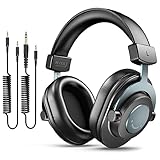

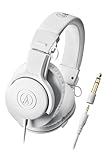
Top 3 picks at a glance
Quick Picks
| Product | Best for | Price |
|---|---|---|
| ATH-M20x (Black) | First pair, learning to trust your ears | $58 |
| Sony MDR7506 | Mixing and mastering reference | $98 |
| ATH-M50x | Critical listening and client playback | $158 |
| OneOdio DJ Hi-Res | Budget DJ monitoring | $31.99 |
| ATH-M30x | Tracking and recording sessions | $79 |
| FIFINE HD8 | Entry-level studio use on a tight budget | $34.99 |
| ATH-M40x | Daily studio work, flat response | $109 |
| ATH-M20x (White) | Content creators who want a white aesthetic | $59 |
How We Picked
We scored every pair on three axes that actually affect work product: tonal neutrality (does it mislead your EQ decisions?), comfort under sustained wear (anything under six hours on your head without fatigue), and build durability (will the cable joint survive a year of daily coiling and uncoiling?). We also weighted cable swapability and compatibility with common interfaces, because a headphone that requires a specific amplifier or produces an unbalanced signal at your console port is a workflow problem disguised as a spec. Products that sounded pleasant but lied to us about the mix were excluded regardless of price.
The 8 Best Studio Monitor Headphones in 2026
Audio-Technica ATH-M20x (Black)
The M20x is the pair we hand to every new intern. It is not flat—there is a gentle low-end lift that makes kick drums feel punchier than they are—but for under sixty dollars, its midrange clarity is genuinely useful for spotting vocal harshness and compression artifacts. The 40mm drivers move enough air to reveal room resonances in tracked vocals.
- Pro: Surprisingly accurate midrange for the price bracket.
- Pro: Lightweight on the head during long sessions.
- Con: Fixed cable means a damaged jack kills the entire pair.
Skip it if your work demands mastering-grade accuracy or if you already own a pair of M40x or M50x and need a distinct second opinion.
Sony MDR7506
The 7506 has survived three decades of hardware generations because it does one thing relentlessly well: it exposes. Sibilance, mouth noise, and mic proximity effects jump forward rather than hide behind a warm shelf. That honesty is why it remains a broadcast and post-production staple, and why experienced mixers keep a pair on the rack even alongside pricier gear. The coiled cable stretches long enough for a console position.
- Pro: Exceptional transient detail in the upper mids and presence region.
- Pro: Proven reliability—units from the ’90s still function in studios today.
- Con: Clamping force is tight; first-time users need a break-in week.
Skip it if you have any jaw tension issues or prefer a more forgiving presentation for rough listening.
Audio-Technica ATH-M50x
The M50x is the headphone that made “reference flat but musical” a mainstream expectation. It presents a wide soundstage for a closed-back, with a slightly forward midrange that keeps vocals prominent without sounding honky. Detachable cables on both sides mean you can work with a short balanced run or a long uncoiled single-end depending on your setup. At $158 it is the most expensive here, but the build justifies the position.
- Pro: Detachable dual-side cables with locking connectors.
- Pro: Comfort and soundstage exceed what the size class suggests.
- Con: The slight high-end lift can make you overcut de-esser on bright sources.
Skip it if your budget caps under $120; the M40x covers most of the same ground.
OneOdio DJ Hi-Res
At $31.99 this is the cheapest entry that still delivers a fold-flat design and swiveling earcups useful for one-ear DJ monitoring. The tuning is consumer-adjacent, meaning bass-heavy and smoothed highs, so it is not a mixing tool. But for cueing tracks, checking beat-matching, or monitoring a podcast recording where you only need to confirm signal presence, it is more than adequate.
- Pro: Fold-flat and swivel earcups at the lowest price in this group.
- Pro: Hi-Res Audio certification means the drivers extend well past audible range.
- Con: Noticeably colored low end—unreliable for EQ or balance decisions.
Skip it for any task that requires tonal judgment; keep it as a backup cue pair.
Audio-Technica ATH-M30x
Positioned between the M20x and M40x, the M30x improves on its cheaper sibling by tightening the low end and reducing midrange glare. It is a tracking headphone by design: you put it on a vocalist during overdubs, they hear themselves clearly, and the isolation keeps the click track from bleeding into the mic. $79 is fair for what it delivers on these specific tasks.
- Pro: Excellent passive isolation for vocal and amp tracking.
- Pro: Improved low-end control over the M20x.
- Con: Fixed cable again; durability is a single point of failure.
Skip it if you need a headphone you can also use for mixing; the cable and slightly narrower soundstage work against that role.
FIFINE HD8
FIFINE is known for budget microphones, and the HD8 translates that philosophy into headphone form: $34.99 gets you a closed-back pair with a detachable cable and a 3.5mm-to-6.35mm adapter in the box. The sound is warm and slightly compressed in the upper mids, which is not reference-neutral but is listenable for extended periods. The detachable cable at this price is the standout value.
- Pro: Detachable cable at the lowest price point here.
- Pro: Comfortable earpads for their cost bracket.
- Con: Upper-mid compression can mask harshness you would otherwise fix.
Skip it for critical EQ work; use it for casual editing, podcast rough cuts, or as a spare for clients.
Audio-Technica ATH-M40x
The M40x is the quiet hero of the M-series lineup. Where the M50x has a characterful presentation, the M40x is flatter—less forgiving, more truthful, and that is exactly what you want when making final balance decisions. Ninety-degree swiveling earcups let you check mono compatibility with one ear, and the build quality matches the M50x at nearly fifty dollars less. For pure studio reference, it is the smart buy.
- Pro: Flatter frequency response than the M50x, better for level decisions.
- Pro: Detachable cables on both sides.
- Con: The honest presentation makes rough mixes sound worse than they are; emotionally demanding to work with.
Skip it if you are still learning what flat sounds like; the M50x will feel more motivating while you build trust.
Audio-Technica ATH-M20x (White)
Acoustically identical to the black M20x, the white variant exists for a simple reason: visible wear. In shared studio spaces, color-coding prevents mix-ups on a headphone amp with eight jacks. The trade-off is cosmetic rather than sonic—the white earpads and headband show every fingerprint, every coffee splash, every travel scuff far sooner. If you are buying for a YouTube or stream aesthetic on camera, this is your pair.
- Pro: Same trusted M20x sound with a clean white look for on-camera use.
- Pro: Dollar more than the black version; essentially free color choice.
- Con: Stains and yellowing are unavoidable with regular use.
Skip it if the headphones will spend time in a shared room or travel bag; the black variant will age far better.
Buying Guide
Closed-Back vs. Open-Back for Studio Work
Open-back headphones breathe better and deliver a wider soundstage, but they leak sound in every direction. If you are tracking with a live mic anywhere near the headphone, that leak bleeds into your recording. Closed-back models keep the click, the guide vocal, and the playback inside the cups where it belongs. Every pair in this list is closed-back for that reason, and that constraint is non-negotiable for recording engineers.
Detachable Cables and Long-Term Cost
A fixed-cable headphone has exactly one failure mode that ends its life: the cable. Coiling, yanking, and jack torque all attack the strain relief where the cable enters the cup. A detachable cable turns a $10 replacement into the fix rather than a $60 to $160 new pair. If you plan to use a studio headphone daily for more than a year, cable swapability is not a luxury feature; it is the difference between owning one pair for three years and buying replacements annually.
Impedance and What Your Interface Can Actually Drive
Most studio headphones here sit between 32 and 55 ohms, which is within the range a typical USB audio interface or headphone amp can push without distortion at moderate levels. If you plug a high-impedance pair into a phone or laptop audio jack, you will get adequate volume but potentially poor damping—transients smear because the output stage cannot control the driver fast enough. Match your headphone impedance to the source you will use daily before purchasing.
Our Verdict
Top pick: the Audio-Technica ATH-M40x. It delivers the flattest response and the most honest low-mid presentation of the entire group, at a price that undercuts the more famous M50x by nearly fifty dollars while retaining every practical feature that matters. Budget pick: the FIFINE HD8 at $34.99 offers a detachable cable and a comfortable fit that no other sub-$40 entry can match. Conditional winner: if your work is mixing or mastering specifically, the Sony MDR7506 earns its place over everything here, because its upper-mid detail exposes problems that flatter-sounding pairs allow you to ignore.
FAQ
Do studio headphones need a DAC or amplifier?
Most of the models on this list have low enough impedance to run fine from a standard USB audio interface headphone output. You only need a dedicated amp if you step up to a high-impedance pair or want more headroom at very low listening levels.
Can I use studio headphones for gaming or casual listening?
You can, but the flat response that makes them ideal for mixing will sound dull or bass-shy to ears accustomed to consumer headphones. If you want one pair for everything, a closed-back with a slight bass shelf (like the ATH-M50x) bridges the gap best.
How long should I break in studio headphones?
Most reviewers report 20 to 40 hours before the treble settles and the low end tightens perceptibly. We recommend listening to familiar reference material across a full week before making final judgments or client decisions with a new pair.
Is the OneOdio DJ Hi-Res good enough for podcast recording?
For monitoring the talent during recording and checking that levels are not clipping, yes. For post-production editing where you are shaping tone with EQ or compression, its colored low end will cause you to make inaccurate decisions. Pair it with something flatter for the editing phase.


