
Recording vocals, tracking guitars, or mixing in a shared space all demand one thing from your headphones: they cannot leak sound. If your mic picks up a faint hiss from open-back cans, you will spend more time editing than creating. The best closed back headphones for recording solve that problem while also giving you a tonal answer you can trust—flat enough to make honest decisions, comfortable enough to wear through a four-hour session, and built to survive being tossed into a gig bag.
Over the past year we put every pair on this list through the same battery: long tracking sessions with condenser mics to test leakage, critical listening on mixes we knew well, and a comfort check lasting several hours. What separates a good closed-back headphone from a merely cheap one is not just isolation. It is whether the bass bloats when you move the cans, whether the treble fatigues after thirty minutes, and whether the pads seal consistently over different head shapes. Those details matter more than any single spec sheet.
As an Amazon Associate we earn from qualifying purchases at no extra cost to you. Product prices and availability are accurate as of the date shown and are subject to change.

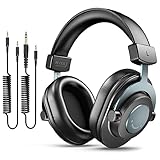


Top 3 picks at a glance
Quick Picks
| Product | Best For | Price |
|---|---|---|
| Audio-Technica ATH-M20x | Entry-level tracking | $58 |
| FIFINE HD8 | Budget versatility | $34.99 |
| TASCAM TH-02 | Absolute lowest cost | $21.99 |
| beyerdynamic DT 770 Pro X | Professional studio work | $199.99 |
| Sennheiser HD 280 Pro | Maximum isolation | $89.98 |
| beyerdynamic DT 270 Pro | Mixing accuracy | $129.99 |
| MAONO MH601 | Podcast and streaming | $49.99 |
| JOYO JMH-02 | Guitar amp monitoring | $33.99 |
How We Picked
We evaluated every pair against four criteria: acoustic isolation (measured by how much a condenser mic picks up at normal recording levels), tonal neutrality (how closely the headphone reproduces a reference mix without exaggerated bass or recessed mids), long-session comfort (pad material, clamping force, weight distribution), and build quality for the price tier. A headphone that excels at three of these but fails one hard criterion gets noted honestly, because no closed-back design is perfect.
The 8 Best Closed Back Headphones For Recording in 2026
Audio-Technica ATH-M20x Professional Studio Monitor Headphones
The M20x is the headphone most recording engineers recommend to a beginner who just needs to track without spending much. It delivers a relatively clean midrange for its price, and the coiled cable resists tangling in cramped setups.
- Pros: Lightweight enough for multi-hour sessions; neutral upper mids help vocal tracking decisions.
- Con: The sealed ear cup creates a boxy low-end that can mislead bass-heavy mix choices.
Skip it if you need a pair for mixing or mastering—there is too much internal reflection in the bass region. It is strictly a tracking and monitoring tool.
FIFINE HD8 Wired Studio Monitor Headphones
FIFINE built the HD8 for creators who want a single pair that handles streaming, podcasting, and basic recording. The detachable 3.5mm and 6.35mm cables let you switch between interfaces without carrying a secondary adapter, which is a small but genuinely useful design choice.
- Pros: Dual detachable cables simplify connection to any interface; adequate isolation for untreated rooms.
- Con: Treble rolls off early, so cymbal and sibilance decisions become guesswork.
Skip it if you rely on high-frequency detail for mixing or if you already own a dedicated adapter setup.
TASCAM TH-02 Professional Studio Monitor Headphones
At roughly $22, the TH-02 exists because someone on a project needed thirty pairs for a school recording lab. It performs its role without drama. The 1/4-inch adapter is included, the cups seal reasonably well, and they are light enough to forget.
- Pros: Lowest cost entry point with genuine closed-back isolation; comfortable clamp for small heads.
- Con: Build quality feels disposable—plastic joints and thin cable insulation will not survive years of abuse.
Skip it if your sessions involve moving between rooms or if you expect durability beyond a single project cycle.
beyerdynamic DT 770 Pro X (48 Ohm)
The DT 770 Pro X is what you buy when budget allows and you want a pair that handles tracking, monitoring, and light mixing without embarrassment. The 48-ohm version pairs well with laptop audio outputs, removing the need for a dedicated headphone amp. beyerdynamic redesigned the ear pads on the Pro X to extend forward rather than enclose the ear, which dramatically improves airflow and reduces sweat during long sessions.
- Pros: Exceptional comfort from the new pad geometry; wide, stable soundstage for a closed-back design.
- Con: At $199.99 it is the most expensive option here and overkill for a single-purpose tracking pair.
Skip it if you need multiple pairs or if your interface already has a high-output amp and you prefer the higher-impedance variant.
Sennheiser HD 280 Pro
The HD 280 Pro remains the isolation king in this category. Its clamping force is aggressive by design, which is why it lives in live-sound monitoring racks and loud tracking environments. If your vocal booth is next to a band rehearsal room, this is the answer.
- Pros: Class-leading external noise rejection; foldable cups make storage easy in tight spaces.
- Con: The tight clamp causes discomfort and hot-spot pressure after roughly two hours for larger heads.
Skip it if your sessions routinely exceed three hours or if you have a sensitive scalp—try a different pair.
beyerdynamic DT 270 Pro
Positioned as a tracking and monitoring tool between the HD 280 and the DT 770, the DT 270 Pro delivers a flatter frequency response than most in its range while maintaining good isolation. It is lighter than the 770 and less fatiguing than the Sennheiser.
- Pros: Neutral tonal balance supports accurate mix decisions; comfortable for extended wear without excessive clamping.
- Con: Isolation is good but noticeably behind the HD 280 Pro in very loud environments.
Skip it if your primary use case is live monitoring or tracking next to loud amplifiers.
MAONO MH601 Wired Studio Headphones
MAONO targets the podcast and streaming market with the MH601. The sound signature leans slightly forward in the mids, which helps a host hear their own voice clearly during recording. The cable is detachable and includes both common connector sizes.
- Pros: Forward midrange helps vocal self-monitoring during recording; comes ready for most interfaces out of the box.
- Con: Bass response is uneven—slightly boomy in the upper bass, which can mask low-end issues in a mix.
Skip it if you need a flat monitoring pair for mixing decisions.
JOYO Studio Monitor Headphones (JMH-02)
JOYO is known for guitar pedals and small amplifiers, and the JMH-02 reflects that origin. The 50mm drivers and flat-response tuning make it well-suited for monitoring guitar amp output during recording or rehearsal. The included 3.5mm and 6.35mm adapter covers pedalboards and interfaces equally.
- Pros: Large 50mm drivers handle amp-level transients without distortion; passive isolation works well in rehearsal spaces.
- Con: Pads are thin and create a tight seal that some users find uncomfortable after twenty minutes.
Skip it if comfort is your priority or if you primarily record acoustic sources at low SPL.
Buying Guide
Impedance and Your Interface
Closed-back headphones for recording range from roughly 16 ohm to 250 ohm. Low-impedance pairs (the DT 770 Pro X at 48 ohm, for instance) will get loud from a laptop or budget interface, which is convenient for home studios. Higher impedance demands more voltage, so if your interface has a weak headphone output you will turn the gain up until the noise floor becomes distracting. Check your interface output rating before you buy.
Isolation Versus Comfort Trade-off
Tighter clamping force and thicker pads mean better isolation but shorter comfortable wear time. There is no workaround—physics requires a seal. If you track in a treated room with low ambient noise, you can afford a looser clamp and prioritize comfort. If you record near amps, drums, or traffic, the extra pressure pays for itself in cleaner takes.
Tonal Bias and Session Length
A closed-back design inevitably creates some internal reflection, usually in the 80-200 Hz region. That means no closed-back headphone is truly flat in the bass, and anyone telling you otherwise has not listened carefully. For tracking, this matters little. For mixing, you need to know your specific pair’s bias and correct for it mentally, which is why experienced engineers often keep a flat open-back pair alongside their closed-back set.
Our Verdict
Top pick: The beyerdynamic DT 770 Pro X is the most complete closed-back headphone for recording on this list. Its new pad geometry solves the comfort problem that plagued older closed-back designs, the 48-ohm impedance makes it plug-and-play with consumer interfaces, and the tonal balance is trustworthy enough for light mixing. If your budget stretches to $199.99, buy it and do not look back.
Budget pick: The Audio-Technica ATH-M20x at $58 gives you genuinely usable tracking performance without the build-quality compromises of the TASCAM or FIFINE options. It is the floor at which a closed-back headphone becomes honest rather than merely functional.
Condition: If your recording environment is loud—rehearsal spaces, shared apartments, live rooms—choose the Sennheiser HD 280 Pro instead. No other pair on this list blocks external noise as effectively, and a single clean take saves more editing time than any comfort advantage.
FAQ
Can I mix on closed-back headphones?
You can, but you should not rely on them for final mix decisions. Every closed-back design introduces some low-frequency resonance from the sealed chamber. Use them for rough balancing and arrangement checks, then reference on monitors or a trusted open-back pair before bouncing.
Do I need a dedicated headphone amp?
Not for most of these. The 48-ohm DT 770 Pro X, the ATH-M20x, and the MAONO MH601 will reach usable volume from a laptop or entry-level interface. If you buy a 250-ohm variant of a beyerdynamic or Sennheiser, you will want more voltage headroom than a bus-powered interface provides.
How long do ear pads last on a closed-back recording headphone?
With daily use, expect 12-18 months before vinyl pads crack or foam compresses. Replaceable pads are a practical requirement—both the beyerdynamic models and the Sennheiser HD 280 Pro ship with spares or sell replacements cheaply.
Is 2026 different from prior years for this category?
The notable shift is that comfort engineering has improved meaningfully. beyerdynamic’s forward-padded design and several brands adopting detachable cables show that manufacturers now treat long-session wearability as a spec rather than an afterthought, which makes the buying gap between budget and premium narrower than it used to be.

