
As an Amazon Associate we earn from qualifying purchases at no extra cost to you. Product prices and availability are accurate as of the date shown and are subject to change.

The Short Answer
Yes — a boom arm is worth it for streaming if you talk on camera for more than an hour at a time or your desk is cluttered. That’s the one condition: you need enough desk depth (at least 24 inches) to clamp the mount and swing the arm without it colliding with your monitor. If you only record occasional voiceovers or your setup is a laptop on a kitchen table, skip it and spend the money elsewhere.
What You Actually Get
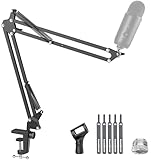
A boom arm replaces the small desktop tripod that ships with most USB microphones. Instead of a mic sitting on a folding stand in the middle of your desk, you get an articulated metal arm — usually 26 to 40 inches of reach — that clamps to the desk edge and holds the microphone exactly where your mouth is, then swings out of the way when you’re done.
The typical boom arm weighs 1.5 to 3 pounds, is built from steel or aluminum tubing with spring-loaded or tension-knob joints, and includes a 5/8-inch or 3/8-inch threaded mount (almost always with an adapter for the 1/4-inch threads on standard mic clips). Cheaper spring-based arms like the InnoGear run around $25 and handle mics up to roughly 2 pounds — fine for a Blue Yeti at 2.6 pounds is pushing it, but fine for a Fifine or HyperX model in the 1 to 1.5 pound range. Low-profile designs like the FIFINE BM88, around $57, tuck the arm beneath your monitor line and often route the XLR or USB cable internally through the arm itself, which matters a lot if your on-camera background is visible to viewers.
What you’re really buying is ergonomics and framing. The mic moves to your face, which means you can turn your gain down, which means less room noise and keyboard clatter in your audio. Your desk gets its surface back. And the mic stops photobombing your face cam.
Pros
- Better mic position. Placing the capsule 4 to 6 inches from your mouth instead of 18 lets you drop gain and reduce room echo, fan noise, and mechanical keyboard bleed.
- Frees up desk space. A desktop tripod consumes a 6-to-8-inch circle of surface; a boom arm uses one clamp about 2 inches wide on the desk edge.
- Cleans up your camera shot. The mic swings out of frame between segments and drops back in instantly.
- Fewer accidental bumps. Desk-stand mics pick up every tap, nudge, and coffee mug placement. A boom isolates the mic from desk contact noise.
- Comfort on long sessions. You stop leaning toward the mic or hunching to stay on-axis during multi-hour streams.
- Cable management options. Mid-range and low-profile arms route cables internally or provide clips, eliminating the dangling-wire look on camera.
- Cheap relative to what it fixes. At $25–$60, a boom arm costs less than most microphones and noticeably improves how the same mic sounds.
Cons
- Weak arms droop. Spring-loaded budget arms sag under mics heavier than 2 pounds; a Blue Yeti (2.6 lb) or Shure MV7 (1.2 lb with a heavy shock mount) can slowly sink out of position mid-stream.
- Desks can be the bottleneck. Glass tops, desks with thick bevels, undersurface cable trays, and Anything under about 0.4 inches of solid edge make clamping difficult or impossible.
- It’s one more thing on camera. A bulky chrome arm in a minimalist background can look worse than a small tripod.
- Vibration transfer on cheap models. Knocking the desk still travels up thin-gauge arms without a shock mount or isolation point.
- Wear at the joints. Budget arms lose tension over 12–18 months of daily adjustment and start drifting or squeaking.
- Reaching the controls gets awkward. A Yeti’s gain knob or a USB mic’s mute button is harder to hit when the mic is floating near your face.
Who Should Buy It
You’ll get real value from a boom arm if you fit one of these profiles:
- Streamers on camera more than 5 hours a week. The ergonomic and framing benefits compound fast at that usage level.
- Anyone with a full desk. Dual monitors, an audio interface, and a keyboard leave no room for a desktop stand.
- Podcasters and VTubers who sit still. A fixed, precise mic position beats chasing a tripod with your chair.
- Owners of light-to-medium USB mics (1–1.5 lb). Fifine, HyperX, Razer, and similar mics are squarely in the safe weight range for a $25–$57 arm.
- Anyone whose background is visible. Internal cable routing on a low-profile model like the FIFINE BM88 keeps the shot clean.
Who Should Skip It
- Mobile or occasional recorders. If you record less than a couple hours a week, the included tripod is fine.
- Shallow or unclampable desks. Under 24 inches deep, glass tops, or desks with risers and trays mean the clamp has nowhere to go.
- Heavy mic plus shock mount combinations on a tight budget. A $25 arm will fight you; you’d need a $90–$150 broadcast arm, which changes the math.
- Standing-desk users who move a lot. Frequent height changes re-tension the clamp constantly and can drag cables unless you buy a dedicated desk-hole mount.
Cheaper Alternatives
| Option | Cost | Trade-off |
|---|---|---|
| Keep the included desktop tripod | $0 | Occupies 6–8 inches of desk; mic sits too far away, so gain (and room noise) goes up; mic stays in your camera shot. |
| Compact tripod with adjustable height (e.g., small desk stands) | $10–$20 | Gets the mic closer to mouth level but still transfers desk bumps and clutters the shot. |
| Desk-hole mic mount (grommet-style) | $10–$15 | Cleaner look than a clamp and works on thin tops, but requires drilling or an open cable grommet. |
| Monitor-mounted mic bracket | $20–$30 | No desk clamp needed and stable, but positions the mic relative to the monitor, not your mouth, and adds weight to the stand. |
| Overhead camera-arm repurposed as a mic boom | $30–$40 | Decent reach, but joints aren’t tuned for mic weight and cable routing is DIY. |
If none of those appeal, the budget boom option is straightforward: the InnoGear arm at $24.99 covers most lightweight USB mics, and stepping up to a low-profile, cable-routed design like the FIFINE BM88 at $56.99 makes sense when your background is on camera. Both land well below the $90–$150 broadcast-arm tier and handle the weight of typical streaming mics.
FAQ
Will a boom arm hold a Blue Yeti?
It depends on the arm. The Yeti weighs about 2.6 pounds without a shock mount, which is at or above the safe capacity of most $25 spring arms — expect droop and slow sagging. Look for arms rated for at least 3 pounds, or use a low-profile tension-knob design and position the mic toward the center of the arm’s reach rather than fully extended.
Do I need a shock mount if I have a boom arm?
Not always, but it helps. A boom arm stops you from bumping the mic directly, but it can still transmit desk knocks up the arm itself. If you type aggressively on a mechanical keyboard or have a bouncy desk, adding a shock mount ($15–$40 for most USB mics) on top of the arm noticeably reduces low-frequency thumps.
How much desk space and what size mic do I need for a boom arm?
Plan on a desk at least 24 inches deep and a mounting edge at least 0.4 inches thick for a standard clamp. Arms offer roughly 26 to 40 inches of horizontal reach; a low-profile model needs a few extra inches of clearance beneath your monitor. Most arms weigh 1.5 to 3 pounds themselves and hold mics up to about 2 pounds reliably at the budget end.
Boom arm or desk stand — which is better for beginners?
Start with whatever came with your mic for the first few weeks. If you find yourself leaning in, knocking the mic, or wishing it were out of your camera frame, that’s your answer — upgrade to a boom arm. For under $30, the InnoGear is a low-risk test; if streaming becomes a regular habit in 2026 and beyond, the low-profile upgrade path is the FIFINE BM88-style design with internal cable routing.


