
Every streamer hits the same fork in the road within a week of buying a decent microphone: do you clamp a boom arm to the edge of your desk and float the mic in front of your face, or do you set a desk stand down and leave the microphone parked on the surface? It sounds trivial, but this single choice shapes how your setup looks on camera, how your audio sounds, how much desk space you lose, and how often you’re fiddling with gear instead of streaming. Get it wrong and you’ll spend months bumping the mic with your keyboard hand or fighting a wobbly arm mid-broadcast.
The honest answer is that neither option is universally better. A boom arm is about flexibility and getting the mic off your desk. A desk stand is about simplicity, stability, and leaving the gear alone. Your room, your desk, and your streaming habits decide which one actually fits. Here’s the full breakdown.
As an Amazon Associate we earn from qualifying purchases at no extra cost to you. Product prices and availability are accurate as of the date shown and are subject to change.


Top 3 picks at a glance
Quick Verdict
Buy a boom arm if: you stream regularly, you want the mic close to your mouth without hunching, you care about a clean on-camera look, and you’re willing to spend 20 minutes on setup and cable routing. Budget arms start around $25, and even well-built low-profile models land under $60.
Buy a desk stand if: you record occasionally, you share your desk with other work, you have kids or pets that knock things over, or you simply don’t want anything clamped to your furniture. A solid adjustable desktop stand costs $30–$60 and requires essentially zero maintenance.
If you’re still torn, the safest move for most first-time streamers is a quality desk stand for six months. If you find yourself leaning toward the mic constantly, upgrade to a boom arm then — nothing about a desk stand purchase is wasted, since it becomes your backup.
Side by Side
| Factor | Boom Arm | Desk Stand |
|---|---|---|
| Mic position flexibility | Excellent — positions the mic within an inch or two of your mouth at any angle, then swings out of the way | Limited — mic sits 8–14 inches from the desk surface wherever you place the base |
| Audio quality potential | Higher — closer mic distance means more gain headroom and less room noise | Good, but you’ll typically run higher gain, which picks up keyboard and room reflections |
| Desk space used | Almost none — base clamps to the desk edge (needs roughly 2 inches of clearance underneath) | Base footprint of 4–8 inches, permanently occupying surface area |
| On-camera appearance | Clean, professional, broadcast-style look | Functional but cluttered; mic and cables sit in frame |
| Stability | Good when clamped properly, but cheaper arms can sag or transmit desk knocks | Excellent — heavy bases (often 2–4 lbs) are nearly impossible to tip during normal use |
| Setup effort | 30–60 minutes including clamp mounting, cable routing, and counterweight balancing | Under 5 minutes — screw on the adapter, plug in, done |
| Maintenance | Occasional tightening of tension knobs; springs wear over years of repositioning | Essentially none |
| Typical price range | $25–$120 (budget: $24.99 InnoGear; low-profile: $56.99 FIFINE BM88; premium broadcast arms: $100+) | $20–$70 (heavy-duty adjustable models like the FIFINE BS1 run $29.99) |
| Durability | 3–7 years for budget arms; spring clamps and joints are the first failure points | 10+ years; with no moving joints beyond a simple angle adjustment, there’s little to break |
| Best for | Regular streamers, podcasters, anyone on camera | Occasional recorders, shared desks, homes with kids or pets |
Where Boom Arm Wins
Mic-to-mouth distance. This is the single biggest audio upgrade most streamers can make. Dynamic and condenser mics both sound noticeably better 2–4 inches from your mouth than 12+ inches away on a desk. Closer positioning lets you turn the gain down, which means less keyboard clatter, less room echo, and less HVAC hum bleeding in. No desk stand can replicate this — physics won’t let the mic float.
Getting the mic out of your way. With a boom arm, you swing the mic aside when you need to type, eat, or use your full desk. With a desk stand, the microphone is a permanent obstacle between you and your keyboard, and you’ll move it — and re-plug the cable — dozens of times a week.
On-camera polish. A boom arm with cleanly routed cable reads as “professional broadcaster.” Viewers notice. If your stream is a hobby today but you want it to look like more tomorrow, this matters more than it sounds.
Ergonomics. Desk stands force you to either lean down toward the mic or crane your chair height to compensate. Over a three-hour stream, that hunch adds up. A boom arm brings the mic to your posture instead of the reverse.
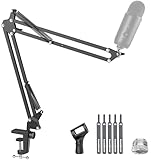
Budget entry is real. You don’t need a $100 broadcast arm to get these benefits. A basic spring-loaded arm like the InnoGear model at $24.99 handles a Blue Yeti (roughly 1.6 lbs with its shock mount) or similar mics fine for most home setups. Stepping up to something like the FIFINE BM88 low-profile arm at $56.99 gets you a cleaner silhouette on camera and smoother repositioning — the low-profile design is specifically popular with gamers who don’t want a tall arm crossing the frame.
Where Desk Stand for Streaming Mic Wins
Stability you never think about. A weighted desktop stand does not sag, drift, or creep downward over a long session. Cheap boom arms sometimes do exactly that, especially carrying heavier condenser mics. If your mic silently dropped two inches mid-stream, you’d notice — viewers would too.
No clamp, no furniture concerns. Boom arms need a desk edge to clamp onto: typically 0.5–2 inches thick, with open clearance underneath. Glass desks, shallow shelving, standing-desk frames, and hollow-core surfaces are all bad candidates. A desk stand needs nothing but flat surface.
Zero learning curve and zero fuss. There are no tension knobs to balance, no springs to squeak, no joints to loosen. A heavy-duty adjustable stand like the FIFINE BS1 ($29.99) is a set-it-and-forget-it piece: set the height once, adjust the angle occasionally, done.
Kid- and pet-proofing. A cat batting at a swinging boom arm is a genuine streaming hazard — for the mic, the arm, and your broadcast. A low, heavy base on the desk is far harder for small hands and paws to topple. Households with toddlers or curious pets consistently report fewer disasters with desk stands.
Rentals and shared spaces. Clamping hardware can leave marks, pressure dents, or finish damage on desk edges. In a rental or when furniture isn’t yours, a desk stand eliminates that risk entirely.
Longevity per dollar. There are decade-old desk stands still in daily service. Budget boom arms, particularly spring-loaded ones under $30, commonly develop loose joints or fatigued springs within 2–4 years of heavy repositioning. That doesn’t make them a bad buy — it just changes the math, which we’ll do below.
Cost Over 5 Years
Boom arm path: A budget arm at $25–$30 that lasts 3 years before joints loosen means a likely replacement around year 3–4. Total over 5 years: roughly $50–$85 (two budget arms), or a single $55–$70 low-profile or heavy-duty arm that survives the full five years with a knob tightened occasionally. Add $5–$10 if you buy cable clips or a small shock mount.
Desk stand path: A $30 heavy-duty adjustable stand has no meaningful failure mode. Total over 5 years: $30, possibly $40–$60 if you add a replacement stand or a second mic position. Nothing else to buy.
The desk stand wins on raw 5-year spend. But the boom arm’s extra cost buys better mic placement the entire time — which, for a streamer, is the difference between “acceptable audio” and “good audio.” Frame it this way: the arm costs about $6–$12 per year more, and that’s what you pay for proximity. Only you can decide if better sound is worth a coffee a month.
Which One for Your Home
Small Apartment or Studio
Desk space is your scarcest resource, so a boom arm is usually the right call — it reclaims the 30–50 square inches a mic base would occupy. The catch is the clamp: check that your desk edge is wood or sturdy composite, 0.5–2 inches thick, with clearance underneath for the clamp screw. A low-profile arm keeps sightlines open in a small room where the camera sees everything. If your desk is glass or a shallow IKEA-style tabletop, fall back to a compact desk stand with a small base.
Family with Kids or Pets
Go desk stand. A swinging arm at kid height is an irresistible target, and a surprise yank can pull a $100+ microphone off the desk with it. A weighted base (2+ lbs) with a low center of gravity, pushed back from the desk edge, survives household chaos far better. If you’re set on an arm anyway, mount it on the side of the desk away from walkways, keep it folded back when not streaming, and never leave a heavy mic dangling at reachable height.
Rental or Temporary Setup
Desk stand, without hesitation. You avoid any risk of clamp marks or finish damage on furniture you’ll be charged for, there’s nothing to uninstall when you move, and the whole setup packs into a box in five minutes. If you do use an arm in a rental, put a thin rubber or felt pad between the clamp and the desk edge — but the simplest answer is to skip the clamp entirely.
Long-Term Home and Dedicated Streaming Corner
This is the boom arm’s home turf. A permanent setup with a sturdy desk, no move-out date, and regular streaming justifies the setup time and the modest extra cost. Route the cable along the arm with clips, balance the tension once, and you’ll get years of broadcast-style convenience. Pairing a heavier low-profile arm with a dynamic mic (many of which weigh 0.7–1.1 lbs) is the sweet spot — lighter mics also put less strain on budget arm joints. Expect streaming hardware prices to stay friendly through 2026, with capable arms and stands both available well under $100, so you can always upgrade the arm later without rethinking the whole rig.
FAQ
Will a boom arm hold a heavy mic like a Blue Yeti?
Most will, with caveats. A Blue Yeti weighs about 1.6 lbs on its own — check the arm’s stated maximum load, and prefer arms with metal joints over all-plastic ones. Budget spring arms handle it, but expect to tighten the tension knobs periodically so the arm doesn’t slowly sink.
Do boom arms damage desks?
They can. The clamp applies steady pressure to the desk edge, which may leave pressure marks or finish dents, especially on soft wood or laminate. A felt or rubber pad between clamp and surface reduces the risk. Glass desks and desktops thinner than about half an inch are poor candidates.
Can I use a desk stand and still get good audio?
Yes, with adjustments. Position the stand so the mic is 6–10 inches from your mouth, add a foam windscreen or pop filter, and speak slightly off-axis to tame plosives. You’ll run more gain than with a boom arm, so treat any room echo — a rug and curtains help more than people expect.
Is a shock mount necessary with either option?
It’s most valuable with a boom arm, where desk knocks travel up the arm into the mic. With a desk stand, a shock mount helps less because the heavy base itself isolates a lot of vibration; a foam windscreen covers most remaining needs. Either way, it’s a $10–$30 add-on, not a requirement.


