
As an Amazon Associate we earn from qualifying purchases at no extra cost to you. Product prices and availability are accurate as of the date shown and are subject to change.
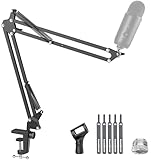


Boom arms look like the default in every streamer setup, but the quiet truth is that plenty of people are better served by a plain desk stand. The real decision isn’t “which one is more pro” — it’s which one matches your desk, your room, and how much you move around while you talk. Here’s how they actually compare for a home streaming setup.
Top 3 picks at a glance
Quick Verdict
Get a boom arm if you sit close to your mic, type loudly, or need the mic off your desk and out of your sightline. Get a desk stand if your setup is mostly static, your desk is small or flimsy, or you share your space with kids, pets, or a landlord who’d rather you not clamp things to furniture. Most streamers land on a boom arm eventually — but a solid desk stand is rarely the wrong first purchase, and a low-profile boom arm like the FIFINE BM88 ($56.99) splits the difference for tight setups.
Side by Side
| Factor | Boom Arm | Desk Stand |
|---|---|---|
| Mic positioning | Full 3D reach; positions mic inches from your mouth, off-desk | Fixed point on the desk; adjust height and angle only |
| Comfort over long sessions | Excellent — mic follows you, no leaning forward | Fair — you adjust to the mic, not the other way around |
| Noise isolation | Strong; keeps desk taps and keyboard clatter away from the capsule | Weak; every bump transmits straight through the desk |
| Space needed | Clamp needs 1–2 inches of clear desk edge; arm sweeps up to ~30 inches | Needs 4–6 inches of footprint on the desktop itself |
| Durability | Mixed — cheap springs sag; quality arms last years | Very predictable — few moving parts, little to fail |
| Price range | $20–$60 for consumer models | $25–$50 for consumer models |
| Maintenance | Occasional tightening of spring clutches and joints | Virtually none |
| Look | Broadcast/streaming aesthetic; visible hardware | Cleaner, blends into a home office |
| Resale/donation appeal | High demand in the streaming community | Modest but steady — useful to almost anyone with a mic |
| Best for | Active streamers, podcasters, close-talkers | Static setups, shared spaces, budget builds |
Where Boom Arm Wins
Mic-to-mouth distance. Most broadcast mics want to sit 4–8 inches from your mouth. On a desk stand, that means leaning forward or crowding your keyboard. A boom arm swings the capsule right where it belongs, which matters more than most beginners expect — it’s the difference between a quiet, close-sounding voice and a distant, roomy one.
Handling noise. Every knock on your desk travels through a desk stand and into your recording. A boom arm physically separates the mic from the surface, so typing, mouse clicks, and coffee-cup thuds get quieter before you even touch a noise gate.
Camera framing. A boom arm can park the mic above and in front of your face at roughly a 45-degree angle, keeping your webcam shot clean. A desk stand usually blocks something — your monitor, your keyboard, your hands.
Cable management and mouse space. Routing a cable along a boom arm clears the clutter that a desk stand leaves in your working area. On a 48-inch desk, that reclaimed 4–6 inches of footprint is real estate you’ll notice.
The trade-offs: cheap spring arms sag under heavier mics (a Blue Yeti weighs about 2.4 pounds without its shock mount), audible spring creak can bleed into recordings, and clamping forces can stress thin or hollow desk edges. If you go this route, check the arm’s rated load — many budget arms top out around 2.2 pounds, which is cutting it close with a shock mount attached. The InnoGear Boom Arm ($24.99) handles common mics like the Blue Yeti, Fifine, and HyperX models and is a sensible entry point if you’re testing whether an arm suits you. If your desk is shallow or your monitor sits close to the edge, a low-profile arm like the FIFINE BM88 ($56.99) keeps the boom below your sightline instead of arching over your monitor.
Where Desk Stand for Streaming Microphone Wins
Zero setup drama. A desk stand is place it, plug it, done. No clamp fitting your desk edge, no routing cables along joints, no balancing a counterweight. You’re recording within two minutes of unboxing.
Stability on the right desk. On a heavy, solid desk, a weighted desktop stand doesn’t wobble when you bump it, and it can’t slowly rotate or droop the way a worn boom joint can. Something like the FIFINE BS1 ($29.99) is a heavy-duty adjustable desktop stand built for exactly this static-use case.
Shared and kid-proof spaces. A boom arm is a lever with a microphone on the end — irresistible to toddlers and cats, and a spring-loaded pinch hazard. A desk stand on a stable surface is simply harder to break, pull over, or get tangled in.
Rentals and fragile furniture. Clamps and C-clamps can dent, scratch, or stress hollow-core and glass desk edges. A desk stand asks nothing of your furniture.
Maintenance-free longevity. Fewer moving parts means fewer failures. A decent desk stand will outlast two or three cheap boom arms, which narrows the real cost gap over time.
The trade-offs: you live with handling noise, you can’t reposition the mic mid-sentence, and the stand occupies desk space permanently.
Cost Over 5 Years
Boom arm path: entry arms run $20–$30, mid-tier $40–$60. If you start cheap and upgrade once after two years (a common path when a $25 spring arm sags under a heavier mic), you’re looking at roughly $50–$85 total, plus possibly $10–$20 for a replacement shock mount or thread adapter. One smart purchase up front — a $56.99 low-profile arm, say — keeps the five-year total at about $60–$75 with no replacements.
Desk stand path: $25–$50 once, almost certainly no replacement. Add a desk pad or isolation feet ($10–$15) if keyboard noise becomes an issue, and your five-year total is roughly $30–$65.
Bottom line: desk stands are cheaper over five years by a modest margin, usually $20–$40. But if a boom arm saves you from buying a noise gate, a shock mount, or a second “quiet” mic because you hated your first setup’s sound, the arithmetic flips fast.
Which One for Your Home
Small Apartment or Tiny Desk
A boom arm actually wins small spaces — it uses vertical air instead of desk surface. The catch is clearance: you need roughly 30 inches of swing radius and enough headroom above your monitor. If your desk sits under a shelf or window, check that overhead space first. For desks shallower than about 24 inches or setups hugging a wall, a low-profile arm keeps the mic below monitor height. If even that feels crowded, a compact desk stand with a 4–5 inch footprint is the safer call.
Family with Kids or Pets
Go desk stand, or go boom arm mounted far out of reach — not a boom arm at kid height. Springs pinch small fingers, arms get yanked, and a swinging mic is a toy by any toddler’s standard. A weighted desk stand on a high or stable surface survives households with cats and children far better. If you must use an arm, mount the clamp end and route the cable so nothing dangles invitingly.
Rental or Shared Space
Desk stand, easily. Nothing gets clamped, drilled, or stressed, and you can pack it in one box when you move. If your desk has a glass edge, a hollow-core top, or a pull-out keyboard tray, a clamp-based arm is either impossible or a slow-motion dent in your security deposit. Some arms do offer a desk-edge weight base instead of a clamp, but those need a flat, clear spot and their own footprint — which starts to defeat the purpose.
Long-Term Home Setup
Boom arm, and skip the $25 starter tier. Buy once at the $50–$60 level with a load rating comfortably above your mic’s weight (add ~1 pound if you use a shock mount), metal joints rather than plastic clutches, and a standard 5/8-inch thread or included adapter. Pair it with a pop filter and a shock mount, and you’ve built the core of a broadcast setup that will still be current hardware years from now — no reason to expect that to change by 2026 or beyond.
FAQ
Do boom arms fit all streaming microphones?
Most, but check two things: thread size (most arms use a 5/8-inch thread; many European mics need a 3/8-inch adapter, usually included) and weight capacity. Match the arm’s rated load to your mic’s weight plus any shock mount, with a little headroom. Heavy mics like the Shure SM7B (about 1.2 pounds but stiff to position) need a sturdier arm than a lightweight dynamic mic.
Will a desk stand make my recordings noisier?
It transmits more desk vibration, yes — but how much that matters depends on your typing style, desk material, and mic type. Dynamic mics reject more room noise than condensers, so the difference is smaller than forum threads suggest. A foam pad or isolation feet under the base narrows the gap further.
Can I use a boom arm on a glass or standing desk?
Glass edges are a bad clamp target — they can crack or the clamp can slip. Standing desks with thin tops can work, but verify the clamp opens wide enough (many top out at about 2 inches of thickness) and that the desk’s lift mechanism can handle the offset weight. Some arms offer a base-mounted alternative for exactly this problem.
Which should a complete beginner buy first?
If you’re unsure, start with a decent desk stand in the $30 range. It teaches you how your mic sounds at fixed positions, costs little, and never goes to waste — you’ll use it as a backup or for a second mic later. Once you know you’re streaming regularly and you’re tired of leaning into the mic, upgrade to a quality boom arm. You’ll buy the right arm the second time because you’ll know exactly what you need.
Related guides
- Green Screen Paint vs Fabric Backdrop for Streaming: Which Is Right for Your Home
- Ring Light vs Key Light Panel for Face Lighting: Which Is Right for Your Home
- Usb Microphone vs Xlr Microphone for Beginner Streamers: Which Is Right for Your Home
- Dynamic Microphone vs Condenser for Streaming Voice: Which Is Right for Your Home
