
Managing home video archives has shifted from a niche tech hobby into an everyday reality for modern households. Between high-bitrate 4K family clips, drone footages, security camera logs, and footage pulled from car safety systems—such as offloading daily commuting clips captured on a 10’’ Mirror Dash Cam Front and Rear View Mirror Camera Night Vision for Car ($62.99)—the sheer volume of digital media can overwhelm standard external hard drives. Even home security installers running lines like a QDiShi Backup Camera RCA Video Cable with Detection Wire ($6.99) quickly realize that storing hours of raw video requires serious local capacity.
When setting up a reliable desktop archiving station, homeowners usually land on a fundamental crossroads when evaluating hardware raid vs das for video backup: should you buy a standard Direct Attached Storage (DAS) unit that relies on your computer’s operating system, or invest in a DAS unit with built-in Hardware RAID processing? While both plug directly into your PC or Mac via USB-C or Thunderbolt cables, the way they handle your video files, desktop footprint, fan noise, and long-term data safety differs significantly. Here is how to choose the right setup for your living space and workflow.
As an Amazon Associate we earn from qualifying purchases at no extra cost to you. Product prices and availability are accurate as of the date shown and are subject to change.



Top 3 picks at a glance
Quick Verdict
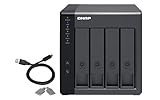
If you prioritize maximum data redundancy, background performance, and instant drive-failure protection without taxing your computer’s CPU, choosing direct storage equipped with Hardware RAID (such as the 4-bay QNAP TR-004 at $219) is the superior long-term choice. It protects multi-terabyte video archives automatically behind the scenes.
If you want a simple, budget-friendly plug-and-play system with smaller physical dimensions, lower power draw, and silent operation on a minimal desk, a standard or entry-level dual-bay DAS enclosure (like the TERRAMASTER D2-320 at $116.99) offers the most straightforward way to expand your local storage without complex configuration.
Side by Side
| Feature | Hardware RAID Storage | Standard / Software DAS |
|---|---|---|
| Comfort & Fan Noise | Low to moderate fan hum (30–42 dBA); best kept under or behind large desks. | Quiet to near-silent (20–30 dBA); minimal thermal output on open tabletops. |
| Durability & Drive Protection | High; parity protection (RAID 1/5/10) keeps data intact if a drive fails. | Moderate; single drive failure loses that disk’s data unless backed up elsewhere. |
| Price Range (Diskless) | $180 – $450+ depending on bay count and controller speed. | $60 – $150 for basic single or dual-bay enclosures. |
| Maintenance & Setup | Initial hardware switch/software utility setup; automatic background rebuilds. | Zero configuration; simple drag-and-drop formatting in Windows/macOS. |
| Space Needed & Footprint | Larger box footprint (approx. 6.3 x 8.6 x 8.7 inches for 4-bay models). | Compact footprint (approx. 4.5 x 5.0 x 8.0 inches for 2-bay models). |
| Look & Desk Aesthetics | Industrial mini-tower appearance; visible status LEDs for drive health. | Minimalist aluminum or matte plastic chassis; sleek and unobtrusive. |
| Power Draw (Wattage) | 25W – 50W operational power draw with 4 enterprise HDDs spinning. | 8W – 20W operational power draw with 1-2 standard drives spinning. |
| Resale & Upgrade Flexibility | High resale value; modular bays allow swapping drives over time. | Moderate resale value; limited expandability beyond original bay capacity. |
| Best For | Content creators, large family photo/video vaults, continuous archival. | Casual video backups, secondary offsite clones, tight desk spaces. |
Where Hardware Raid Wins
The primary advantage of choosing Hardware RAID for video backup lies in hardware independence and fault tolerance. In a Hardware RAID setup, a dedicated microcontroller inside the storage chassis handles all calculations for mirroring (RAID 1) or parity striping (RAID 5/6). When editing or transfering massive 4K video libraries, your computer’s CPU and RAM remain completely free because the storage box manages data distribution entirely on its own chip.
For home users storing irreplaceable family memories or high-volume footage, data protection is seamless. If a hard drive mechanically fails inside a 4-bay Hardware RAID unit like the QNAP TR-004 4 Bay USB Type-C Direct Attached Storage (DAS) with hardware RAID (Diskless) ($219), the system sounds an alert while your data remains fully accessible. You simply pull out the dead drive, slide in a fresh hard drive, and the internal controller rebuilds the missing data without interrupting your workday.
Hardware RAID also offers consistent read and write speeds when working with huge continuous files. Because the array combines multiple drive spindles working simultaneously, sustained transfer speeds often hover between 250 MB/s to over 500 MB/s over USB 3.2 Gen 2 connections. This creates a smooth playback environment directly off the backup unit, turning your storage array into an active editing scratch disk as well as an archival safe.
Where Das for Video Backup Wins
Standard Direct Attached Storage (DAS) running without onboard RAID hardware excels in simplicity, lower overall cost, and desktop integration. A standard dual-bay enclosure like the TERRAMASTER D2-320 USB RAID Enclosure 2-Bay (Diskless) ($116.99) gives home users direct access to raw storage space without complex controller configurations or proprietary array formatting.
Because there is no hardware RAID controller locking the drives into a custom array, each hard drive inside a standard DAS operates as an independent disk volume. If the enclosure itself ever suffers a power supply failure after years of sitting on a shelf, you can pull the hard drives out, insert them into virtually any cheap USB dock, and instantly read every video file on any PC. This zero-lock-in structure provides exceptional peace of mind for simple drag-and-drop video backups.
From a spatial and aesthetic viewpoint, standard DAS units are lighter and far more compact. Weighing only 2 to 4 pounds without drives, a dual-bay DAS takes up less surface area than a hardback book on an office desk. They operate with lower power consumption (frequently under 15 watts during write cycles) and generate very little heat, allowing manufacturers to use smaller, quiet-cooling fans that keep home offices completely silent.
Cost Over 5 Years
Calculating the true cost of video backup involves looking beyond the initial enclosure sticker price to account for drive capacity, power consumption, and long-term disk maintenance over a 5-year period heading toward 2026 and beyond.
Standard 2-Bay DAS System:
- Diskless Enclosure: ~$115
- Two 8TB Mechanical Hard Drives: ~$280 ($140 each)
- Electricity Cost (12W average running 8 hrs/day for 5 years at $0.16/kWh): ~$35
- Total 5-Year Ownership Cost: ~$430 for up to 16TB raw (or 8TB mirrored via OS).
4-Bay Hardware RAID System:
- Hardware RAID Enclosure: ~$220
- Four 8TB Enterprise/NAS Hard Drives: ~$600 ($150 each)
- Electricity Cost (35W average running 8 hrs/day for 5 years at $0.16/kWh): ~$100
- Single Drive Replacement (budgeted over 5 years): ~$150
- Total 5-Year Ownership Cost: ~$1,070 for 24TB usable protected storage (RAID 5 configuration).
While Hardware RAID carries a higher total investment, it delivers significantly lower cost per protected terabyte once scaled across four or more drive bays.
Which One for Your Home
Small Apartment or Shared Desk Space
If you work out of a nook in the living room or share a modest writing desk, space and acoustics take top priority. A compact 2-bay DAS unit fits discreetly behind a desktop monitor or alongside an upright desk lamp. Its small footprint and whispering cooling fan ensure that background backups won’t disrupt quiet living areas.
Family with Kids and Pets
In a busy home environment where cables get bumped and power strips might accidentally get switched off, hardware redundancy provides crucial safety. A 4-bay Hardware RAID unit operating in RAID 1 or RAID 5 ensures that an unexpected power disconnection or physical shock to a single drive won’t destroy family video archives or years of home movie uploads.
Rental or Temporary Setup
For renters who move frequently or swap workstations often, standard software-managed DAS units offer effortless portability. Weighing under 3 pounds empty and requiring just one power adapter and one USB-C cable, a basic DAS setup can be packed into a backpack instantly and plugged into any laptop without installing controller management software.
Long-Term Home or Dedicated Studio
For homeowners with a dedicated office, custom built-in shelving, or a permanent desktop setup, a multi-bay Hardware RAID unit is the gold standard. Tucked neatly into cable-managed desk cubbies, a Hardware RAID system delivers expanding storage capacity, maximum transfer speeds, and continuous automated backup protection for years of high-resolution video production.
FAQ
Can a DAS unit also have Hardware RAID built into it?
Yes. DAS simply refers to how the storage connects to your computer (directly via USB or Thunderbolt cables rather than over a Wi-Fi or Ethernet network). Many advanced multi-bay DAS units feature onboard hardware RAID chips, combining local high-speed cable connections with automated drive mirroring or parity protection inside the enclosure box.
Is Hardware RAID safe enough to be my only video backup?
No. While Hardware RAID protects your video files against physical hard drive failures, it does not protect against accidental deletion, file corruption, software ransomware, or catastrophic home disasters like fires or floods. For complete safety, follow the standard 3-2-1 backup rule: keep three copies of your video data across two different media types, with one copy kept offsite or in cloud storage.
How much desk space and power do these storage setups actually take?
A standard 2-bay DAS enclosure occupies roughly 4.5 by 8 inches of desk space and uses between 10 to 20 watts under load. A larger 4-bay Hardware RAID enclosure requires a footprint of roughly 6.5 by 9 inches, standing about 7 to 8 inches tall, with power consumption ranging from 25 to 50 watts depending on hard drive activity.
Will standard DAS slow down my computer when backing up large 4K video files?
When running a standard DAS without a hardware RAID chip, using software-based RAID or manually syncing massive folders can temporarily spike your computer’s CPU usage during file transfers. On modern computers with multi-core processors, this impact is minimal, but older laptops may experience brief system slowdowns during continuous heavy background transfers.
Related guides
- Usb vs Xlr Microphone for Streaming: Which Is Right for Your Home
- Dynamic vs Condenser Microphone for Untreated Rooms: Which Is Right for Your Home
- Best Desktop Microphone Isolation Shields for Narration: Tested and Ranked: 8 Tested (2026)
- Best Slim Led Panels for Desk Videos: Tested and Ranked: 8 Tested (2026)


