
You add a capture card, an audio interface, a webcam, a stream controller, and RGB lights, and suddenly devices randomly disconnect mid-stream. The culprit is often USB power and bandwidth. This guide explains when your motherboard ports are enough, when a powered USB hub saves you, and how to stop those maddening disconnects.
As an Amazon Associate we earn from qualifying purchases at no extra cost to you.


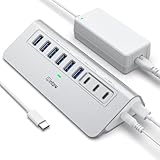
Top 3 picks at a glance
Why streaming gear stresses USB
Every USB device draws power and shares bandwidth on a controller. A single USB port supplies limited current, and a busy streaming setup can exceed what a chain of ports or an unpowered hub can deliver. When a device does not get enough power, it drops off and reconnects, which on a capture card or interface means a visible or audible glitch on your stream.
Bandwidth matters as much as power
High-throughput devices like capture cards and webcams need real USB bandwidth, not just power. Plugging several of them into ports that share one internal controller can saturate it, causing dropped frames even when power is fine. Spreading demanding devices across separate controllers helps.
| Option | Power per port | Best for |
|---|---|---|
| Motherboard rear ports | Full spec | Capture card, interface |
| Front-panel case ports | Often lower | Low-draw accessories |
| Unpowered hub | Shared, weak | Keyboards, low-draw only |
| Powered USB hub | External supply | Many devices at once |
When motherboard ports are enough
Rear motherboard ports connect directly to the board’s USB controllers and deliver full-spec power, so they are the best home for your most critical devices: the capture card and audio interface. If you only run a few devices, plugging each demanding one into a separate rear port often solves disconnects with no hub at all.
The front-panel trap
Case front-panel USB ports run through internal headers and sometimes deliver less stable power, which is why a webcam or interface may misbehave on the front but work on the rear. Move troublesome devices to rear ports before buying anything.
When a powered hub is the fix
A powered USB hub has its own external power adapter, so it supplies each connected device full current regardless of how many you attach. If you have more devices than reliable rear ports, a quality powered hub consolidates low-to-medium-draw gear (lights, controllers, some webcams) onto one dependable supply. Keep your capture card and interface on the motherboard, and offload the rest to the hub.
Map your devices to the right ports
Take five minutes to plan your USB layout instead of plugging things in wherever they reach. Assign the capture card and audio interface to separate rear USB 3.0 ports, ideally on different controllers if your motherboard exposes them. Put your webcam on another rear port, then group the low-draw accessories, lights, controllers, and stream deck onto a powered hub. This deliberate mapping prevents the bandwidth saturation that causes mid-stream dropouts.
Pick a hub with enough power budget
Not all powered hubs are equal; check the included adapter’s wattage and make sure it comfortably exceeds the total draw of everything you will attach. A hub with a weak power brick still starves devices even though it is technically powered. A quality hub with an ample supply and individual port switches lets you isolate a misbehaving device without unplugging everything.
FAQ
Should my capture card go on a powered hub?
Prefer a direct rear motherboard port for a capture card, ideally one not shared with other high-bandwidth devices. Capture cards are sensitive to bandwidth and power; a direct connection is the most reliable. Use the powered hub for less demanding accessories instead.
Does USB 2.0 vs USB 3.0 matter for streaming gear?
Yes for bandwidth-heavy devices. Capture cards and high-resolution webcams often need a USB 3.0 (blue) port to hit full resolution and frame rate. Audio interfaces and controllers are usually fine on USB 2.0. Match each device to the right port type.
Bottom line
Keep your bandwidth-critical devices, the capture card and audio interface, on direct rear motherboard ports, and add a powered USB hub to handle the pile of lower-draw accessories. Most random disconnects come from underpowered front-panel ports or an unpowered hub asking too much of one port. Distribute power and bandwidth deliberately and the dropouts stop.


