
Every desk mic transmits more than your voice. Keyboard clacks, mouse thumps, and the bump of your elbow travel through the desk, up the stand, and straight into your microphone. A shock mount promises to isolate the mic from those vibrations. But is it a must-have or just a nice-looking accessory? Here is when a shock mount actually earns its place.
As an Amazon Associate we earn from qualifying purchases at no extra cost to you.


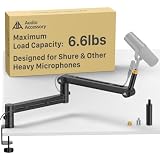

Top 3 picks at a glance
What a shock mount does
A shock mount suspends your microphone in an elastic web or set of bands, decoupling it from the stand or boom arm. Instead of a rigid connection that conducts every desk vibration, the mic floats. When you slam your keyboard, the energy is absorbed by the suspension rather than picked up as a low thud on your recording.
The problem it solves is low-frequency rumble
Vibration noise shows up as low-frequency thumps and rumble, the kind that a high-pass filter can partly tame but never fully remove. Because it is mechanical, the cleanest fix is to stop the vibration reaching the mic in the first place, which is exactly what a shock mount is for.
| Setup | Vibration pickup | Extra cost |
|---|---|---|
| Mic clamped rigidly to arm | High | $0 |
| Mic on shock mount | Low | $15–50 |
| Shock mount + isolation arm | Very low | $40–120 |
When a shock mount is clearly worth it
If your mic sits on the same desk as your keyboard and mouse, and especially if you type aggressively during streams, a shock mount makes an audible difference for $15–50. It is one of the cheapest quality upgrades available and often comes bundled with boom arms or mics anyway.
When it matters less
If your mic is on a separate stand on the floor, or you use a heavily desk-decoupled boom arm and rarely bang the desk, the benefit shrinks. Likewise, a tightly cardioid dynamic mic held close to your mouth rejects some off-axis vibration on its own, so the improvement is smaller than on a sensitive condenser.
Shock mount vs a boom arm
These are not competitors; they work together. A boom arm gets the mic off the desk surface and positions it, while the shock mount isolates the mic from vibration traveling up the arm. The best desk setups use both: a sturdy boom arm for placement and a shock mount for isolation. A boom arm alone still conducts some vibration through its joints.
Stacking isolation for a silent desk
A shock mount is one layer of vibration defense, and it works best combined with others. Put your keyboard on a soft desk mat to dampen impact, place small isolation feet or a mouse pad under the base of your boom arm clamp, and route the mic away from the direct line of your keyboard. Each layer removes a little more thump, and together they beat any single fix for a desk that stays quiet even when you type hard.
Check the fit before your next stream
A shock mount only isolates if the mic is held firmly but the suspension can flex freely. Make sure the elastic bands are not stretched to their limit and that no cable is bridging the mount rigidly to the arm, which would transmit vibration straight through and defeat the whole point. A quick check that the mic can gently bounce on the bands confirms it is doing its job.
FAQ
Does a shock mount reduce keyboard noise the mic hears through the air?
No. A shock mount only blocks vibration traveling through the stand. Airborne keyboard clatter still reaches the mic and must be handled with mic placement, a cardioid pattern, quieter switches, or a noise gate. Do not expect a shock mount to silence a loud keyboard.
Are universal shock mounts any good?
Model-specific shock mounts fit best and hold the mic securely. Universal or thread-adapter mounts work but can allow the mic to sag or slip if the diameter is not matched well. If a mount is made for your exact mic, prefer it.
Bottom line
For a desk mic that shares a surface with your keyboard, a shock mount is absolutely worth the $15–50; it removes low-frequency thumps that filters cannot fully fix. Pair it with a boom arm for the best isolation. Just remember it addresses vibration, not airborne noise, so a loud keyboard still needs a separate solution.


