
Top 3 picks at a glance
The Short Answer
For a heavy microphone — think Shure SM7B (1.5 lbs), RØDE PodMic (1.7 lbs), or Blue Yeti (2.2 lbs) plus a shock mount — you want a boom arm with a reach of 30 to 40 inches and a stated load capacity of at least 3.3 lbs (1.5 kg). Ideally, pick one rated for 4.4 to 6.6 lbs (2–3 kg) so the mic, shock mount, and cable weight sit comfortably under the limit. A boom arm that is too short forces the mount close to your face and cramps your desk; one rated for too little weight will sag within weeks, no matter how well you tighten it. If you use a broadcast dynamic mic with a metal shock mount and a boom pole, budget for the full combined weight and choose a heavy-duty arm with a gear or friction lock rather than plain springs.
Standard Sizes
Boom arms come in a few standard size classes. Manufacturers usually list two arm segment lengths, total reach, and maximum load. Here is how the common classes compare:
As an Amazon Associate we earn from qualifying purchases at no extra cost to you. Product prices and availability are accurate as of the date shown and are subject to change.


| Size Class | Arm Segments | Max Horizontal Reach | Max Vertical Height | Typical Load Capacity | Best For |
|---|---|---|---|---|---|
| Compact | 10–12 in + 10–12 in (25–30 cm each) | 20–24 in (50–61 cm) | 18–22 in (46–56 cm) | 2–3 lbs (0.9–1.4 kg) | Lightweight condensers under 1 lb |
| Standard | 12–14 in + 12–14 in (30–36 cm each) | 26–32 in (66–81 cm) | 24–30 in (61–76 cm) | 2.2–3.3 lbs (1–1.5 kg) | Blue Yeti, AT2020, small dynamics |
| Large / Heavy-Duty | 14–16 in + 14–16 in (36–41 cm each) | 32–40 in (81–102 cm) | 30–36 in (76–91 cm) | 4.4–6.6 lbs (2–3 kg) | SM7B, PodMic, MV7 with shock mounts |
| Professional broadcast | 15–17 in + 15–17 in (38–43 cm each) | 36–42 in (91–107 cm) | 32–40 in (81–102 cm) | 4.4–7.7 lbs (2–3.5 kg) | Full broadcast chains, on-air use |
For reference, heavy mics with their hardware typically weigh:
- Shure SM7B: 1.5 lbs (0.77 kg); SM7B in a standard shock mount: roughly 2.4–3 lbs (1.1–1.4 kg)
- Shure MV7: 1.2 lbs (0.55 kg); with mount: about 2 lbs (0.9 kg)
- RØDE PodMic: 1.7 lbs (0.79 kg); with PSA-style mount: about 2.6 lbs (1.2 kg)
- Blue Yeti: 2.2 lbs (1.05 kg) on its own — heavier than most broadcast mics before you add anything
Because the mic is only part of the total, the 3.3 lb class arms are often borderline for heavy setups. That is why most experienced streamers and podcasters buy in the 4.4–6.6 lb capacity range.
How to Measure Your Space
- Measure your desk depth. A standard desk is 24–30 inches (61–76 cm) deep. Mount the boom clamp at the back edge or rear corner. If your desk is only 20 inches deep, a 40-inch reach arm will extend well past your workspace, which is fine, but check ceiling clearance.
- Measure the distance from the clamp point to your mouth position. Sit where you actually record and measure from your mouth to the rear edge of the desk. Most people need 22–30 inches of horizontal reach to position the mic 4–8 inches from their face. Add 20% to that number to account for the arm needing to bend around monitors.
- Measure upward clearance. Hold a tape measure at the clamp point and check what is above: shelves, monitors on arms, light fixtures. You want at least 24 inches (61 cm) of vertical clearance for a large arm to pass over your monitor without collision.
- Weigh your full setup. Put the mic, shock mount, boom pole (if any), and an estimated cable weight (add roughly 0.3–0.5 lbs / 150–250 g for a coiled XLR run) on a kitchen scale. Choose an arm rated for at least 1.5 times that total.
- Check your desk edge and underside. Heavy arms clamp best on desk edges 0.6–2.4 inches (1.5–6 cm) thick. If your desktop is thicker or has a beveled edge, look for a C-clamp with a deep throat or plan a grommet or through-desk mount. An undersized clamp on a thick desk is the most common installation failure.
- Confirm the thread size. Nearly all boom arms have a standard 5/8-inch (16 mm) threaded connector. Some European stands use 3/8-inch; a cheap 3/8-to-5/8 adapter (around $5–8) solves it. Heavy mics with custom shock mounts may need the manufacturer’s specific threading, so verify before buying.
By Room or Use Case
Small Bedroom Studio or Dorm
Space is the constraint here, not load capacity. A compact-to-standard arm with 26–32 inches of reach and a low-profile desk clamp works best. Expect to pay $29–50; the InnoGear Microphone Stand Boom Arm Desk (Large) at $28.99 fits this class and handles a Blue Yeti, though for heavier broadcast mics step up in load rating. Clamp near a back corner so the arm folds flat against the wall when not in use.
Dedicated Podcast or Recording Room
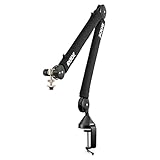
With room to spread out, prioritize capacity and stability over compactness. Choose a large or professional-class arm with 36–42 inches of reach, a 4.4–6.6 lb rating, and internal cable channels so the XLR run does not drag on the desk. The RØDE PSA1+ Professional Studio Boom Arm at $112 sits in this tier; its spring damping keeps a fully loaded SM7B and shock mount from drifting. Budget $90–150 for this class.
Streaming and Gaming Desk
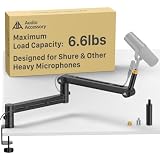
Streamers typically juggle a monitor arm, a boom arm, and lighting on one desk. A heavy-duty arm with a low-profile metal clamp keeps the boom out of camera frame. Look for 32–38 inches of reach, a load rating of 4.4 lbs or more, and a clamp base under 2 inches tall. The AA AUDIO ACCESSORY Mic Arm Desk Mount at $49.99 is designed for heavy mics up to 6.6 lbs with a gear lock that resists sag — a good match for SM7B, SM7dB, MV7, and PodMic setups without broadcast-arm pricing.
Office or Hybrid Workstation
If the mic doubles for video calls, choose a mid-size arm with 30–34 inches of reach and a discreet folded footprint. Weight capacity of 3.3–4.4 lbs is sufficient for most USB mics, but if you run a Blue Yeti, remember it weighs 2.2 lbs bare, so stay at the top of that range. A spring arm in the $30–60 range, such as the InnoGear Mic Arm with cable management at $49.99, handles this use case well and hides the USB cable.
Common Sizing Mistakes
- Reading load capacity as mic-only weight. A “3.3 lb” arm holding a 3 lb mic plus a 0.8 lb shock mount is already over the limit. Springs fatigue, and the arm slowly droops. Always leave at least 30–50% headroom.
- Buying reach you cannot use. A 40-inch arm in a 20-inch-deep bedroom desk with a shelf overhead creates collisions. Match reach to measured space, not to the biggest number available.
- Ignoring cable weight and drag. A stiff XLR cable hanging off the boom adds sideways pull that light arms cannot counter. Route the cable along the arm and secure it every 8–10 inches.
- Skipping the headroom check above the desk. Monitor arms, shelving, and overhead lights are the number one reason returns happen. Measure vertical clearance before ordering.
- Using a thin or glass desk. Glass tops and hollow-core desktops flex under heavy arms. If your desk is glass, use a freestanding heavy base stand instead of a clamp.
- Confusing reach specs. Some brands advertise diagonal reach (fully extended at an angle) rather than true horizontal reach. Horizontal reach is always shorter — assume 80–85% of the advertised diagonal figure.
FAQ
Will a standard boom arm hold a Shure SM7B?
Usually not for long. An SM7B with a shock mount weighs roughly 2.4–3 lbs, which is at or above the limit of standard 3.3 lb arms once cable drag is added. Choose an arm rated 4.4 lbs or more with a locking mechanism — a gear lock or quality friction clutch, not springs alone — and it will hold position reliably.
Does a heavier mic need a longer boom arm?
Not necessarily longer, but stronger. Reach and load capacity are independent specs. A 32-inch reach arm rated for 6.6 lbs is a better pairing with a heavy mic than a 40-inch reach arm rated for 2.2 lbs. Prioritize capacity first, then buy the longest reach your measured space allows within that capacity class.
What load capacity do I need for a Blue Yeti?
The Yeti weighs 2.2 lbs (1.05 kg) by itself and does not use a standard shock mount, but it is top-heavy and sits high on its hinge. An arm rated 3.3 lbs works, though 4.4 lbs or more gives you margin against sag and keeps the arm from tipping when you reposition it. Most Yeti owners are happiest with a large heavy-duty arm in the $30–50 range.
How much should I expect to spend in 2026 for a heavy-mic boom arm?
Reliable heavy-duty arms run $45–60, professional broadcast arms run $90–150, and budget large arms start around $29 but often lack the load rating for broadcast mics with shock mounts. Spending $50 on a 6.6 lb-capacity arm with a gear lock is the sweet spot for most heavy microphone setups; go higher only if you need broadcast-grade spring damping or on-air reliability.


