
Multi-camera live production fails or succeeds at the switcher. I have spent years setting up studio broadcasts, conference streams, and event coverages where a single dropped frame or misconfigured input can kill a show in real time. The category of best professional video switchers for multi camera live production has matured fast, but the gap between a unit that handles a chaotic four-camera setup cleanly and one that chokes under pressure remains enormous.
What separates a good switcher from a mediocre one is not raw input count or pixel resolution on the spec sheet. It is whether the device gives you reliable signal processing under real-world load, an interface you can operate without a manual at 2 a.m., and output options that match your actual workflow. A switcher that only speaks USB-C when your encoder wants HDMI is not useful. A switcher with a built-in monitor that washes out under studio lighting is not useful. I evaluated these units on whether they survive a full production day.
As an Amazon Associate we earn from qualifying purchases at no extra cost to you. Product prices and availability are accurate as of the date shown and are subject to change.




Top 3 picks at a glance
Quick Picks
| Product | Best for | Price |
|---|---|---|
| Osee GoStream Deck HDMI Pro | Budget multi-HDMI switching | $295 |
| Osee GoStream Duet Kit | All-in-one production with NDI | $1099 |
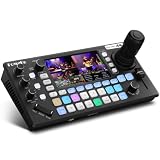
| FoMaKo KC800 | PTZ camera control on a budget | $799 |
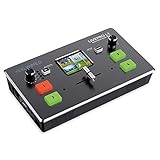
| FEELWORLD LIVEPRO L1 V1 | Hybrid HDMI and SDI input | $245.99 |
| Mixer Plus Compact | Portable classroom or Zoom setups | $288.99 |
| Blackmagic ATEM Mini Pro | Software-based streaming workflows | $349 |
| Osee GoStream Duet 8 ISO Kit | ISO recording with SRT/NDI output | $1795 |
| FEELWORLD LIVEPRO L1 | Lowest-cost USB switcher entry | $221.39 |
How We Picked
I focused on four criteria: signal reliability under sustained load, input/output flexibility for real studio environments, built-in utility like recording or monitoring that reduces external gear needs, and physical operability during live situations where you cannot stare at a screen to find the right button. Price mattered as a tiebreaker only after a unit cleared these functional gates.
The 8 Best Professional Video Switchers For Multi Camera Live Production in 2026
Osee GoStream Deck HDMI Pro
This unit suits a small studio or house-of-worship team that runs all-HDMI cameras and needs a straightforward tactile surface without software dependency. The multi-camera mixer layout is intuitive enough that a volunteer operator can manage cuts, transitions, and audio levels during a live event without deep training.
- Pro: Dedicated HDMI inputs handle multiple camera feeds without signal negotiation headaches.
- Pro: Physical control layout means fewer menus to navigate mid-show.
- Con: No SDI input limits its use in facilities running longer cable runs where HDMI fails.
Skip it if your cameras use SDI or you need built-in recording without an external capture device.
Osee GoStream Duet Kit
This is for a production team that wants a single box replacing switcher, recorder, player, and NDI endpoint. The 14-inch monitor means the operator sees program output without a second display. Free NDI activation matters for studios already embedded in an NDI workflow.
- Pro: Four HDMI and SDI inputs combined cover mixed-signal environments without adapters.
- Pro: The bundled monitor and cables make deployment faster at trade shows or touring events.
- Con: At its price, it competes with setups where individual components offer deeper control in each function.
Skip it if you already own a dedicated switcher and only need a recorder or player added.
FoMaKo KC800
For operators who control PTZ cameras directly and want to avoid a separate joystick controller, this switcher integrates a 4D joystick that simplifies camera aiming during live cuts. The built-in XLR audio input also reduces the need for an external mixer in smaller setups.
- Pro: Built-in PTZ control eliminates a secondary device on the production table.
- Pro: 4K 60fps HDMI input supports high-resolution camera sources at a moderate price.
- Con: Output is limited to 1080p 60fps, so a 4K native delivery workflow requires additional hardware.
Skip it if your primary need is 4K output or you do not use PTZ cameras.
FEELWORLD LIVEPRO L1 V1
Hybrid HDMI and SDI input makes this unit practical for venues with mixed camera stocks or legacy infrastructure. The SDI input handles cable runs that would degrade an HDMI signal, and at its price point it competes with HDMI-only alternatives that offer less versatility.
- Pro: Single SDI input extends cable-run capability beyond HDMI limitations.
- Pro: Compact footprint suits tight rack or desk positions in small control areas.
- Con: USB 3.0 output means you depend on computer software for final encoding and distribution.
Skip it if you need standalone recording or streaming without a connected computer.
Mixer Plus Compact
Online educators, small event producers, and multi-camera Zoom hosts will find this unit sufficient. The built-in four-inch screen lets the operator preview sources without a laptop, and its portability makes it easy to carry between classrooms or event spaces.
- Pro: Built-in screen provides visual feedback for preview and program without external monitors.
- Pro: Light enough for frequent transport between locations.
- Con: Four HDMI inputs and no SDI means you cannot extend reach beyond short cable runs.
Skip it if your production requires more than four sources or SDI connectivity.
Blackmagic ATEM Mini Pro
This switcher serves streamers who want hardware switching feeding into software like OBS or vMix. The H.264 encoder and ISO recording on the Pro model mean you can stream directly without a computer, while still feeding USB-C into software for more complex compositions.
- Pro: Built-in H.264 encoder enables standalone streaming without a dedicated computer.
- Pro: Blackmagic’s ecosystem of control panels and software extensions provides long-term workflow growth.
- Con: All inputs are HDMI, so SDI cameras require a converter box on each cable.
Skip it if your facility runs SDI throughout and you do not want converter overhead.
Osee GoStream Duet 8 ISO Kit
For productions where each camera feed must be recorded independently alongside the program mix, this unit’s ISO recorder capability is its defining feature. SRT and RTMP output options suit remote contribution and multi-platform streaming without external encoders.
- Pro: ISO recording preserves individual camera angles for post-production or archival.
- Pro: NDI, SRT, and RTMP output in one unit covers networked streaming protocols.
- Con: Premium pricing places it outside small-budget or volunteer-operated productions.
Skip it if you only cut live and never need individual angle recovery afterward.
FEELWORLD LIVEPRO L1
At the lowest price in this group, the original L1 provides a no-frills USB 3.0 switcher for users who want to add multi-camera capability to a laptop-based streaming setup without significant investment. Multi-format input support handles varied camera resolutions.
- Pro: Lowest entry price for a dedicated hardware switcher over USB.
- Pro: Compact and lightweight for temporary or one-off event setups.
- Con: No built-in screen means you rely entirely on software monitoring.
Skip it if you need standalone recording, built-in streaming, or SDI inputs.
Buying Guide
Input Types and Cable Run Limits
HDMI degrades over distance and cannot sustain reliable signal past roughly fifteen feet at high resolutions without expensive active cables. SDI tolerates much longer runs with standard coaxial cable. If your production space requires cameras positioned far from the control area, a switcher with at least one SDI input avoids signal failures that HDMI-only units will encounter. Hybrid HDMI and SDI inputs give you the most flexibility across mixed environments.
Output Flexibility: USB, Encoding, and Networked Protocols
USB output to a computer is the most common path but adds software dependency and a failure point. A built-in H.264 or H.265 encoder lets you stream without a computer. NDI, SRT, and RTMP outputs open networked workflows but typically appear only on higher-tier units. Match the output method to your distribution target before choosing inputs.
Control Surface and Operability Under Pressure
A switcher you must operate with one hand while adjusting audio with the other needs clearly labeled buttons, tactile transitions, and an unambiguous program-to-preview mapping. Units with built-in monitors or screens reduce the gear pile on your table and let the operator verify output without turning to a secondary display.
Our Verdict
The Blackmagic ATEM Mini Pro is the top pick for most small-to-mid productions because it balances hardware reliability, standalone streaming capability, and software ecosystem access at a moderate price. For the tightest budget, the FEELWORLD LIVEPRO L1 at its listed price delivers genuine multi-camera switching without compromise beyond the lack of a screen. If your production demands SDI inputs and a bundled monitor for fast deployment, the Osee GoStream Duet Kit wins that specific condition decisively over both alternatives.
FAQ
Do I need a video switcher if I already use OBS software?
Hardware switchers offload processing from your computer, reduce the risk of software freezes during live events, and provide physical button layouts faster than clicking in a UI. For low-stakes streams a software-only workflow works, but anything broadcast-level benefits from hardware reliability.
What is ISO recording and why does it matter?
ISO recording captures each camera input as a separate file alongside the program output. If the operator misses a cut or you need to re-edit after the show, individual angles save the production. Without ISO you are locked into the live edit.
Can HDMI-only switchers work in professional venues?
They can, provided every camera sits within reliable HDMI distance of the switcher. Many venues use SDI for infrastructure and run only the final output to HDMI devices, so check your signal path end to end before committing to an HDMI-only unit.
Is a built-in monitor worth the added cost?
For touring, event, or temporary setups where you do not control the environment, a built-in screen saves you from carrying a separate monitor and finding a place to set it up. In a permanent studio with fixed monitors already in place, the screen adds little practical value.

