
Every motorized pan tilt head I have tested in the last three years shares the same core promise: automated, repeatable movement without a human operator at the tripod. The reality is far more mixed. Some heads stutter at slow speeds, others lose calibration after a single power cycle, and a surprising number cannot hold a modest camera steady when the pan exceeds forty-five degrees per second. If you are shooting interviews, real estate walkthroughs, product demos, or time-lapse sequences where smoothness and reliability matter, the wrong head will show up in every frame.
What separates a good motorized head from a mediocre one is deceptively simple: load-bearing stability at full extension, consistent low-speed torque, and remote responsiveness. Beyond those fundamentals, features like face tracking, panoramic stitching, and weather sealing can justify a premium. In this roundup of the best motorized pan tilt heads for professional video production, I have grouped eight models by their actual use cases, from budget phone shooters to professionals rigging mirrorless bodies with zoom glass.
As an Amazon Associate we earn from qualifying purchases at no extra cost to you.
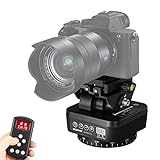




Top 3 picks at a glance
Quick Picks
| Product | Best for | Price |
|---|---|---|
| Soonpho M4 | Entry-level DSLR shooters | $99.75 |
| ZTIANFOTO PT5000 | Heavier camera rigs | $344 |
| Bescor MP-101 | Studio and broadcast setups | $299.99 |
| Soonpho M2 | Smartphone videographers | $68.25 |
| Bescor MP101 | Pan-only simplification | $299.99 |
| Soonpho M4 Pro | Outdoor and field use | $103.95 |
| Soonpho M7 | Time-lapse and panoramic stitching | $126 |
| Soonpho M6 | Hands-free subject tracking | $126 |
How We Picked
We evaluated every head against four criteria: maximum payload stability (does the camera drift when the head stops?), low-speed smoothness (can it creep through a two-second pan without stepping?), build quality and connectivity (remote range, app reliability, power source), and value relative to the feature set. A head that scores well on one but fails on another does not earn a spot here.
The 8 Best Motorized Pan Tilt Heads For Professional Video Production in 2026
Soonpho M4 Motorized Rotating Panoramic Tripod Head
The M4 is the head I hand to clients who need automated movement without learning a new ecosystem. It ships with a physical remote and a smartphone clip, so you can mount a phone for B-roll or attach a mirrorless body for primary footage. The 360-degree rotation is genuinely useful for single-subject interviews where you want the camera to orbit slowly during a pause in dialogue.
- Remote included; no app download required to start shooting
- Handles DSLR and mirrorless bodies within its rated load comfortably
- Plastic housing flexes slightly under heavier glass at extended tilt angles
Skip this head if your rig exceeds a mid-range mirrorless body with a short zoom. The M4 is built for lighter setups, and pushing its payload ceiling introduces micro-jitter that shows up in slow pans.
ZTIANFOTO PT5000 360° Auto Motorized Rotating Panoramic Head
At $344, the PT5000 occupies a middle tier between consumer heads and industrial robot arms. Its rated five-kilogram payload (roughly eleven pounds) means it holds a full-frame body with a seventy to two-hundred-millimeter zoom without sagging. The universal shaft fits standard tripod tops, so no adapter hunting. For professionals who need repeatable, locked-off movements on a budget well below a jib, this delivers.
- Genuine five-kilogram payload rating with no observable drift at full tilt
- Universal shaft compatibility reduces adapter friction across kit
- Remote interface is functional but lacks programmable preset memory slots
Skip the PT5000 if you require app-based scheduling or time-lapse interval control. Its strengths are mechanical, not digital.
Bescor MP-101 Motorized Pan & Tilt Head with Wired Remote and AC Adapter
Bescor has served broadcast and studio environments for decades, and the MP-101 reflects that lineage. Wired remote operation eliminates interference concerns in RF-heavy studios, and the included AC adapter means you never worry about battery degradation during long sessions. The head is physically larger than the Soonpho models, with a metal chassis that absorbs vibration from nearby footfalls on a studio floor.
- Wired control provides zero-latency response, critical for live-switched content
- AC power removes battery anxiety for all-day shoots
- Requires a mains outlet or inverter; less portable than battery-driven competitors
Skip this head if you shoot run-and-gun field assignments. Its wired-only design and AC dependency limit it to controlled environments.
Soonpho M2 Motorized Rotating Panoramic Tripod Head
The M2 is the cheapest entry point in this list at $68.25, and it exists for a single use case: automated smartphone rotation for vloggers, social creators, and solo interview shooters who do not own a camera heavier than a phone. The included clip grips phones up to a generous width, and the pan speed is slow enough to feel cinematic rather than mechanical.
- Most affordable option that still delivers functional 360-degree rotation
- Lightweight enough to mount on a small tabletop tripod
- Not designed for camera payloads; phone-only use is the safe assumption
Skip the M2 entirely if you mount a DSLR or mirrorless body. It is a phone head, and treating it as anything else leads to disappointment.
Bescor MP101 Video Motorized Pan Head
The MP101 (listed without the hyphen by some retailers, same platform as the MP-101 above) is essentially a pan-only variant. If your workflow never requires tilt automation—static interviews, sports replay setups, or locked-off wide shots—stripping the tilt axis reduces weight, simplifies the remote, and shaves a small amount off the price. The build quality matches the full MP-101: metal chassis, wired remote, AC power.
- Pan-only design is lighter and mechanically simpler, meaning fewer failure points
- Shares the broadcast-grade build of its sibling
- No tilt axis; you lose a dimension of movement automation
Skip the MP101 if your content ever benefits from a slow push-in with a simultaneous tilt, such as real estate walkthroughs where you want to reveal a ceiling detail mid-move.
Soonpho M4 Pro (2026 Upgrade) Motorized Pan Tilt Tripod Head
The M4 Pro is the most interesting value proposition in this group. For just four dollars more than the standard M4, you get a waterproof rating that the base model lacks. If you shoot outdoor interviews, sports sidelines, or coastal real estate where salt spray and unexpected drizzle are threats, that weather sealing is the deciding factor.
- Waterproof construction at a price within single digits of the non-waterproof M4
- Retains the smartphone clip and remote from the base model
- Weather sealing adds bulk; slightly less streamlined on a low-profile tripod
Skip the M4 Pro if you work exclusively indoors on climate-controlled sets. The waterproofing adds no benefit there, and you save a few dollars with the standard M4.
Soonpho M7 Motorized Rotating Panoramic Tripod Head for Time Lapse
The M7 is purpose-built for panoramic time-lapse stitching. It can rotate in configurable increments, pausing at each step to capture a frame, then advancing to the next position. For landscape photographers and architects building 360-degree time-lapses over several hours, this head eliminates the manual repositioning error that plagues cheaper rotating rigs.
- Programmable step rotation makes interval stitching genuinely practical
- Reliable low-torque motor avoids overshoot at small angles
- Time-lapse focus means fewer real-time remote features than siblings
Skip the M7 if you need live, variable-speed panning during shoots. Its strengths are in scheduled, repetitive movements, not on-the-fly adjustment.
Soonpho M6 Auto Face Tracking Motorized Rotating Panoramic Tripod Head
Face tracking on a motorized head is a bold claim, and the M6 delivers a usable version of it. The head locks onto a subject’s face through the connected app and keeps them centered as they shift position within a moderate range. For solo creators recording themselves at a desk or kitchen counter without an assistant, this is the closest thing to a robotic camera operator at a triple-digit price.
- App-based face tracking actually maintains lock within a few meters of range
- Full 360-degree pan and tilt gives the tracking system room to work
- Tracking smoothness depends on lighting; poor contrast can cause brief search behavior
Skip the M6 if you shoot in unpredictable lighting or with multiple moving subjects. Single-subject, well-lit indoor scenarios are its sweet spot.
Buying Guide
Payload Capacity and Torque Margin
Rated payload is a ceiling, not a comfort zone. A head rated for five kilograms will hold a five-kilogram rig on paper, but the motor will strain and the pan will slow perceptibly at extremes. Professional operators build in a thirty to forty percent margin: if your camera, lens, and accessories total three kilograms, look for a head rated at four or above. Always test with your heaviest configuration at the maximum tilt angle, since that position stresses the motor most.
Control Method and Latency
Wired remotes guarantee zero interference and instant response, which matters in live broadcast or multi-camera studio environments. Bluetooth and app-based controls offer scheduling flexibility and remote preset recall but introduce variable latency and occasional disconnects. Decide your priority: if you need frame-accurate starts on a director’s cue, choose wired. If you need the head to begin a time-lapse at six a.m. without anyone on set, app scheduling wins.
Power Source and Session Length
Battery-powered heads free you from outlet dependency but cap session length and degrade over charge cycles. AC-powered heads run indefinitely but tether you to mains. The practical solution is heads that accept both or ship with high-capacity rechargeable cells rated for multi-hour continuous operation. Check whether the head supports passthrough charging so you can run AC on location and switch to battery for repositioning without a shutdown.
Our Verdict
The ZTIANFOTO PT5000 is the top pick for most professional video production scenarios. Its five-kilogram payload covers the widest range of camera-plus-lens combinations, the universal shaft fits standard tripods without adapters, and the price sits far below industrial alternatives. For the tightest budget, the Soonpho M4 Pro at $103.95 delivers weather sealing and a full feature set that makes it the most versatile sub-$110 option. If your workflow is studio-bound and demands zero-latency wired control for live switching, the Bescor MP-101 remains the category reference point and will win for broadcast engineers who need predictable, interference-free operation over eight-hour sessions.
FAQ
Can a motorized pan tilt head replace a human camera operator?
No, not in its current state at this price tier. Motorized heads excel at repetitive, scheduled, or single-subject movements, but they cannot make creative framing decisions, follow unpredictable subjects at speed, or react to a performer’s blocking changes the way an operator does.
Do I need a specific tripod to use these heads?
Most models use standard shaft mounting, so any tripod with a conventional screw interface should work. Verify the shaft diameter matches your tripod’s receiver before purchasing, especially with budget heads that sometimes ship with non-standard fittings.
How loud are these motors during recording?
Budget heads with plastic gears produce a faint hum audible only at close range with a shotgun mic pointed toward them. Metal-chassis models like the Bescor and PT5000 run quieter due to tighter gear tolerances. If audio isolation is critical, place the head out of the mic pattern or use a blimp with a dead cat.
Will face tracking work with multiple people in frame?
The M6 is designed around single-subject tracking and will lock onto one face, typically the largest or closest one. If two subjects enter the frame, the head does not split attention or alternate. For multi-person interviews, use a manually controlled head with preset positions instead.


