The best computer speakers with a subwoofer depend mostly on your room size and how much bass your walls can take. For a compact desk, the Cyber Acoustics CA-3090 is the sensible small pick; for a bigger space the Logitech Z623 is the loud option; the Klipsch ProMedia 2.1 THX Certified is the premium desk choice. Every system below uses a 2.1 layout: two small satellites and one bass unit. Details come from listing titles only, so confirm wattage, inputs and warranty on each page before buying.
Our Top Picks
 Klipsch ProMedia 2.1 THX Certified Computer Speaker System3-piece5.67 x 4.2 x 8.5 inches2.1 PoundsCheck on Amazon
 Cyber Acoustics CA-3610 2.1 Multimedia Speaker System with2.1 62W13.2 x 10.6 x 9.8 inches9.7 poundsCheck on Amazon
Top 3 picks at a glance
Eight 2.1 systems at a glance
As an Amazon Associate we earn from qualifying purchases at no extra cost to you.




| Model | Key point from title | Price tier | Best for |
|---|---|---|---|
| Klipsch ProMedia 2.1 THX Certified | THX Certified label, 2.1 layout | Premium | Buyers who want a known name |
| Cyber Acoustics CA-3090 | 18W, 3.5mm, volume pod, bass adjust | Budget | Compact wired setups |
| Nylavee 2.1 Bluetooth Speakers | Bluetooth 5.4, USB/USB-C/AUX, 60W peak, lighting | Mid-range | Multi-device desks |
| Cyber Acoustics CA-3610 | 62W peak, strong bass, 2.1 | Budget | Step-up wired 2.1 |
| Logitech Z623 | 400 watt headline, home 2.1 | Premium | Bigger rooms, loud bass |
| Bluedee 2.1 Speakers with Subwoofer | 80W peak, DSP, Bluetooth 5.4, RGB | Mid-range | Feature-heavy value |
| cinnkeyi USB 2.1 Speakers | USB/3.5mm, PC/Line-in/Bluetooth modes | Budget | Cheapest 2.1 |
| Klipsch ProMedia Lumina 2.1 | Subwoofer, built-in RGB lighting | Premium | Lit gaming desks |
The eight systems, one by one
Klipsch ProMedia 2.1 THX Certified
The title leads with a THX Certified label, which is the headline claim here; check the listing for what that covers. It is a classic two-satellite, one-subwoofer layout aimed at a desk. The title gives no wattage or connection details, so read the listing for inputs and power before assuming it fits your setup.
Pros
- Established desktop 2.1 layout with a separate sub
- THX Certified wording in the title
- Clear step up in class from the budget sets
Cons
- No wattage or input list in the title
- Premium tier for a desk system
Who it’s for: Desk gamers and music listeners who want a recognizable brand and will pay for it.
Cyber Acoustics CA-3090
The title lists 18W, a volume control pod, an adjustable-bass subwoofer and a 3.5mm connection. That is the simple end of 2.1: a small sub, two satellites and one wired cable. The 18W figure is a seller number, so treat it as a rough size indicator rather than a loudness promise.
Pros
- Volume pod keeps the control on the desk
- Adjustable bass on the subwoofer
- Plain 3.5mm connection, nothing to pair
Cons
- 18W is modest for a larger room
- No USB or Bluetooth input in the title
Who it’s for: Small desks and dorm rooms where space matters more than output.
Nylavee 2.1 Bluetooth Speakers
This one runs from an AC adapter and takes USB, USB-C and 3.5mm AUX inputs, plus Bluetooth 5.4 and eight lighting modes, per the title. The 60W figure is labelled peak, which is not continuous output. It overlaps heavily with the Bluedee below, so treat the two as near-duplicate listings and compare return terms and buyer comments.
Pros
- Many input choices including Bluetooth 5.4
- Lighting modes for a lit desk
- AC adapter instead of USB-only power
Cons
- 60W peak is not a sustained rating
- Near-duplicate of the Bluedee listing
- Lighting may not suit a plain desk
Who it’s for: Gamers who want Bluetooth and lighting on a modest budget.
Cyber Acoustics CA-3610
The title cites 62 watts peak power and strong bass, aimed at music, movies and games. Like the CA-3090 it is a wired-first design from the same maker, with a bigger headline number. The title says nothing about Bluetooth, so assume wired and confirm connectors on the listing.
Pros
- More headline power than the CA-3090
- Familiar brand in budget PC audio
- Pitched at movies and games, not only music
Cons
- 62W is a peak figure
- Inputs not listed in the title
Who it’s for: People who want a bit more bass than the smallest sets without leaving the budget class.
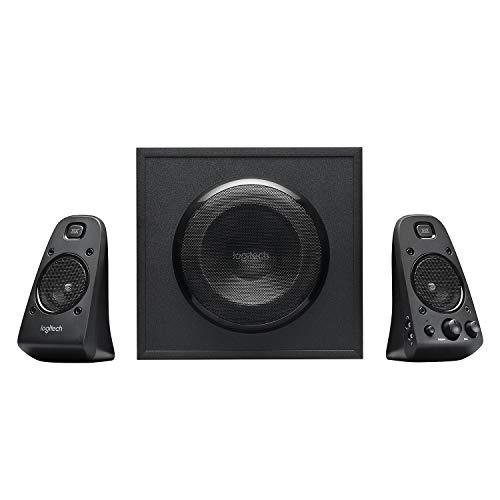
Logitech Z623
The title calls it a home 2.1 system and cites 400 watts. Whether that is peak or continuous is not stated, so check the listing before comparing it with the smaller sets. It is a much larger system than most desk speakers, and the sub is a floor piece, not a desk piece. Plan for the space and a nearby wall outlet.
Pros
- Highest power claim in this set
- Home-style system that suits a living room as well as a desk
- Floor subwoofer can move a lot of air
Cons
- Large footprint
- 400W claim may be a peak number
- Strong bass can annoy neighbors
Who it’s for: Larger rooms and gamers who also want movies and music loud.
Bluedee 2.1 Speakers with Subwoofer
The title cites 80W peak, DSP-tuned sound, Bluetooth 5.4, USB, USB-C and AUX inputs, RGB lighting and an adapter. The spec list reads much like the Nylavee, so this is a near-duplicate class of listing. Peak power is not continuous, and DSP tuning is the seller’s wording, so read buyer comments about bass quality.
Pros
- Bluetooth 5.4 plus wired inputs
- Higher peak claim than the Nylavee
- RGB lighting for a themed desk
Cons
- 80W is a peak claim
- Lookalike of the Nylavee
- Little brand history to lean on
Who it’s for: Value hunters who want inputs and lighting on a tight budget.
cinnkeyi USB 2.1 Speakers
The title lists 3.5mm and USB input and PC, Line-in and Bluetooth modes. The same title carries an update tag that is only marketing text. It sits at the bottom of the price range and is the least documented here. The title gives no wattage, so expect compact, entry-level output.
Pros
- Lowest tier in this roundup
- Three modes including Bluetooth
- USB plus 3.5mm input
Cons
- No wattage in the title
- Unfamiliar brand, so read the return terms
- Likely a small sub
Who it’s for: Very tight budgets and secondary desks where bass is a bonus.
Klipsch ProMedia Lumina 2.1
The title mentions a subwoofer and built-in RGB lighting effects, and positions it as a gaming system. It is the most expensive listing in the set by a wide margin, so judge it against the other Klipsch rather than the budget sets. Specs beyond lighting are not in the title.
Pros
- Brand pedigree in desktop audio
- Built-in RGB lighting
- Gaming-oriented positioning
Cons
- Highest price tier
- Title lists no power or inputs
- Lighting adds cost, not necessarily better sound
Who it’s for: Gamers who want a branded, lit 2.1 system and have the budget.
How these were picked
This list comes from published specifications, manufacturer documentation and buyer reviews, read through listing titles and descriptions. Nobody on the team used or measured these units, so no sound-quality ranking is implied. Wattage numbers are seller claims, and where a title says peak we treat it as a ceiling, not a sustained rating. Two pairs overlap closely: the Nylavee and Bluedee, and the two Cyber Acoustics models.
What to check before choosing a subwoofer set
2.1 or 5.1
A 2.1 system has two speakers and one sub. A 5.1 system adds center and rear channels and needs cable runs behind you. Nothing in this roundup is 5.1. For a single seat at a desk, stereo plus a sub is simpler and usually enough; surround only pays off if you watch films from a sofa with space around it.
Where the subwoofer goes
Bass gets louder near walls and corners. A sub on the floor beside the desk, a hand-width from the wall, is a safe start. Putting it on the desk couples it to the surface and makes the whole desk buzz. If your cable is short, check its length before ordering, since many sets tie the sub to the satellites with a fixed lead.
Power and ports
Count what each system plugs into. Most sets here need a wall outlet for the sub, and some also add an adapter. Check whether you want 3.5mm for a PC, USB for a laptop, or Bluetooth for a phone. A volume pod on the desk is more useful than a knob on the back of a sub under the table.
Desk or floor
Desk-sized subs trade depth for footprint. Larger floor units, like the Z623 class, go deeper but need an outlet and a spot that will not block foot room. The listing images show scale better than the title does.
Bass level in an apartment
Low frequencies pass through floors and walls far more easily than treble. A practical rule: set the sub volume so you can only just feel it at your seat, and keep nighttime listening lower. Adjustable bass controls, like the one in the CA-3090 title, help you do that.
Peak versus continuous watts
Peak numbers can be several times the sustained rating, and the title rarely says which one it is quoting. Compare watt claims only between the same type. Real-world loudness also depends on speaker size and sensitivity, which titles skip.
Desk-fit checklist before you order
- Measure free desk depth for two satellites, plus 10 cm to a monitor or wall.
- Pick the spot for the sub, and check the cable between sub and satellites will reach it.
- Confirm you have a free outlet or power strip slot.
- List the sources you will connect: PC, console, phone.
- Check the return window, since bass quality is the part you cannot judge from a title.
Mistakes buyers make
- Trusting peak watts. A big number in the title can be a ceiling that is not sustained.
- Ignoring the wall behind the sub. Corner placement can turn clean bass into a boom.
- Buying lighting you do not want. RGB adds cost and is hard to switch off on some models.
- Forgetting input type. A 3.5mm-only set will not pair with a phone by Bluetooth.
- Skipping the return terms. Near-duplicate listings from unfamiliar brands can differ in support.
Verdict
For most desks, start with the Cyber Acoustics CA-3090 or CA-3610 and treat them as the plain wired choice. If you want Bluetooth and lights at a low price, the Nylavee and Bluedee are interchangeable enough that return terms should decide. The Klipsch ProMedia 2.1 THX Certified and Lumina are the premium picks, while the Logitech Z623 suits a bigger room. If you need a cheaper alternative, see our cheap PC speakers roundup.
Looking for a different sound profile? Compare these with the models in our hifi PC speakers page, or keep to a ceiling with PC speakers under 100.
Frequently asked questions
Is a 2.1 system enough for gaming?
For one person at a desk, yes. Two satellites give stereo imaging and the sub carries explosions and low music notes. A 5.1 system adds rear speakers and cables, which most small rooms cannot use well. Pick 2.1 unless you have a layout where surround channels can sit behind your seat and you play games that use them.
Where should I put the subwoofer?
Start on the floor near the desk, a hand-width from the wall. Avoid tight corners, which exaggerate bass, and avoid placing it on the desktop, which makes the desk resonate. Move it a few feet and listen. Keep the connecting cable length in mind, since some sets use a fixed lead from the sub to the satellites.
Do peak watts matter?
They tell you less than they appear to. A peak figure is a short-burst ceiling, while continuous output is lower and rarely stated in a title. Compare peak with peak and sustained with sustained. Driver size, the amplifier and your room matter more than the headline number, so read buyer comments on bass quality.
Can I use these with a laptop?
Often yes, through 3.5mm, USB or Bluetooth, depending on the model. Check the listing for the exact inputs, because some titles show only one connection type. If your laptop has a single port, a set with Bluetooth or a 3.5mm cable saves you a dongle. Always confirm wall power is required for the sub.
How loud is too loud in an apartment?
Bass travels through floors and walls more than treble does. A good habit is turning the sub down until you can just feel it at your seat, then keeping nighttime volume lower still. Models with an adjustable bass control are easier to tame. If neighbors share a wall, avoid placing the sub against it.