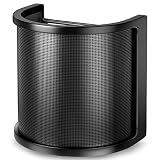
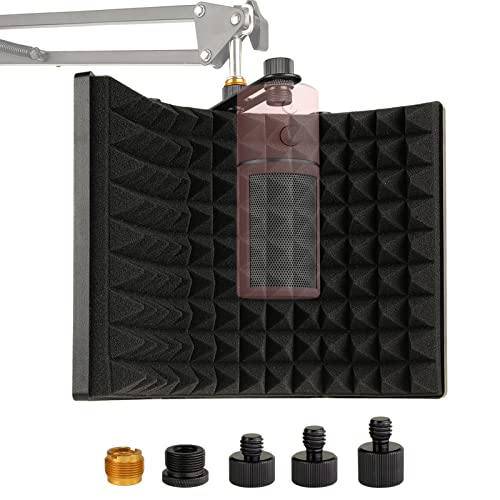
A mic isolation shield is a curved or folding wall of foam that stands behind and around your microphone and soaks up sound that would otherwise bounce back into it. It helps most in untreated rooms with a condenser mic, and least against noise that comes from the front or through the desk. This roundup compares ten listings: nine foldable shields in different mount and stand combinations, and one wrap-around isolation ball. Read the noise-source map further down before you decide a shield is the answer to your problem.
Our Top Picks
Top 3 picks at a glance
Quick picks
As an Amazon Associate we earn from qualifying purchases at no extra cost to you.




- Moukey with pop filter and table stand – best for an all-in-one desktop setup
- Moukey with 3/8 and 5/8 inch mount – best for boom-arm users
- Aokeo with 3/8 and 5/8 inch mount – best as a second brand of the same design
- Frgyee 3-panel with arm adapters – best for mic-arm owners wanting adapters included
- CAHAYA foldable reflector – best for the lowest-cost threaded mount
- Dmsky with pop filter and tripod – best for a bundled tripod stand
- TIZECO with pop filter and tripod – best for a compact tripod bundle
- Ramzi stand with shield – best for a stand-first bundle
- Aokeo AO-504 with stand – best for Blue Yeti style condenser mics
- penypeal isolation ball – best for a wrap-around foam enclosure
Comparison table
| Model | Type | Key specs as stated in the title | Best for |
|---|---|---|---|
| Moukey (table stand) | Foldable shield bundle | Pop filter and table stand; triple sound insulation; high density | Desktop use |
| Moukey (threaded mount) | Foldable shield | Triple sound insulation; 3/8 and 5/8 inch mount | Boom arms |
| Aokeo (threaded mount) | Foldable shield | Same wording as the Moukey above | Boom arms |
| Frgyee | 3-panel shield | Foam for condenser mics; adapters for mic arm stand | Arm owners |
| CAHAYA | Foldable shield | Foam reflector; 3/8 and 5/8 inch adapter | Budget mount |
| Dmsky | Shield bundle | Pop filter and tripod stand; triple insulation | No-stand setups |
| TIZECO | Shield bundle | Foam, pop filter, tripod stand; foldable | Compact bundle |
| Ramzi | Stand plus shield | Isolation shield, pop filter, tripod stand; foldable | Stand-first buyers |
| Aokeo AO-504 | Shield with stand | High density foam; pop filter; for Blue Yeti and other condenser mics | Desk condenser mics |
| penypeal | Isolation ball | Five-sided seal; sound-absorbing foam | Wrap-around cover |
Moukey Isolation Shield with Pop Filter and Table Stand
The bundle version of the Moukey: the title lists a foldable shield with triple sound insulation, a pop filter and a table stand, built from high density material for studio, podcast, singing and broadcast use. If your mic currently sits on its own small stand, this adds the shield and a stand together, so you can set it up on the desk without a boom arm.
The title does not give the footprint or the screen height. Desk space matters because the shield stands behind your mic and a monitor sits behind that, so check the listing images against your layout. The pop filter is a bonus, though its fit depends on the stand’s arm.
Check what “high density” refers to as well: the title says it but gives no thickness. If the panels are thin, they will absorb less than the three-layer wording suggests, so compare the listing photos with the other bundles.
- Pros: shield, pop filter and stand in one listing; foldable
- Cons: size not given in the title; takes desk depth
Who it’s for: a desk streamer starting from scratch. Who should skip it: boom-arm owners who only need the shield.
Moukey Isolation Shield with 3/8 and 5/8 Inch Mount
Here the title shifts to a foldable mic shield with triple sound insulation, a reflection filter and a 3/8 inch and 5/8 inch threaded mount, for recording studio, podcast, singing and broadcasting use. Threaded mounts are the point: they attach to common mic stands and boom arms, so the shield can ride on the same arm as the mic.
This is a shield only, so there is no stand or pop filter in the title. A shield on an arm adds weight, and the title does not give a weight, so check that your arm can handle it before ordering.
Folded flat, it also travels well for streamers who take a rig to events or a friend’s house. When open, the panels wrap around the back and sides of the mic, so aim the open front at your mouth rather than at the monitor.
- Pros: both common thread sizes named; foldable for storage
- Cons: no stand listed; weight unknown, which matters for arms
Who it’s for: boom-arm owners. Who should skip it: anyone with no stand or arm.
Aokeo Isolation Shield with 3/8 and 5/8 Inch Mount
Compare this title with the Moukey above and the match is almost word for word: foldable, triple sound insulation, a reflection filter, a 3/8 inch and 5/8 inch threaded mount, and the same use list. That suggests the same product design sold by two brands, although the titles do not confirm it. Treat them as variants and choose by price and return terms.
Everything noted for the Moukey threaded model applies here: no stand, no stated weight. If you buy it, check for differences in the included parts, since variants of one design sometimes differ in the accessories.
To tell the variants apart, look at the included mounting hardware and packaging photos, and compare the return windows. If the price is identical, pick the seller with the clearer warranty terms.
- Pros: same stated features as the Moukey; second seller to compare
- Cons: near-duplicate listing; no stand or weight given
Who it’s for: boom-arm owners shopping by price. Who should skip it: anyone who wants a clearly distinct design.
Frgyee Microphone Isolation Shield (Foldable 3-Panel)
This title calls it a foldable 3-panel shield in sound-absorbing foam for condenser mics, with high-density acoustic foam and adapters for a mic arm stand, described as a portable vocal booth for home studios. It names adapters rather than specific thread sizes, so check the listing to confirm that they match your arm.
The “portable vocal booth” label oversells things a little. A tabletop shield cuts reflections at the mic, but it does not make a booth around you. It is still a reasonable fit for arm owners who want adapters included.
With three panels the shield wraps further around the sides than a single reflector, which helps when the walls beside you are bare. Check the listing for the folded size, since a three-panel shield can be tall.
- Pros: three panels; adapters for arm stands in the title
- Cons: thread sizes not stated; no stand or pop filter listed
Who it’s for: mic-arm owners with a condenser mic. Who should skip it: buyers who need a stand included.
CAHAYA Microphone Isolation Shield Foldable
The title lists a foldable shield with sound-absorbing foam reflector, a 3/8 inch and 5/8 inch mic adapter, in black, for recording equipment use. Like the Moukey and Aokeo threaded versions it is built for an existing stand or arm, but the wording is simpler and it does not claim triple insulation.
That simplicity is useful in the listing because there is less to verify. It also means less to compare, so look at photos for panel size and the mount’s build quality. No pop filter or stand is mentioned.
A plain listing is not a weaker one; it only claims less. If your room echo is mild, a simple foam reflector may be all you need, and the lower number of claims makes it easier to judge the value.
- Pros: both common adapter sizes; simple, foldable design
- Cons: no pop filter or stand; panel size not given
Who it’s for: buyers who already own a stand and want the basics. Who should skip it: anyone who wants a pop filter included.
Dmsky Isolation Shield with Pop Filter and Tripod Stand
Dmsky’s title adds a pop filter and a tripod stand to a foldable shield with triple sound insulation and a high density mic sound shield for recording studio, podcast, singing and broadcast use. The tripod makes it self-standing, so it works for a mic that sits on a desk without an arm.
Tripods have a wider footprint than a table stand, so measure your desk. The title does not say how stable the tripod is when carrying the shield and a heavy mic, so look for buyer comments about tipping.
Because it is a bundle, check the length and angle adjustment of the tripod arm, and whether the pop filter clips on securely. A drooping pop filter can be an annoyance with bundled kits, and the title cannot tell you.
- Pros: tripod and pop filter included; triple insulation claim
- Cons: large footprint; stability unknown
Who it’s for: streamers without an arm. Who should skip it: those with limited desk depth.
TIZECO Microphone Isolation Shield
The shortest title in the set: foam protection with pop filter, tripod stand and a foldable design. It lists the three elements most buyers look for, but it gives no triple insulation claim, thread sizes or use list, so there is less to evaluate and more to check on the page.
A bundle at a mid-range price tier can be fine, but be careful when a short title hides details such as foam thickness and stand height. Read the listing description before you order.
A short title is also a reason to look for photos of the real product with a hand or a mic for scale, since the size decides whether it hides behind a monitor or towers over it.
- Pros: pop filter and tripod included; foldable
- Cons: few specs in the title; foam details unknown
Who it’s for: buyers who want a bundle and will read the page. Who should skip it: those who need stated insulation details.
Ramzi Microphone Stand With Isolation Shield
The title leads with the stand: a microphone stand with an isolation shield, pop filter and tripod, foldable, with sound insulation for a recording studio. Leading with the stand suggests the bundle is aimed at buyers who need one, not those who want to upgrade a mic arm.
It does not say what the stand holds or how tall it is, and the “recording studio equipment” label is broad. Check listing images for the stand height and for how the mic attaches.
The wording is more generic than the others, with no mention of the mount thread or foam type. Compare its photos with the Dmsky and TIZECO bundles, since kits of this kind may look similar, and the pictures will show whether they are.
- Pros: stand, pop filter and shield in one; foldable
- Cons: stand specs absent; broad labelling
Who it’s for: stand-first buyers. Who should skip it: arm owners.
Aokeo Professional Studio Recording Shield (AO-504 with Stand)
The title names a professional studio recording isolation shield with a pop filter, high density absorbent foam to filter vocals, and a note that it suits the Blue Yeti and other condenser mics, with a stand. Naming the Blue Yeti helps with expectations because that mic is a common streaming choice.
The phrase “filter vocal” is vague, since a shield does not filter a voice but absorbs reflections. Check the listing for the stand type and for how the Yeti’s base attaches.
The AO-504 code in the title helps you search buyer questions for this exact model, which is often the quickest way to learn what the stand attaches to. Ask whether the stand suits the base of your particular mic before ordering.
- Pros: targets the Blue Yeti and other condenser mics; stand and pop filter listed
- Cons: vague wording; stand details not given
Who it’s for: Yeti-style mic owners on a desk. Who should skip it: arm users.
penypeal Microphone Isolation Ball
The odd one out: a wrap-around foam ball, described as a wind shield pop filter and isolation ball with sound-absorbing foam and a five-sided seal design that reduces noise and reflections. Unlike the folding shields it encloses the mic head, which gives a stronger local effect and also blocks access to its controls.
The title gives no mic size, so the ball only suits mics whose head fits inside. It overlaps with pop filters more than with shields.
If your trouble is a mic picking up the room, compare it with a foldable shield before buying, since enclosing the head and standing a shield behind it solve related problems in different ways.
- Pros: encloses the mic on five sides; no stand needed
- Cons: mic fit not stated; may muffle the voice
Who it’s for: handheld or small studio mics in echoey rooms. Who should skip it: big desk mics with front controls.
How we picked these
We read each title, manufacturer documentation and buyer reviews, then grouped listings by mount type and what comes in the box. Near-identical wording is treated as variants of one design. Nobody on the team used or measured these units, so nothing here is a sound result. Claims such as triple sound insulation are repeated as seller claims.
What to look for in a mic isolation shield
Match the mount to your setup
Mic arm owners want a threaded mount in the right size. Desk-stand owners need a bundled stand or tripod. Check the arm’s weight rating as well: a foam shield is light, but a bundle with a metal base on a lightweight arm can droop. Use this table to narrow the field.
| Your setup | Look for | Listings that fit |
|---|---|---|
| Boom arm or stand with thread | 3/8 and 5/8 inch mount or arm adapters | Moukey, Aokeo, Frgyee, CAHAYA |
| No stand at all | Bundled tripod or table stand | Moukey bundle, Dmsky, TIZECO, Ramzi |
| Blue Yeti style desk mic | Shield with stand, named mic | Aokeo AO-504 |
| Handheld or small studio mic | Wrap-around cover | penypeal |
Noise-source map: what a shield can and cannot fix
| Source of noise | Shield helps? |
|---|---|
| Echo off walls behind and beside you | Yes, this is its main job |
| PC fan in front or beside the mic | Partly; moving the PC helps more |
| Keyboard or mouse clicks | Little; use a shock mount and a softer desk surface |
| Traffic or neighbors | No |
For fan noise in particular, see our guide to stopping PC fan noise from reaching your stream mic.
Use the table as a decision aid: if the loudest item on your list sits in a “No” or “Little” row, spend on that source first and add the shield afterwards.
Shield versus room treatment
A shield is a local fix that treats the few feet around the mic. Room panels treat the whole space. In a very echoey room, wall panels and a shield together beat either alone, because the shield still leaves the front open to whatever reflects off the wall behind your monitor.
Foam and panel claims
“Triple sound insulation” means three layers or panels, not a measured rating. Foam thickness and density matter more, but titles rarely give numbers. Compare the listing photos and read buyer comments about how thick the panels feel. A hinge that flexes, a thin panel or a stand with a narrow base is a warning sign for wobble.
Condenser or dynamic mic
Condenser mics hear more of the room, so a shield pays off most with them. A dynamic mic used close to the mouth rejects more room sound, and the gain from a shield is smaller. Check which type you own before spending.
Pop filter and stand extras
A bundled pop filter saves a small purchase but may not fit the mic you own. A tripod saves a stand but costs desk space. Count what you already have before paying for duplicates. Bundled pop filters are usually small mesh discs on a flexible arm, fine for plosives if the clamp fits the stand without a gap. Tripod legs that fold flat help with storage, but a wide base can collide with a keyboard or mouse pad, so measure your desk first.
Placement
Put the shield behind the mic, open side toward you, and keep the mic’s dead zone toward the loudest noise. Do not place it between you and the mic, and do not box in a mic whose controls you need. Sit in your normal position first and then place the shield, because a narrow opening is unforgiving if you move around.
A quick A/B check at home
Record twenty seconds of normal speech with the shield pushed aside, then again with it in place, keeping the same gain and distance. Listen for the room tail: the faint ring that lingers after you stop speaking. If it shortens, the shield is doing its job. If you cannot hear a difference, send it back and treat the room instead.
Mistakes buyers make
- Expecting a silent room. A shield trims reflections, nothing more.
- Ignoring the thread size. A 3/8 inch mount will not fit a 5/8 inch stand without an adapter.
- Buying a bundle you do not need. Arm owners pay for a stand they never use.
- Placing it in front. The shield belongs behind the mic.
- Leaving the gain high. A shield cuts the room’s share, but a hot input still picks up everything else, so set the gain first and then judge the shield.
- Counting duplicates as options. Two listings with the same wording may be one design.
Verdict
Pick by mount first. Boom-arm owners should start with the threaded Moukey, Aokeo or CAHAYA shields, with Frgyee as the one that names arm adapters. Desk users without a stand should look at the Moukey table-stand bundle, Dmsky, TIZECO or Ramzi, and Yeti-style mic owners can check the Aokeo AO-504. The penypeal ball is a different tool. Treat any shield as echo control, not noise removal.
Related guides
- When I Turn On Record Game In Background On Gamebar. Gamebar Crashes, What Do I Do?
- Poly Computer Accessories Company Streaming Evaluation
- Hyperx Gaming Peripherals Review For Game Streaming
Frequently asked questions
What does a mic isolation shield actually do?
It sits behind and beside the microphone and absorbs part of the sound that would otherwise bounce off walls and return to the mic. That reduces room echo in the recording. It works best when you speak into the open front of the shield, and it helps less with noise that comes from the same direction as your voice, such as a PC fan in front of you.
Will a shield remove PC fan or keyboard noise?
Only partly. A shield cuts reflections and some side noise, but sounds that travel straight to the mic, or through the desk as vibration, still get through. Move the PC away, point the mic’s dead zone at the noise, use a shock mount and lower the gain. Our guide on keeping PC fan noise out of the stream mic goes deeper.
Do I need a shield if I use a dynamic mic?
Often less than with a condenser. Dynamic mics pick up less room sound at normal speaking distance, so a shield adds a smaller gain. Condenser mics are far more sensitive to reflections, and shield listings usually describe them as the target. If you already speak close to a dynamic mic in a treated room, a shield may not be worth the desk space.
What does 3/8 inch and 5/8 inch mean in these listings?
Those are the two common thread sizes on microphone stands and boom arms. A shield with a threaded mount fits onto a stand with the matching thread, and adapters let it attach to the other. If your mic arm uses a different attachment, check the listing for which sizes are included and whether the mount can carry the shield’s weight.
Is a bundled tripod or table stand worth having?
It is worth it if you have no stand or arm, because the shield is held in front of the mic without extra purchases. If you already own a boom arm, a shield with a threaded mount is usually the tidier choice. Tripod stands also take desk space, so measure the area behind your monitor before buying one.