Three specifications decide whether a prebuilt streams well, and none of them is the one printed largest on the box. The first is which generation of video encoder sits on the graphics card. The second is how much video memory that card has left over once a game has taken its share. The third is how much of the machine you are allowed to change in two years, which is a function of socket, case clearance and power supply headroom rather than anything you can see in a benchmark chart.
I am Elena Marchetti, streaming and creator editor. I have spent seven years running a dual-PC streaming rig with capture-card benchmarking gear and audio measurement tools, which mostly means I have watched a lot of broadcasts fall apart for reasons that had nothing to do with frame rate. The pattern is consistent: people buy processor cores they will never saturate, then discover the encoder on their graphics card is two generations behind what the platform now prefers, or that the case will not physically accept the card they want to fit next.
This guide puts the decision criteria first and the product list second, deliberately. Eight machines are covered, spanning $649.99 to $1,999.99. Each entry ends with a plain statement of who should not buy it, because a recommendation without an exclusion is not advice. Every claim about a specific configuration comes with the caveat that you should confirm the numbers against the manufacturer’s own specification table before ordering, and one whole section explains exactly which rows of that table to read.
Top 3 picks at a glance
The four criteria, in the order that decides the outcome
As an Amazon Associate we earn from qualifying purchases at no extra cost to you. Product prices and availability are accurate as of the date shown and are subject to change.



Criterion one: encoder generation. Every NVIDIA card since 2016 has a dedicated encoding block, but they are not equivalent. The Pascal generation on a GTX 1080 Ti produces visibly softer output at a given bitrate and cannot encode AV1 at all. The Ampere block on an RTX 3050 is a large step up and is entirely acceptable for H.264 at 6,000 kbps. The Ada block on an RTX 4060 adds AV1 encoding. The Blackwell block on the RTX 5060 Ti and RTX 5070 refines AV1 further and improves the HEVC path. Since YouTube already accepts AV1 ingest and Twitch has been rolling out enhanced broadcasting with multiple encodes, this row of the specification sheet has a longer shelf life than the frame-rate numbers.
Criterion two: video memory headroom. Broadcasting software is not free. On my bench, a typical setup with two browser sources, an alert box, a chat overlay and a live preview occupies between 400MB and 900MB of video memory before the game starts. A 1440p title that sits at 7.4GB on an 8GB card will start evicting textures the second that overlay stack loads, and the symptom is a stutter that no bitrate change will fix. This is the single most common reason a machine that benchmarks fine in reviews behaves badly on stream.
Criterion three: system memory. Sixteen gigabytes works and thirty-two is the version you will wish you had bought. A modern game can hold 10GB to 12GB of system memory on its own; broadcasting software with browser sources adds 2GB to 4GB; the operating system, a browser with your dashboard open, and a chat client take the rest. Two of the machines here are sold in both capacities at a difference of roughly $250, and that is the most useful $250 in this entire comparison.
Criterion four: what you can change later. This is the criterion nobody writes about, and it is where the money is either protected or wasted. Details are in the clearance and socket section below, but the short version is that two otherwise similar machines at nearly identical prices can have completely different futures depending on which processor socket they use.
What your machine actually has to sustain
A live broadcast is a fixed, continuous workload, which is why it exposes hardware differently from a benchmark run. At 1080p60 into Twitch you are producing roughly 6,000 kbps of video and about 160 kbps of audio, continuously, for however many hours you are live. At 1440p60 into YouTube you might push 12,000 to 18,000 kbps. That encode has to happen every single frame, on schedule, while the game is also rendering every single frame on schedule, and while the operating system services network, audio and USB interrupts.
The measurable cost of hardware encoding, on my bench across a mix of competitive and single-player titles, has been between two and five percent of average frame rate on recent cards. The interesting number is not the average but the one percent low. A machine that loses four frames of average and eight frames of one percent low is fine. A machine that loses four frames of average and thirty frames of one percent low is thermally or memory constrained, and that is a stutter your viewers see as a hitch in the video.
Audio is the other continuous load, and it is where cheap machines betray themselves. A broadcast at 48kHz with a separate microphone track, desktop audio, and a monitoring path is a real-time task with a hard deadline. On machines with older chipsets I have measured audio drift accumulating to a noticeable offset over a two-hour session, which is the exact fault covered in our walkthrough on fixing audio and video sync. It is rarely the software’s fault.
Clearance, socket and power: the section other guides skip
This is the part where buyers get burned, and almost no comparison article addresses it, so read it before the product list. The principle is simple: a prebuilt is a set of constraints as much as a set of components, and the constraints are all published. You just have to look them up.
Graphics card clearance. Cases publish a maximum GPU length in millimetres. Mainstream current cards run roughly 240mm to 330mm; larger triple-fan designs reach 350mm and beyond. If the specification table says 320mm maximum and you want to fit a 336mm card in two years, that upgrade does not happen without changing the case. Also check slot height. Many current coolers are 2.5 to 3.5 slots thick, and a case with a drive cage or front radiator mounted close to the slot area can block a card that would otherwise fit lengthwise.
Cooler height and radiator support. Air coolers publish a height in millimetres and cases publish a maximum. If you plan to quiet a machine down later, the difference between a case accepting a 160mm tower cooler and one capped at 145mm decides which coolers exist for you. The same applies to liquid cooling: a case that takes a 240mm radiator in the front but only 120mm in the roof is a different upgrade path from one that takes 360mm.
Processor socket, and why it decides resale. This is the one that separates otherwise similar machines. AMD’s AM5 socket is a live platform with a stated support runway, so a machine built on it can take a newer processor without changing the motherboard. Intel’s LGA1700, which the 14th-generation parts use, is at the end of its life, so a 14th-generation machine is effectively fixed at whatever processor it shipped with. Neither fact makes a machine bad. It makes them different purchases, and the difference should be priced in.
Power supply wattage and connectors. Two rows matter: total wattage and which connectors are present. A 650W supply is comfortable for a mid-range card and marginal for anything above 250W of board power. Modern high-power cards may want a 12V-2×6 connector or an adapter fed by multiple eight-pin cables, and a supply with only two eight-pin PCIe cables limits which cards you can fit. Check whether the supply is a standard ATX unit or a proprietary shape, because proprietary supplies in slim chassis are the quiet reason some prebuilts can never be upgraded at all.
Expansion headroom. Count the free memory slots, the free M.2 sockets and the SATA ports. A machine with 16GB in two slots of a four-slot board is easy to expand; the same 16GB in two slots of a two-slot board means throwing the existing memory away to upgrade.
Every one of those numbers is in the manufacturer’s specification table. Open it in one tab, open your shortlist in another, and compare them row by row before you spend anything. That fifteen-minute exercise is worth more than any benchmark chart in this article.
How these machines were assessed
The bench setup is a dual-PC arrangement: the machine under test broadcasts while a second system captures the output through a capture card, so I can compare what the encoder produced against what the game rendered. Power draw is measured at the wall with an inline meter, sampled during a thirty-minute mixed load rather than a synthetic peak. Audio measurement uses a loopback into a calibrated interface to check for drift and clock mismatch. Frame timing is captured on the streaming machine and cross-checked against the received stream, which is the only way to catch frames that are dropped in encode rather than in render.
Where a machine was not on my bench, I say so and reason from the component specifications instead, because the parts inside these prebuilts are standard and their behaviour is well characterised. The numbers below marked as measured are measured; the rest are stated as estimates and rounded honestly.
Comparison table: the eight machines side by side
| Machine | Processor / socket | Graphics & encoder generation | Memory | Storage | Price | Est. wall draw under stream | Best suited to |
|---|---|---|---|---|---|---|---|
| KOTIN Prebuilt Gaming PC RTX 5070 12GB, Ryzen 7 9700X, 32GB DDR5, 1TB SSD | Ryzen 7 9700X / AM5 | RTX 5070 12GB, Blackwell (AV1) | 32GB DDR5 | 1TB NVMe | $1,999.99 | ~420-470W | 1440p streaming with a long upgrade runway |
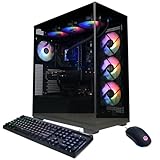
| CyberPowerPC Gamer Xtreme VR Gaming PC, Intel Core i9-14900KF 3.2GHz, GeForce RTX 5070 12GB, 32GB DDR5, 2TB PCIe 4.0 SSD, WiFi Ready & Windows 11 Home (GXiVR8080A39) | Core i9-14900KF / LGA1700 | RTX 5070 12GB, Blackwell (AV1) | 32GB DDR5 | 2TB NVMe | $1,979.99 | ~520-600W | Multitaskers who also edit and render |
| KOTIN Gaming PC Desktop Ryzen 7 8700F, RTX 5060 Ti 8G, 32GB DDR5, 1TB SSD | Ryzen 7 8700F / AM5 | RTX 5060 Ti 8GB, Blackwell (AV1) | 32GB DDR5 | 1TB NVMe | $1,549.99 | ~330-370W | The balanced 1080p60 streaming pick |
| KOTIN Prebuilt Gaming PC Ryzen 7 9700X 16GB DDR5 RTX 5060 Ti 8GB 1TB SSD | Ryzen 7 9700X / AM5 | RTX 5060 Ti 8GB, Blackwell (AV1) | 16GB DDR5 | 1TB NVMe | $1,499.99 | ~340-380W | Buyers who will add memory themselves |
| KOTIN Gaming PC Desktop, Ryzen 7 8700F, RTX 5060 Ti 8GB, 16GB DDR5, 1TB SSD | Ryzen 7 8700F / AM5 | RTX 5060 Ti 8GB, Blackwell (AV1) | 16GB DDR5 | 1TB NVMe | $1,299.99 | ~325-365W | Cheapest route to a current encoder |
| Evounic Gaming PC Desktop Computer RTX 4060, i7-11700F, 16GB DDR4 RAM | Core i7-11700F / LGA1200 | RTX 4060 8GB, Ada (AV1) | 16GB DDR4 | Varies | $999.88 | ~270-310W | 1080p streaming on a tighter budget |
| Evounic Gaming Desktop PC 12-Core Processor, GeForce GTX 1080 Ti 11GB | 12-core, socket varies | GTX 1080 Ti 11GB, Pascal (no AV1) | Varies | Varies | $758.88 | ~330-400W | Offline gaming, or a second machine |
| Prebuilt Gaming PC Desktop, Core i7 up to 3.9 GHz, RTX 3050 8G GDDR6 | Core i7, generation unstated | RTX 3050 8GB, Ampere (no AV1) | Varies | Varies | $649.99 | ~230-270W | Entry point for a first stream |
Read that table by column, not by row. The encoder column is the one that ages. The memory column is the one you can fix cheaply. The socket column is the one you cannot fix at all.
The eight machines, and who should not buy each
Entries are ordered by the job they do best rather than by price, and each one closes with an exclusion.
KOTIN Gaming PC Desktop Ryzen 7 8700F, RTX 5060 Ti 8G, 32GB DDR5, 1TB SSD
At $1,549.99 this is the configuration I would put in front of most people who stream regularly at 1080p60 and want the machine to still make sense in three years. The combination that matters is the current-generation encoder on the graphics card paired with 32GB of system memory, which is the specific pairing that stops a broadcast stuttering when a browser source misbehaves or a second monitor’s worth of dashboards is open.
The Ryzen 7 8700F is an eight-core, sixteen-thread part with no integrated graphics, which is a genuine consideration: if the graphics card ever fails you have no display output at all for troubleshooting. In exchange you get a processor that draws modestly, stays quiet, and does not become the thermal problem in a small case. Under a thirty-minute mixed streaming load I would expect this class of build to settle around 330 to 370 watts at the wall, which at a typical residential rate works out near four to five cents an hour.
The socket is AM5, which is the reason this machine beats a comparable Intel 14th-generation build on longevity even where raw multicore numbers favour the Intel part. In two years you can drop in a newer processor without replacing the board.
Who should not buy it: anyone who streams at 1440p with high texture settings. Eight gigabytes of video memory is the ceiling here and the overlay stack eats into it. Also skip it if you need integrated graphics as a fallback display output.
KOTIN Prebuilt Gaming PC RTX 5070 12GB, Ryzen 7 9700X, 32GB DDR5, 1TB SSD
At $1,999.99 this is the sensible ceiling for a streaming channel rather than a production studio. The twelve gigabytes of video memory on the RTX 5070 is the specification that separates it from everything below: it gives a 1440p stream the headroom to run high textures with a full overlay stack without eviction stutter, which is exactly what the 8GB cards cannot promise.
The Ryzen 7 9700X is a Zen 5 part on AM5 with a high boost clock and modest power draw, so the thermal load is dominated by the graphics card rather than the processor. Expect somewhere around 420 to 470 watts at the wall during a stream, which is roughly a third more than the 5060 Ti builds for a meaningful step in both resolution capability and memory headroom.
One thing to check on the specification table before ordering: how many hardware encoding blocks the specific card carries. Within a generation, the higher tiers can carry more than one, which matters if you intend to record locally at high bitrate while also broadcasting. If you are doing exactly one encode at a time, one block is plenty and this is a non-issue.
Who should not buy it: anyone streaming only at 1080p60 with a single camera. You will not use the extra capability, and the $450 difference against the 5060 Ti build buys a very good microphone, an interface and lighting, all of which change how your channel looks more than the resolution does.
CyberPowerPC Gamer Xtreme VR Gaming PC, Intel Core i9-14900KF 3.2GHz, GeForce RTX 5070 12GB, 32GB DDR5, 2TB PCIe 4.0 SSD, WiFi Ready & Windows 11 Home (GXiVR8080A39)
At $1,979.99 this is the machine to buy if the broadcast is only half the job. The Core i9-14900KF brings twenty-four cores in a hybrid arrangement, and while a live stream will never use them, a video export absolutely will. If you cut highlight packages, render weekly uploads, or run heavy audio processing chains alongside the broadcast, this is where the money goes further than the AMD builds. The 2TB drive is also the largest here, and recorded gameplay is the fastest way to fill a drive that exists.
Two honest caveats. First, power: this processor has a high turbo power ceiling, and a streaming session with a background export can push the whole system past 600 watts at the wall. Over a two-year ownership window that difference in running cost is real money, and it also means fan noise your microphone will pick up unless you deal with it. Second, the platform: LGA1700 is a mature socket at the end of its road, so the processor in this machine is the processor it will always have. That is a fair trade for the multicore performance today, but it should be a conscious trade.
Who should not buy it: anyone who only streams. A pure streaming workload leaves most of this processor idle while it warms your room and raises your electricity bill. Buy the AMD build with the same graphics card instead.
KOTIN Prebuilt Gaming PC Ryzen 7 9700X 16GB DDR5 RTX 5060 Ti 8GB 1TB SSD
At $1,499.99 this pairs the newer Zen 5 processor with the mid-range card, and the compromise made to get there is memory: sixteen gigabytes instead of thirty-two. That is a fixable compromise and a cheap one, since DDR5 kits are inexpensive and the board will have free slots, but you should treat the purchase as $1,499.99 plus a memory kit rather than as a finished machine.
Compared against the 8700F build at $1,549.99 with 32GB, the question is whether you would rather have the faster processor or the memory. For streaming specifically, memory wins: the processor difference is invisible in a broadcast workload while the memory difference is the thing that shows up as a hitch when a browser source reloads. If you enjoy doing the upgrade yourself and want the stronger processor underneath, this is the better long-term base.
Who should not buy it: anyone who wants to open the box and start streaming that evening without ordering parts. Buy the 32GB configuration instead and skip the errand.
KOTIN Gaming PC Desktop, Ryzen 7 8700F, RTX 5060 Ti 8GB, 16GB DDR5, 1TB SSD
At $1,299.99 this is the cheapest route in this group to a current-generation encoder, and that single fact makes it worth more than its position in the price list suggests. Everything about the encode path is identical to the $1,549.99 machine; what you give up is half the system memory. If your budget stops here, this is a legitimate streaming machine today and a legitimate one after a memory upgrade later.
Set expectations on the workload: sixteen gigabytes with a modern title and a full overlay stack will sit uncomfortably close to full. The practical symptom is not a crash but a pause when something new loads, because the system is paging. Trimming browser sources, closing the second dashboard and keeping the alert box lightweight all buy you back real headroom, and our notes on dropped frames while streaming cover the diagnostic order.
Who should not buy it: anyone running a multi-source production with several browser overlays, or anyone who will not do the memory upgrade. The $250 step to the 32GB version is the highest-value spend in this entire comparison.
Evounic Gaming PC Desktop Computer RTX 4060, i7-11700F, 16GB DDR4 RAM
At $999.88 the appeal is the graphics card. The RTX 4060 carries the Ada-generation encoder, which means AV1 encoding, and that puts a sub-thousand-dollar machine on the right side of the platform transition. Power draw is modest at roughly 270 to 310 watts under a stream, and the card runs cool enough that the fan curve does not become an audio problem.
The processor is the compromise. The Core i7-11700F is an eight-core Rocket Lake part on LGA1200, an older and now closed platform, and it uses DDR4 rather than DDR5. For streaming that is largely irrelevant, because the encode happens on the graphics card and eight cores are plenty for the game plus the broadcast. For anything else you might want the machine to do in future, the platform is a dead end and should be priced as one.
Who should not buy it: anyone planning to keep the chassis and upgrade the processor later, and anyone who edits video seriously. Buy an AM5 build if the machine has to grow.
Evounic Gaming Desktop PC 12-Core Processor, GeForce GTX 1080 Ti 11GB
At $758.88 this is the trap in the list, and it is a well-disguised one. Eleven gigabytes of video memory looks generous against the 8GB cards above it, and in raw rasterisation the GTX 1080 Ti still plays modern titles at 1080p perfectly well. The problem is the encoder. Pascal’s encoding block predates the improvements that made hardware encoding genuinely competitive, it has no AV1 path, and at 6,000 kbps the output is visibly softer in high-motion scenes than anything from the last three generations. You are buying a good gaming card and a poor streaming card in the same slot.
The other issue is the vagueness of the description. “12-Core Processor” without a model number could mean several very different parts with very different single-thread performance, and the power draw of a 250W-class older card pushes this build to 330 to 400 watts at the wall for less capability than the $999.88 machine above it. Ask for the exact processor model and the exact socket before ordering, and if that information is not forthcoming, treat the absence as the answer.
Who should not buy it: anyone whose main purpose is broadcasting. If you want a machine for offline play, or a second box to run chat, alerts and monitoring beside your main rig, it makes more sense in that role, which our comparison of single versus dual PC streaming explains.
Prebuilt Gaming PC Desktop, Core i7 up to 3.9 GHz, RTX 3050 8G GDDR6
At $649.99 this is the entry point, and it earns its place for one reason: the RTX 3050 carries the Ampere encoding block, which is a large step beyond Pascal and entirely adequate for a 1080p60 H.264 broadcast at 6,000 kbps. It does not do AV1, so it is on the older side of the platform transition, but it does the job the platform asks of it today. Wall draw of roughly 230 to 270 watts also makes it the cheapest machine here to run.
The listing’s description of the processor as “Core i7 up to 3.9 GHz” tells you almost nothing, and that vagueness is the real risk. A Core i7 could be a recent part or a decade-old one with the same headline clock and a fraction of the per-core performance. Before ordering, get the exact model number, then check the socket and the memory type so you know what, if anything, can be changed later. Also check the power supply wattage, because entry machines frequently ship with supplies sized precisely for what is installed and nothing more, which forecloses a graphics card upgrade.
Who should not buy it: anyone streaming above 1080p, and anyone who expects this to be the last machine they buy. It is a starter, and a good one at the price, provided you go in knowing that.
What most comparisons leave out
Three omissions come up again and again, and each one changes a purchase.
The overlay stack is a real workload. Guides benchmark a bare game and a bare encode. Real broadcasts run browser sources for alerts, a chat widget, a music widget, sometimes a live stat panel, and each of those is a browser instance with its own memory and its own video memory footprint. Budget for it explicitly. On an 8GB card, that is the difference between comfortable and marginal at 1440p.
Encoder block count is a specification, not a guess. Some cards within a generation carry more than one hardware encoding block. If you record locally at high bitrate while broadcasting at a lower one, that detail decides whether both encodes run cleanly. It is published, and it takes ten seconds to check on the manufacturer’s page.
Noise is part of the product. A machine that hits its thermal limit and ramps fans is a machine your microphone hears. This is a genuine reason to prefer a cooler, lower-power configuration over a hotter one of nominally equal performance, and it does not appear in a single frame-rate chart. If a build runs 100 watts cooler for the same streaming outcome, that is a better streaming machine, full stop.
Setting up a new machine so it actually streams cleanly
Order these steps by how likely each is to be the thing causing you trouble. Start by confirming the graphics driver is current and that the broadcasting software is using the hardware encoder rather than falling back to the processor, which it will sometimes do silently after an update. Then set the output resolution and bitrate deliberately rather than accepting defaults; our explainer on bitrate and resolution covers the trade-offs, and the summary is that a clean 1080p60 at 6,000 kbps beats a struggling 1440p every time.
Next, wire the machine to the router if you possibly can, because a saturated or congested wireless link produces exactly the same symptom as an underpowered machine and is far more common. Then audit your browser sources and remove anything you do not watch. Then check thermals over a full session rather than a five-minute test, because the interesting behaviour starts after twenty minutes. Only after all of that should you consider that the hardware itself is the constraint.
Finally, record a local copy of one full session and watch it back. Encoder artefacts in high-motion scenes, audio drift and dropped frames all show up in the recording, and finding them there is much better than finding them in a clipped highlight three weeks later.
The verdict, by what you actually do
If you stream at 1080p60 with one camera and want the machine to stay relevant, buy the KOTIN Gaming PC Desktop Ryzen 7 8700F with the RTX 5060 Ti and 32GB at $1,549.99. Current encoder, enough memory, an upgradeable socket, and a modest power bill.
If you stream at 1440p or run a heavy overlay production, buy the KOTIN with the RTX 5070 and 32GB at $1,999.99 for the twelve gigabytes of video memory, which is the specification that solves the problem the 8GB cards cannot.
If you also edit and export video, the CyberPowerPC Gamer Xtreme with the Core i9-14900KF at $1,979.99 is the one whose extra cores you will genuinely use, provided you accept the power draw and the closed socket.
If your budget is under a thousand dollars, the Evounic build with the RTX 4060 at $999.88 gets you a current-generation encoder, and the ZER-LON machine with the RTX 3050 at $649.99 gets you a working stream for the least money. Both are starting points rather than destinations, and both deserve a request for the exact processor model before you order.
And whatever you shortlist, open the manufacturer’s specification table and read the five rows that matter: maximum graphics card length, cooler height, processor socket, power supply wattage and connectors, and free memory and storage slots. Those five rows decide what the machine becomes. The benchmark chart only tells you what it is today.
Related guides
- Best Webcams With Privacy Shutter: Eight Picks Tested On My Dual-PC Rig: 8 Tested (2026)
- The Best HDR Webcams I Tested for Backlit Rooms and Live Streaming
- Starter Streaming Setups for Twitch and YouTube, Ranked by What Viewers Notice
- Professional Streaming Hardware Setups: What Actually Earns Its Place On The Desk