
Our Top Picks


Top 3 picks at a glance

The Short Answer
Here is the twist most buyers discover too late: 4K capture cards are small. The physical device you plug into your setup is rarely bigger than a deck of cards. When people search for how much bandwidth they need for 4K capture, they are usually asking one of two different questions, and both matter:
- Data bandwidth — how much video data moves through your connection. A true 4K60 signal with HDMI 2.0 carries roughly 18 Gbps of raw bandwidth, while a 4K144 signal over HDMI 2.1 can exceed 40 Gbps. USB 3.0, the most common capture interface, tops out around 5 Gbps, which is why most budget cards pass 4K in and record or stream at 1080p60 out.
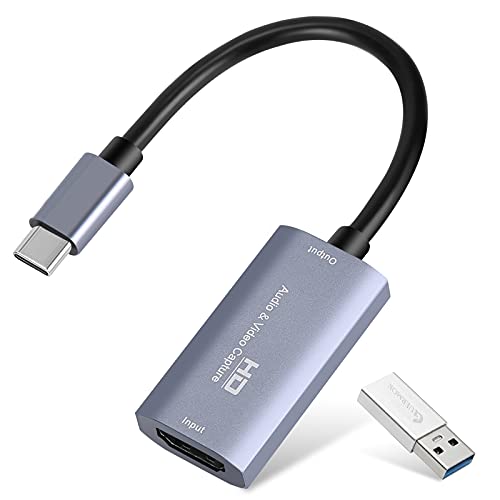
- Physical space — how much room the card takes on your desk, in your PC, or in your camera bag. Budget dongles run 2.2 to 4 inches long; premium internal-grade cards with heatsinks can run 4.5 to 7 inches.
For most setups, plan for a USB 3.0 port (5 Gbps minimum), about 25 to 60 cubic inches of clear desk or bag space, and a host PC with a dedicated graphics card. If you want full 4K passthrough at high refresh rates, budget for an HDMI 2.1 card like the Elgato 4K X and a PCIe slot or Thunderbolt enclosure.
As an Amazon Associate we earn from qualifying purchases at no extra cost to you.



Standard Sizes
Common capture card form factors fall into three categories. Actual products vary slightly, but these ranges reflect what ships in the box today:
| Form Factor | Typical Length | Typical Width | Typical Thickness | Typical Weight | Example |
|---|---|---|---|---|---|
| Compact USB dongle | 2.2–2.8 in (5.6–7.1 cm) | 0.9–1.2 in (2.3–3.0 cm) | 0.4–0.6 in (1.0–1.5 cm) | 0.7–1.4 oz (20–40 g) | Guermok 4K USB 3.0 HDMI to USB-C card |
| Mid-size USB stick | 2.8–3.9 in (7.1–9.9 cm) | 1.2–1.8 in (3.0–4.6 cm) | 0.5–0.8 in (1.3–2.0 cm) | 1.4–2.8 oz (40–80 g) | Generic 4K HDMI capture card, 1080p60 output |
| Premium external card | 3.9–4.5 in (9.9–11.4 cm) | 1.4–2.0 in (3.6–5.1 cm) | 0.7–0.9 in (1.8–2.3 cm) | 2.8–4.5 oz (80–130 g) | Elgato Cam Link 4K |
| High-performance external unit | 4.4–7.0 in (11.2–17.8 cm) | 2.2–3.5 in (5.6–8.9 cm) | 0.7–1.2 in (1.8–3.0 cm) | 4–12 oz (115–340 g) | Elgato 4K X, HDMI 2.1 |
Internal PCIe capture cards follow a different spec: full-height cards measure roughly 4.8 to 6.6 inches long (12.2–16.8 cm) and 4.8 inches tall (12.2 cm) on a standard ATX bracket. Measure your case clearance before buying.
How to Measure Your Space
- Measure your USB port clearance. Leave at least 1.5 inches (3.8 cm) of free space around the port. Chunky dongles and attached cables overhang neighboring ports; a short USB 3.0 extension cable (6 inches to 3 feet) solves crowding for under $10.
- Check PCIe slot length if going internal. Measure from the rear bracket to the first obstruction inside your case. Full-length cards need about 7 inches (17.8 cm); shorter cards fit x1-length slots around 3 inches (7.6 cm).
- Allow ventilation room. Cards handling full 4K passthrough dissipate real heat. Keep 0.5 to 1 inch (1.3–2.5 cm) of clearance on all sides and avoid sandwiching one between a console and a wall.
- Measure your cable run. HDMI signal integrity degrades beyond about 15 feet (4.6 m) at 4K60 without active or fiber cabling. Keep passive runs under 10 feet (3 m) for reliability.
- Count your power draw. Most USB dongles sip under 2.5 watts from the bus. High-refresh cards like the 4K X can pull 4.5 watts or more, so avoid unpowered hubs — plug directly into a motherboard or powered port.
- Verify your display chain. A 4K144 passthrough card needs a 4K144-capable monitor and an HDMI 2.1 or DisplayPort 1.4+ cable rated for that rate. One weak link caps your entire chain.
By Room or Use Case
Dedicated Streaming Desk
A dual-PC or single-PC streaming station benefits from a premium card with 4K passthrough and low latency. Budget roughly 6 by 3.5 inches (15.2 by 8.9 cm) of surface or mount space plus cable slack. Expect to spend $200 to $300 for HDMI 2.1-class hardware, and route the HDMI output straight to your gaming monitor so passthrough latency stays in the single-digit milliseconds.
Living Room Console Setup
Consoles under a TV need short, tidy runs. A compact dongle at 2.2 to 2.8 inches long (5.6–7.1 cm) tucks behind a console and costs $15 to $30, though it will typically pass 4K60 and record at 1080p60. If you want on-card 4K recording in the living room, step up to a full-size unit and leave 4 inches (10.2 cm) of depth behind your console for the device and both HDMI connectors.
Home Office and Video Calls
Using a DSLR or mirrorless camera as a webcam is the classic Cam Link 4K job. The card needs one free USB 3.0 port and about 3.5 by 2 inches (8.9 by 5.1 cm) of clearance. Confirm your camera outputs clean HDMI and that your desk PC is a desktop or a laptop with a dedicated GPU — integrated graphics struggle with sustained USB video ingest at 4K30.
Bedroom or Travel Kit
For grab-and-go capture, a sub-$20 dongle weighing under 1.5 ounces (43 g) fits in any accessory pouch. Pair it with a short 1-foot (30 cm) HDMI cable to cut clutter. These are fine for casual clips at 1080p60, but they are not the tool for high-bitrate 4K archival footage.
Small-Form-Factor and HTPC Builds
If your PC is an ITX box, check internal clearance carefully — many SFF cases accept only half-length PCIe cards under 6.3 inches (16 cm). An external USB card sidesteps the problem entirely, but make sure the case has a proper USB 3.0 Type-A port on the front or rear panel.
Common Sizing Mistakes
- Assuming “4K capture card” means 4K recording. Many $15 to $30 cards accept 4K input but record or stream at 1080p60. Read the spec table, not the title, before buying.
- Plugging into a USB 2.0 port. USB 2.0 offers about 480 Mbps — nowhere near enough for a 4K30 feed, which needs roughly 25 to 50 Mbps of encoded bitrate and a faster pipe than 2.0 can guarantee. Use a blue USB 3.0 port at minimum.
- Ignoring connector overhang. A wide dongle can block the adjacent port on a laptop. Check the card’s width against your port spacing, or plan on an extension cable.
- Forgetting the upstream PC requirement. Manufacturers typically list a 4th-generation Intel Core i5 or better (or AMD equivalent) plus a dedicated GPU for 1080p60 capture, and noticeably more for 4K work. An old laptop will drop frames regardless of card quality.
- Buying HDMI 2.0 gear for a 4K120 or 4K144 monitor. HDMI 2.0 caps out at 4K60; passthrough above that requires HDMI 2.1 hardware and cables.
- Skipping the extension cable for bulky cameras. The HDMI plug on a camcorder can physically collide with the capture dongle. A short male-to-female HDMI adapter eliminates the fight.
FAQ
What bandwidth does 4K60 capture actually use?
Raw HDMI 2.0 signal bandwidth for 4K at 60 Hz is about 18 Gbps, but what you store is far smaller: a typical encoded 4K60 recording runs 40 to 130 Mbps depending on codec, or roughly 18 to 58 GB per hour of footage. Streamed 4K output generally targets 15 to 50 Mbps of upload bandwidth, so make sure your internet upload speed exceeds your streaming bitrate with headroom to spare.
Do I need a PCIe card, or is USB 3.0 enough?
USB 3.0’s 5 Gbps is enough for encoded 4K30 capture and most 1080p60 work, and it is the standard on nearly every external card. For 4K60 recording or 4K120-plus passthrough, you need PCIe (internal) or Thunderbolt-attached hardware with HDMI 2.1 input. If your monitor chain tops out at 4K60, a quality external card is usually the smarter buy.
How much space and power does a capture card setup need?
Externally, count on 4 by 2.5 inches (10.2 by 6.4 cm) of clear space plus cable slack, and 0.5 to 1 inch of ventilation clearance. Power draw is modest — under 2.5 watts for dongles, up to roughly 4.5 watts for high-refresh units — but plug directly into the computer rather than an unpowered hub. Internally, a full-height PCIe card needs about 7 inches (17.8 cm) of slot length and an open fan header path if it includes a heatsink fan.
Are cheap capture cards worth it for 4K?
For under $30, cards like the Guermok or a generic 1080p60 dongle are excellent for webcam-style capture, game clips, and travel kits. They accept a 4K signal and downscale it, which is exactly what most creators need. If your goal is true 4K recording, high-frame-rate passthrough for competitive gaming, or the cleanest image for color work in 2026, step up to the $85 to $250 tier where hardware encoding and HDMI 2.1 input justify the price.
Related guides
- Best Black Friday Elgato Deals: Capture Cards & More (2026)
- Blackmagic Design DeckLink Duo 2 Review: Four SDI Connections for a Desktop Production Workflow
- DigitPro Cam Link 4K USB Capture Card Review: HDMI Workflow and Capture Limits
- VIXLW USB-C HDMI Capture Card Review: Recording Limits and Desk Compatibility


