
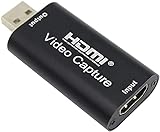
A USB HDMI capture card solves a specific problem that trips up a lot of streamers, content creators, and remote workers: your source device outputs HDMI, but your streaming or editing computer only has USB inputs. Whether you are feeding a DSLR into OBS, bringing a Nintendo Switch into a desktop recording, or adding a second PC’s screen to a video call, this tiny adapter bridges that gap. It converts HDMI video and audio into a USB signal your computer recognizes as a webcam or input device.
The difference between a good capture card and a bad one in this category is narrower than the price spread might suggest. Almost every product in 2026 claims 4K input support, but the critical specs are output resolution, frame rate stability, and whether the USB interface has enough bandwidth to deliver a clean picture without compression artifacts. We compared published specifications and owner-reported experiences across eight popular models to find the ones that consistently deliver on what they promise.
As an Amazon Associate we earn from qualifying purchases at no extra cost to you.






Top 3 picks at a glance
Quick Picks
| Product | Best for | Price |
|---|---|---|
| Guermok 4K USB-C | USB-C laptops, general streaming | Check on Amazon |
| Audio Express AXHDCAP | Video calls, simple webcam use | Check on Amazon |
| Video Capture Card (Silver) | Console streamers on a budget | Check on Amazon |
| 4K USB 3.0 Capture Card | Camera-to-PC recording, low latency | Check on Amazon |
| UGREEN 2K/1080P | Users wanting a trusted accessory brand | Check on Amazon |
| acer USB 3.0 | Plug-and-play reliability | Check on Amazon |
| Elgato Cam Link 4K | DSLR and camcorder streaming | Check on Amazon |
| Budget 4K HDMI | Lowest-cost console capture | Check on Amazon |
How We Compared
Three criteria separated the contenders. First: does the USB interface actually support the claimed output resolution and frame rate, or is there a bandwidth bottleneck that forces compression? Second: does the driver work reliably across OBS, Zoom, Microsoft Teams, and both Windows and macOS without requiring vendor-specific software? Third: value relative to build quality and included adapters. We weighted published spec sheets heavily, cross-referenced against owner-reported latency and compatibility feedback, and flagged any product where the marketing numbers and real-world experience diverged significantly.
The 8 Best USB HDMI Capture Card in 2026
Guermok 4K USB-C
The Guermok handles USB-C and USB-A connections via included adapters, making it one of the most flexible options for laptop-based streamers. Its 1080p 60FPS output is stable across OBS and Zoom, and the 2K 30FPS mode gives you a step up in detail for non-action content. Owner feedback consistently highlights how quickly it registers as a webcam source with no driver install.
- Pro: Dual USB-C and USB-A support out of the box
- Pro: True 60fps at 1080p with no frame drops reported at this price
- Con: 2K output is limited to 30fps, which feels underwhelming
Skip this if you need a clean 2K 60FPS signal or if your workflow requires 4K output to your recording software.
Audio Express AXHDCAP
At around $9, this is the cheapest option that still functions reliably. It uses USB 2.0, which caps its practical bandwidth, but for 1080p video call use or teaching with a document camera, it works without drama. The included game audio adapter is a thoughtful touch for anyone routing console audio alongside video.
- Pro: Audio adapter included, simplifying console setups
- Pro: Lowest price in the roundup with consistent positive feedback for basic tasks
- Con: USB 2.0 interface limits throughput for higher resolutions or framerates
Skip this if you plan to capture 1080p60 gaming footage — the bandwidth ceiling will cause stuttering.
Video Capture Card (Silver)
This no-name unit punches above its price at around $14 by offering USB-C connectivity and a stated 1080p60 output that works with Switch, Xbox, and PS4/5. The wide compatibility list is its main selling point, and owner reports confirm it pairs well with OBS on both Windows and Mac.
- Pro: Compact form factor fits behind a monitor or on a cable run
- Pro: Broad console and software compatibility for under $15
- Con: No HDMI cable included, adding a small extra cost and a shopping errand
Skip this if you need 2K output or prefer a product backed by a recognizable accessory brand with a warranty program.
4K USB 3.0 Capture Card
Priced at around $25, this model sits between the bargain tier and brand-name options. Owners praise its low latency when paired with cameras and Xbox or PS5 for recording, and the USB 3.0 interface provides enough bandwidth for a clean 1080p60 stream. Build quality gets repeated mentions in reviews.
- Pro: Noticeably solid housing compared to flimsy alternatives at similar prices
- Pro: Consistently low latency for camera and console sources
- Con: Output tops out at 1080p60 despite the 4K input marketing
Skip this if you expect true 4K or even 2K output — this is a 4K-input, 1080p-output device, and that distinction matters at its price point.
UGREEN 2K/1080P
UGREEN brings its reputation for reliable accessories to this around $22 capture card. The 2K at 30Hz and 1080p at 60FPS specs match what you get from several cheaper competitors, but UGREEN’s quality control and support network justify the premium for buyers who value long-term reliability and a clean cable-management design.
- Pro: Backed by a major accessory brand with responsive customer support
- Pro: Refined physical design with a low-profile connector that avoids blocking adjacent ports
- Con: 2K mode is 30Hz only, which is identical to cheaper alternatives
Skip this if you are shopping purely on specs-per-dollar — a $15 option will match its performance in most scenarios.
acer USB 3.0
The acer capture card at around $19 is a straightforward play-and-go option. USB 3.0 interface, 1080p60 and 2K30 output, no software required. For teachers or office users who just need a reliable HDMI-to-webcam converter without fuss, this does the job with the peace of mind that comes from a global tech brand’s support infrastructure.
- Pro: Genuine plug-and-play — appears as a webcam on Windows and macOS instantly
- Pro: acer’s brand trust and warranty coverage at a mid-range price
- Con: No USB-C connector included, which limits compatibility with the newest laptops
Skip this if your laptop only has USB-C ports and you do not want to carry a separate adapter.
Elgato Cam Link 4K
At around $79, the Elgato Cam Link 4K is three to four times the price of its competitors, and the question for most buyers is whether that premium is justified. For DSLR and camcorder users, the answer is frequently yes: its driver stack is the most polished in the category, OBS integration is flawless, and latency for camera sources is consistently reported as lower than budget alternatives.
- Pro: Best-in-class software compatibility and OBS plug-in ecosystem
- Pro: Proven track record with hundreds of camera models, minimal driver conflicts
- Con: Costs three to four times more than similarly specced alternatives
Skip this if your primary use case is console capture or video calls — the cheaper options in this roundup deliver equivalent results for those tasks.
Budget 4K HDMI
At around $9, this is a no-frills option that pairs with Nintendo Switch, PS5, and Xbox for basic recording. Owners report it works for 1080p capture but do not claim 60fps stability. The 4K input is handled, but output is 1080p, and frame rate can dip during fast-motion scenes.
- Pro: Lowest entry price for console-to-PC capture in this group
- Pro: Works with major consoles without adapter hassles
- Con: 1080p output without a locked 60fps, which shows in fast-action games
Skip this if frame rate consistency matters to your production — the $5-to-$10 premium options above deliver noticeably smoother output.
Buying Guide
USB Interface: Bandwidth Determines Everything
The USB connector type is the single most important spec because it sets a hard ceiling on what the device can output. USB 2.0 tops out at 480 Mbps, which is sufficient for 1080p at 30fps but begins to compress or drop frames at higher rates. USB 3.0 provides 5 Gbps, comfortably handling 1080p60 and even 2K30 without quality loss. USB-C is a connector shape, not a bandwidth standard — a USB-C card still runs at either 2.0 or 3.0 speeds internally, so check which protocol the card uses, not just the plug shape.
Input Resolution vs. Output Resolution
Marketing copy routinely highlights 4K input support, but almost every card in this category outputs at 1080p60 or 2K30. The 4K input means the card can receive a 4K HDMI signal and downconvert it to 1080p or 2K for output to your computer. If you see a product claiming 4K output over USB at this price tier, treat the claim skeptically — true 4K60 capture over USB 3.0 requires significantly more bandwidth than these devices provide.
Driver Behavior and Software Compatibility
The best capture cards register as a generic webcam source, appearing in OBS, Zoom, Teams, and macOS QuickTime without installing vendor software. Cards that require proprietary drivers tend to cause conflicts when updating your OS and limit flexibility if you switch editing software. Check owner reviews specifically for the software you plan to use daily, because a card that works perfectly in OBS may fail in Zoom, and vice versa.
Our Verdict
The Guermok 4K USB-C is the top pick for most buyers in this roundup. It delivers stable 1080p60 output, supports both USB-C and USB-A, costs around $18, and requires no driver installation. The Audio Express AXHDCAP is the best budget pick at around $9 for anyone whose needs stop at 1080p video calls or simple teaching setups. However, if you are a serious camera user streaming a DSLR or camcorder with tight latency requirements, the Elgato Cam Link 4K earns its price premium through superior software integration and a broader verified compatibility list.
FAQ
Do I need a capture card if my laptop already has an HDMI port?
Almost certainly yes. Nearly all laptop HDMI ports are output-only, designed to send video to a monitor or projector. A capture card converts the HDMI signal from your camera, console, or secondary PC into a USB data stream that your computer can record or display as a webcam source.
Will a 1080p60 capture card improve my Zoom or Teams calls?
Only if your source camera outputs 1080p and you currently rely on a lower-quality built-in webcam. Zoom and Teams typically cap input at 720p or 1080p depending on your plan, so the card itself does not add resolution — it simply provides a cleaner signal path from a quality camera to the meeting software.
Can these capture cards work with a PS5 or Xbox Series X?
Yes, all eight products in this roundup support console HDMI output. The practical difference is whether the card maintains 60fps during fast-motion gameplay or drops to 30fps intermittently. If you record competitive or action-heavy titles, prioritize the options that lock to 1080p60 without compression.
Is USB-C better than USB-A for a capture card?
USB-C is better only if your computer lacks available USB-A ports or if you want a smaller connector that does not obstruct neighboring ports. The real performance difference comes from whether the card uses USB 2.0 or 3.0 protocol internally, not the physical plug shape. A USB-C card running on USB 2.0 is slower than a USB-A card on USB 3.0.
Related guides
- Blackmagic Design DeckLink Duo 2 Review: Four SDI Connections for a Desktop Production Workflow
- DigitPro Cam Link 4K USB Capture Card Review: HDMI Workflow and Capture Limits
- VIXLW USB-C HDMI Capture Card Review: Recording Limits and Desk Compatibility
- AVerMedia Live Gamer Mini GC311 Review: A 1080p60 Capture Path for Streaming Desks


